

State wildlife authorities euthanized a mother bear with two cubs in Monrovia after the bear swiped at a woman’s leg, officials said Wednesday.
The cubs are healthy and were in the process of being relocated Wednesday with the intention of eventually returning them to the wild, according to the California Department of Fish and Wildlife.
Monrovia City Manager Dylan Feik said state officials told him Tuesday that the mother bear had been euthanized despite a request from the Monrovia City Council for the animal to be relocated to the Angeles National Forest.
“By the time we were able to speak with state officials involved in the decision-making, the decision to euthanize was already made,” Feik said in a statement.
Wildlife officials captured the bear Monday. According to the CDFW, the animal clawed a Monrovia woman on Saturday while she was walking her dog. The woman was not seriously injured. A neighbor helped scare the bear away, and the cubs were not present during the attack.
According to Feik, state wildlife officials told him DNA testing confirmed that the bear was involved in a previous incident in June 2025. An elderly Monrovia resident was sitting on his enclosed porch when the bear approached and swiped at him.
“A caretaker witnessed the incident and helped scare the bear away while the resident received treatment,” Feik said.
The injured man recovered, and authorities could not locate the bear following that incident.
“The bear DNA from Saturday’s incident matches the bear DNA from the June 2025 incident,” Feik said. “Local CDFW officials, as well as those working at state offices in Sacramento, determined the two incidents which caused human injury were sufficient justification to euthanize the bear, according to state policy.”
Over 3,000 people had signed a petition to relocate rather than kill the bear, which some said was just exhibiting the natural instinct of a mother protecting her offspring.
On Wednesday afternoon, a CDFW statement defended officials’ decision to euthanize the bear.
“Anytime there is human-wildlife conflict, the California Department of Fish and Wildlife’s foremost responsibility is the protection of human life and ensuring public safety,” according to agency. “With that priority in mind, the black bear responsible for the March 14 attack on a resident in Monrovia, Los Angeles County, has been determined by CDFW law enforcement officers to be a public safety … (threat).
The decision to euthanize the bear came after a “thorough assessment of the bear’s behavior and the circumstances of the incident,” according to state wildlife officials, who added that killing an animal “is used only as a last resort when an animal poses a risk to public safety and cannot be safely returned to the wild.”
According to the CDFW, the deadly outcome and similar incidents “underscore the importance of prevention.”
“Bears are highly adaptable and will seek out food and shelter when opportunities are present,” officials said. “Securing crawl spaces, removing food attractants such as unsecured trash or pet food and eliminating access to sheltered areas around homes are critical steps residents must take to reduce the likelihood of conflict and habituation. These actions help keep both people and wildlife safe and bears wild.”
The statement went on to say that mother bears teach their foraging methods to cubs, which can learn to associate people and homes with food, leading to potentially dangerous encounters.
“Relocation may seem like a solution, but is not an option when it could put public safety at risk,” according to the CDFW. “Bears have strong spatial memory and often return to familiar areas. When translocated long distances, they recreate the same conflict behavior or struggle to survive in unfamiliar habitat. Without humans taking steps to reduce attractants and access to urbanized shelter, the underlying issue remains.”
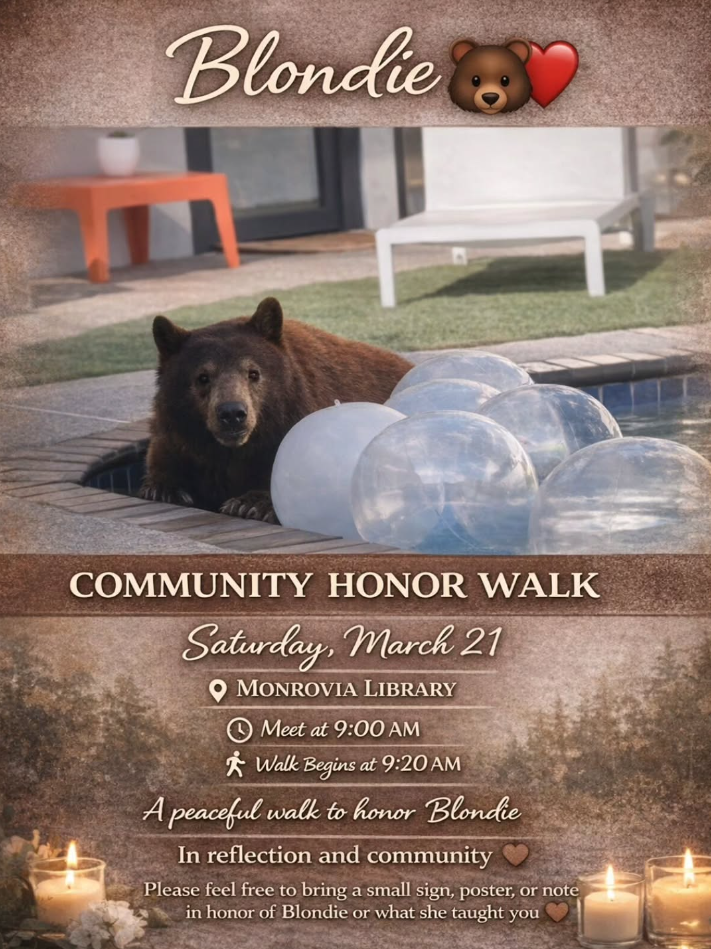
Area residents opposed to the euthanasia gathered more than 3,700 signatures for a petition that sought relocation for the mother bear, who they named Blondie, and her cubs. A “Community Honor Walk” vigil is planned for 9 a.m. Saturday at Monrovia Library, 321 S. Myrtle Ave.
Organizers said the event “is not a protest. This is a space for reflection, respect, and community.” Attendees “are welcome to bring a small sign, note, or message for Blondie or what she taught you.”
Updated March 19, 2026, 9:11 a.m.