

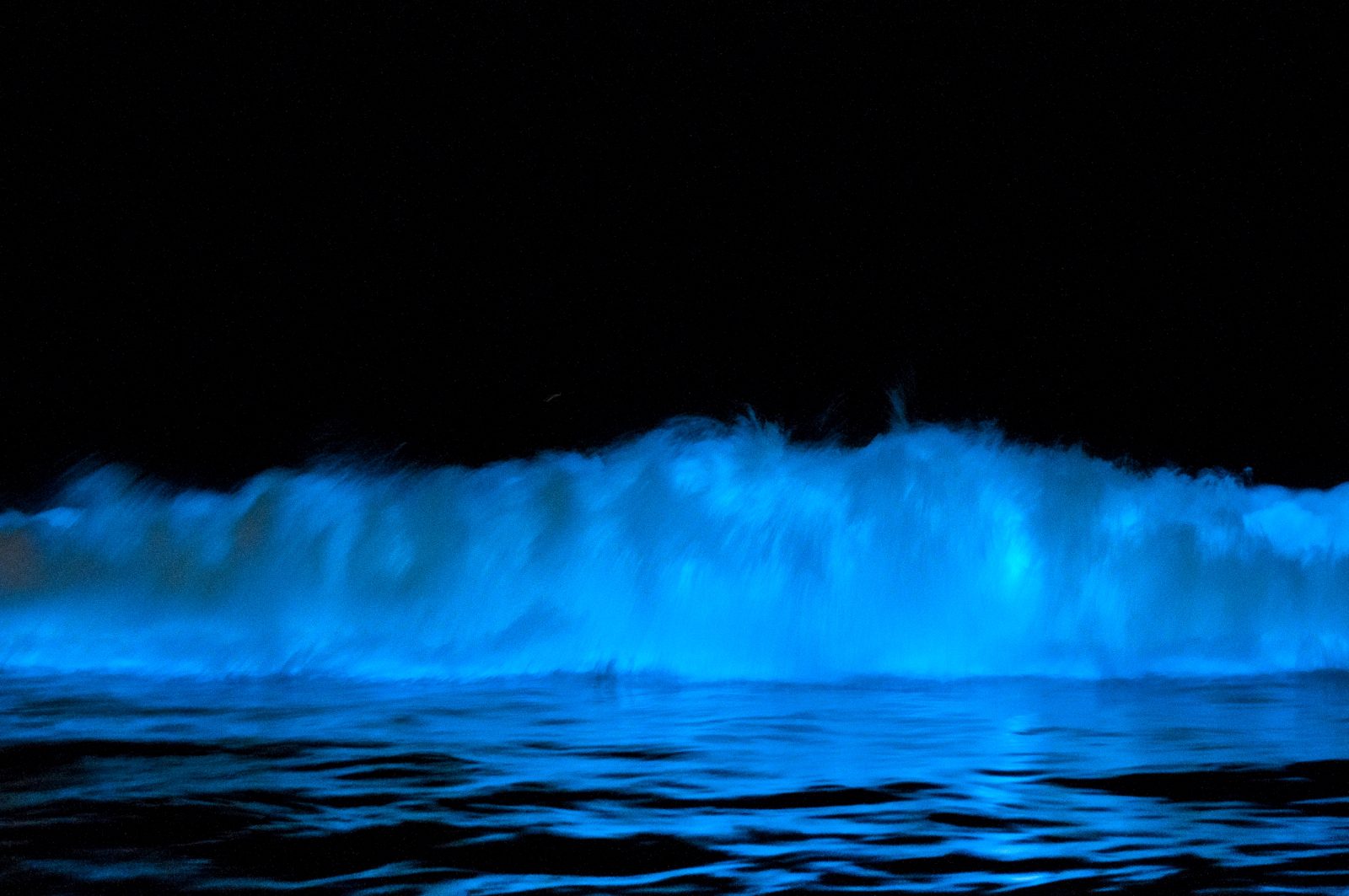
Southern California’s beaches have once again turned into a nighttime spectacle, with stretches of coast glowing bright blue as waves crash onto the shore. Over the past week, nocturnal beach enthusiasts have been marveling at the alien-like sight, captured from Oxnard to Malibu, Newport Beach to Laguna Beach, and even as far south as San Diego.
The phenomenon, known as bioluminescence, is the result of algae known as dinoflagellates. By day, they cause the ocean to take on a reddish hue, but by night, when agitated by waves or other disturbances, they emit an ethereal blue glow.
Mark Girardeau, operator of the website Orange County Outdoors, has noted the phenomenon’s sporadic nature, describing it as being “not an insane algae bloom but enough where it’s in multiple spots.” His documentation includes an expedition along Laguna Beach’s shoreline on Aug. 30, with fellow photographer Patrick Coyne, highlighting the unpredictable magic of these glowing waves.
Coyne, recently returned from a film project in Florida documenting the East Coast’s seasonal algae blooms where such bioluminescence is more of a sure bet compared to the unpredictable nature observed along Southern California’s coast due to winds and tides and waves making it difficult to find the glow at night.
Earlier this week, the duo also managed to document a fascinating, otherworldly glow in the waters of Newport Harbor. Pursuing these luminescent spectacles is not a new endeavor for the two photographers, who have been tracking bioluminescent displays along the coast since a 2020 super bloom.
A recently released research paper has shed further light, or glow, on the 2020 mega bloom which spanned months and dazzled with bright blue luminescence. The spectacle was caused by the presence of Lingulodinium polyedra, a plankton known for its neon blue glow, but the event proved a double-edged sword.
While the spectacle garnered public attention and made headlines, the researchers noted it had a detrimental effect on local ecosystems. As vast swathes of the red tide decomposed, oxygen levels plummeted, causing substantial marine life fatalities and damaging local ecosystems.
The study, conducted by scientists at UC San Diego’s Scripps Institution of Oceanography and Jacobs School of Engineering, laid out how the plankton, a dinoflagellate, formed such a dense bloom. It appears the key lies in their unique ability to swim, positioning them to outcompete other phytoplankton species.
Drew Lucas, senior author of the paper and an associate professor at the Scripps Oceanography and the Department of Mechanical and Aerospace Engineering at UC San Diego, explained that this theory of competitive advantage has long been discussed, though tangible proof has only recently been possible.
As researchers work to understand and predict these mesmerizing events, Girardeau, Coyne, and their network of fellow enthusiasts remain vigilant, relying on alerts from their network, checking live cameras along the coast, and dedicating countless hours to the pursuit of these naturally occurring light shows.