

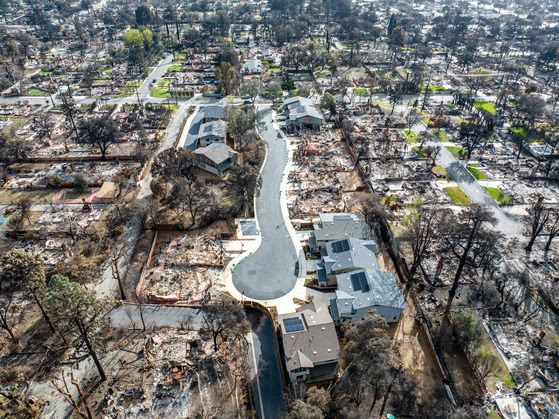
Airborne particles containing cancer-causing hexavalent chromium, or chromium-6, were found in neighborhoods near the devastating 2025 Los Angeles County wildfires, according to a study announced Friday.
The study — by researchers from UCLA and UC Davis published May 13 in the journal Nature Communications Earth & Environment — found elevated amounts of chromium-6 nanoparticles in the air around wildfire cleanup zones about two months after the Eaton and Palisades fires were extinguished.
Researchers said the particles may have traveled into communities located 6 to 9 miles downwind of the burn areas.
“Hexavalent chromium, or chromium-6, is a toxic metal and carcinogen that can impact the lungs and is associated with asthma, bronchitis, and lung cancer,” Michael Jerrett, a professor in UCLA’s Department of Environmental Health Sciences and a co-author of the study, said in a statement. “It shows that well after the wildfires were extinguished, nanoparticles, which are so small they can enter the circulatory system very quickly, were in the air around the burn zones.”
Jerrett said as many as 3.3 million people may have been exposed to levels hundreds of times higher than in typical Los Angeles air.
Modeling suggests airborne particles may have reached communities including Beverly Hills, West Hollywood and parts of the San Fernando Valley, according to the study.
Researchers reported average chromium-6 concentrations of 13.7 nanograms per cubic meter. While below federal workplace exposure limits, the levels exceeded U.S. Environmental Protection Agency screening thresholds for indoor air, according to the study.
“These results are below the official limits set by federal agencies for worker health, but above screening levels for indoor air,” UC Davis professor Michael Kleeman, the study’s lead author, said in a statement. “Results were shared early to inform the affected communities. Caution and health surveillance is warranted for nearby residents given that nanoparticles can easily cross cell membranes and circulate throughout the body.”
Kleeman added that chromium in the wildfire debris cleanup zones is a unique find “that implicates the fires as a source of toxic nanoparticle metals.”
Yifang Zhu, another UCLA co-author, said chromium-6 concentrations declined over time and returned to background levels about eight months following the fires. The substance converted into the less toxic form known as chromium-3 during that period.
Researchers recommended continued monitoring around wildfire cleanup areas and advised residents in adjacent communities to use indoor air filtration and limit outdoor exercise until conditions normalize.
The January 2025 Palisades and Eaton fires killed 31 people and destroyed or damaged over 18,000 structures, according to Los Angeles County.
Co-author Christopher Cappa said the findings also underscore growing concerns about health risks that arise when wilderness interfaces with urban areas via wildfires that are becoming more common.