

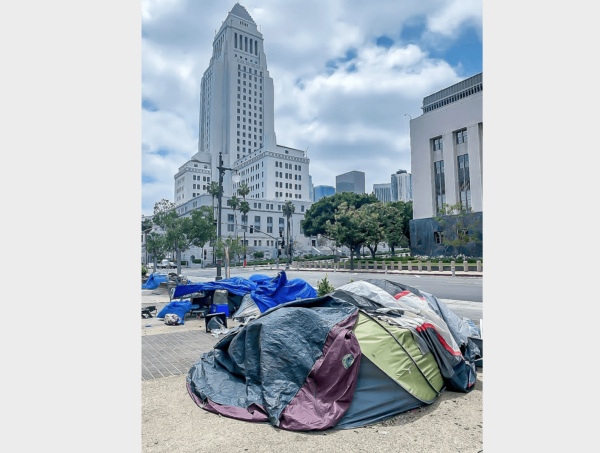
The number of people living without homes in three Los Angeles neighborhoods that for decades have had large homeless populations was flat last year, but those sleeping on the streets without encampments — “rough sleeping” — reached the highest amount in four years, the research organization RAND Corp. announced Friday.
The Santa Monica-based nonprofit released the 2025 Los Angeles Longitudinal Enumeration and Demographic Survey, or LA LEADS last week, reporting that the combined number of unsheltered residents in Hollywood, Skid Row and Venice remained statistically the same between December 2024 and January 2026.
However, researchers found that rough sleeping increased 20% to the highest level in four years. The term identifies the number of unhoused individuals who sleep on the streets without a tent, vehicle or other form of shelter, according to RAND.
“The total count held steady in 2025, but the makeup of the population continued to shift substantially,” Louis Abramson, the study’s lead author and adjunct researcher at RAND, said in a statement. “Compared to a year ago, more people are sleeping completely unsheltered, more spread out geographically, and with fewer connections to the systems that contributed to the prior year’s progress.”
The report indicated the number of tents and encampments has decreased in the three neighborhoods since 2021. Last year saw a 23% decrease, but reduction in tents and encampments has been offset by a surge in rough sleeping as well as more unhoused individuals living in vehicles.
Using vehicles for shelter increased 11% in 2025, RAND reported.
Nearly 90% of tents remained in Skid Row, an increase from 60% four years earlier, and Skid Row’s homeless population increased again in 2025, reaching record-high numbers before decreasing late in the year.
It was the only neighborhood with a continuous increase in the unhoused population in each year of the study, researchers reported.
Overall unhoused population numbers for Venice and Hollywood were for the most part flat because of “stalled progress,” according to RAND. Both communities posted a drop in homelessness in 2024.
The new survey data suggests that removing tents and encampments may be contributing to the rise in rough sleeping, researchers said. Almost half of rough sleepers who participated in the survey reported losing their dwelling in the past year, and 46% said dwellings were confiscated or towed by government agencies or service providers.
“The continued increase in rough sleeping from 2024 to 2025 is concerning because our data show that this population can be harder to engage and often has greater clinical needs,” Sarah Hunter, LA LEADS co-author and a senior behavioral scientist at RAND, said in a statement. “It suggests encampment- based approaches may no longer be effective and that different strategies are needed.”
Researchers said Skid Row had the greatest concentration of need followed by Hollywood and Venice. Skid Row also received the majority of outreach and housing assistance from officials and service providers with city contracts.
In all three areas, RAND identified barriers to services and housing because job opportunities for residents were nearly nonexistent, their cash reserves extremely limited and the majority of homeless residents did not have a mobile phone or basic forms of identification.
RAND recommended that attempts to address homelessness should be customized to reflect neighborhood conditions and residents’ needs because strategies that focus on encampments are not equally effective for addressing rough sleeping or living in vehicles.
The survey took place throughout the year by RAND staff and concluded in January. It is the second-largest point-in-time count of homelessness in the LA area next to the annual count conducted by officials from Los Angeles Homeless Services Authority and volunteers.
The full report is on the organization’s website.