



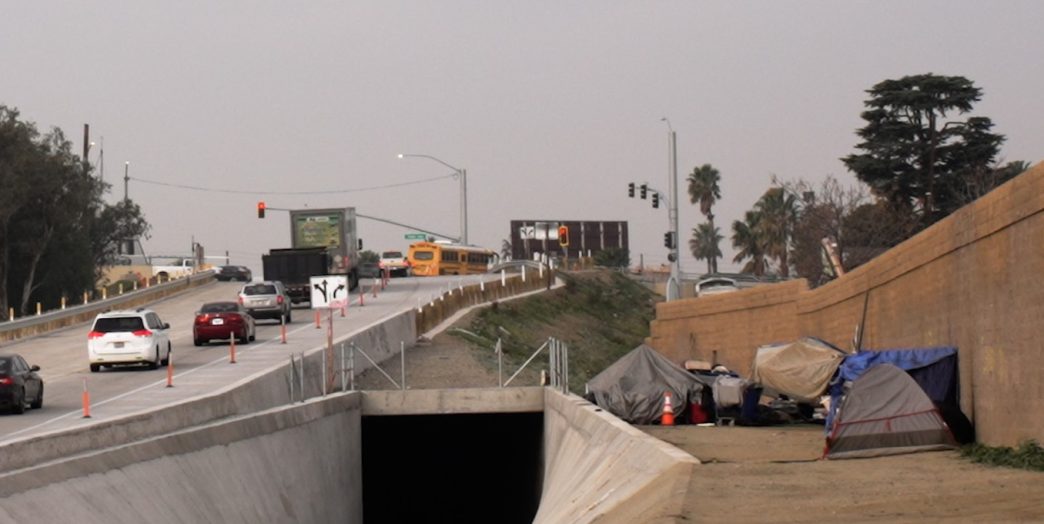
San Bernardino, Ontario and San Diego have joined a state program that reimburses cities for the costs of removing homeless encampments along or near highways, officials announced Tuesday.
Encampment Delegated Maintenance Agreements provide state funding to offset the cost for municipal agencies that work with the California Department of Transportation to remove roadside dwellings.
Under the agreements, city or county crews can clear out encampments on the “state right-of-way” as long as they comply with policies and reporting rules that aim to “ensure eligible reimbursable costs are used effectively and transparently,” according to the governor’s office.
“Our partnerships must continue delivering results — helping keep roadways clean and addressing the very real issues of homelessness in our state,” Gov. Gavin Newsom said in a statement. “By pairing historic state investments with local-level coordination, we are helping communities across California create safer, healthier places for everyone.”
Caltrans has signed similar agreements with the San Francisco County and city as well as the cities of Claremont, Commerce, Fresno, Paramount, Riverside, Santa Ana, Santa Fe Springs, San Jose and Santa Monica.
“Caltrans understands the vital importance of local partnerships as we remain fully committed to our role of providing a safe transportation system for all Californians,” Caltrans Director Dina El-Tawansy said in a statement. “These latest agreements combine the department’s best practices with regional expertise to deliver safer outcomes for people experiencing homelessness and the traveling public.”
Advocates for compassionate policies to address homelessness have criticized encampment bans and removals, which have increased since Newsom’s 2024 executive order that paved the legal path for municipal and Caltrans cleanup operations.
Members of the Inland Region Housing Justice Coalition said the San Bernardino County encampment ban last year “fails to address the real crisis. Our region’s lack of affordable housing and supportive services. Criminalizing homelessness only deepens poverty and makes it harder for people to get back on their feet.”
According to the governor’s office, encampments that threaten public health and safety remain the top priority in cleanup operations. Tasks involved in removing encampments include litter and debris collection, vegetation management and graffiti abatement.
Since July 2021, Caltrans has removed nearly 26,500 encampments along the state right-of-way and collected approximately 457,000 cubic yards of litter and debris, officials reported.
“Encampment Delegated Maintenance Agreements are designed to augment the state’s continued efforts to prioritize public safety, protect vital infrastructure and coordinate with social service partners who connect people experiencing homelessness with safer, more stable housing alternatives,” Caltrans spokesman Christopher Clark told HeySoCal.com. “Under these agreements, cities are given access to state rights of way to perform encampment removals, provided they follow state policies and reporting requirements to ensure eligible reimbursable costs are used effectively and transparently.
“Additional maintenance tasks under these agreements include the removal of encampments, litter and debris collection, vegetation management, and graffiti abatement,” Clark added.
Caltrans’ agreement with was executed June 1 with a funding total of $400,000, and the agreement with San Bernardino was on July 17 for $400,000, Clark reported. San Diego’s agreement was signed on July 16 for $400,000 for fiscal year 2025-26 and $800,00 for fiscal year 2026-27.
Riverside’s two-year pilot agreement allows the city to remove encampments on State Route 91, State Route 60 and Interstate 60 and bill Caltrans as much as $50,000 per quarter for the work totaling up to $400,000, officials reported.
“Keeping San Bernardino clean, safe, and welcoming takes strong partnerships and a shared commitment to our community,” Mayor Helen Tran said in a statement. “This agreement with Caltrans strengthens our ability to address encampments and remove debris along our freeways while ensuring outreach teams continue connecting individuals with shelter, supportive services and pathways toward long-term stability. Together, we’re improving public safety, protecting our environment and enhancing the quality of life for everyone who calls San Bernardino home.”
Ontario Public Works Executive Director Tito Haes said the new agreement will allow the city’s departments of Public Works, Police and Housing Services “to address ongoing homeless encampments and debris more quickly in the Caltrans easements throughout the city. Through this collaboration, Ontario is exhibiting our commitment to connecting those experiencing homelessness with our housing services staff to provide these individuals with housing and essential services.”
The 2026 point-in-time count to assess the number of unhoused San Bernardino County residents reported 298 people experiencing homelessness with 245 living in unsheltered circumstances.
San Bernardino’s unhoused residents totaled 1,172, with 737 unsheltered on the street, in vehicles, encampments of tents or makeshift dwellings, public places, abandoned buildings or other places “not designed for or ordinarily used as a regular sleeping accommodation for human beings,” according to the U.S. Department of Housing and Urban Development’s definition of unsheltered homelessness.
Homelessness in San Diego this year totaled 5,958 people with 3,132 unsheltered.
“Keeping our freeway corridors safe and clean while helping people move off the streets and into shelter is a top priority for my administration,” Mayor Todd Gloria said in a statement. “I’m grateful to Governor Newsom for his support and to our partners at Caltrans for renewing this agreement so we can continue this important work together, build on the progress we’ve made, connect more people experiencing homelessness with shelter and services, and deliver safer, cleaner freeway corridors for everyone who lives, works and travels through San Diego.”
Homelessness has been trending modestly downward in the Inland Empire and San Diego County over the last two years after steady increases during and following the coronavirus pandemic at the start of the decade.
Newsom’s office touted the largest statewide reduction in unsheltered homelessness in 16 years, citing 2025 federal data that also shows:
- California reduced unsheltered homelessness by 8,391 people, or 6.8%, more than any other state. That decline is more than double the national reduction of 2.9% and significantly exceeds that of the next-largest state by population, Texas, which experienced a 1.4% decrease.
- California’s overall homeless population dropped 2.8%, the state’s largest decline since 2009.
- From 2023 to 2025, California was first among all states and the District of Columbia in reducing the number of veterans experiencing homelessness, chronic homelessness, homelessness among young adults ages 18-24 and homelessness among parents under 25.
Caltrans’ website has additional information on encampment removals.
Updated July 31, 2026, 1:17 p.m.