

A new conservancy has been created to support restoration efforts at the Salton Sea, Gov. Gavin Newsom announced Friday.
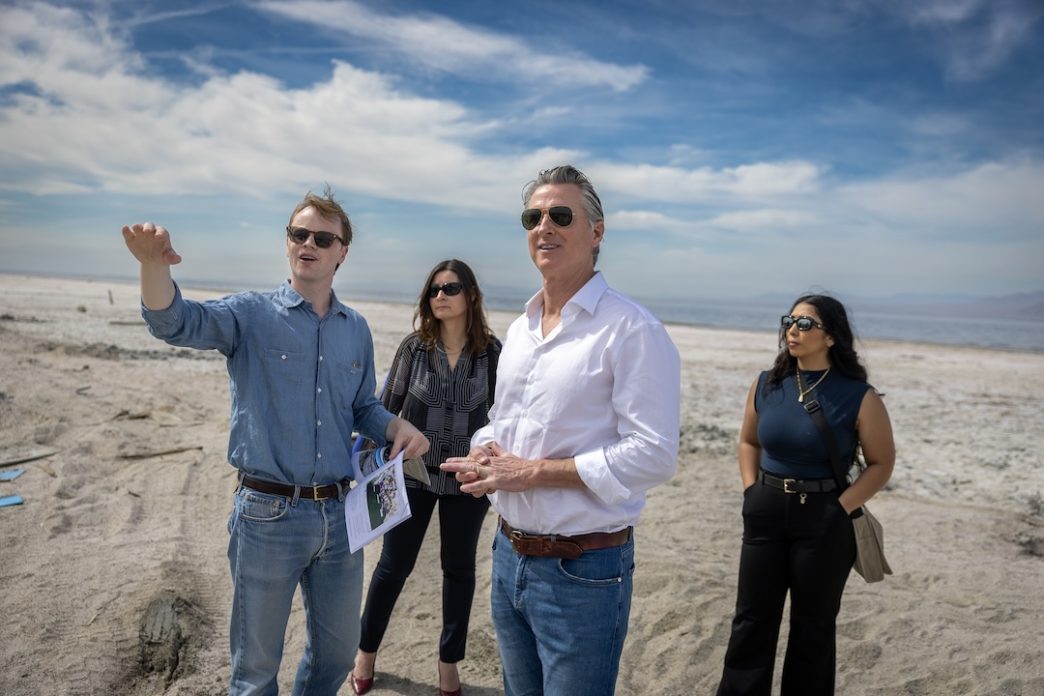
The Salton Sea is California’s largest inland water body, and it has shrunk in recent years because of reduced inflows, exposing a lakebed that could release small dust particles that worsen the air quality of the Imperial Valley and surrounding areas, according to the governor’s office. The reduced water levels and increased salinity also negatively impact habitat for wildlife, including millions of birds traveling the Pacific flyway.
“For too long, communities around the Salton Sea have carried the burden of environmental challenges and neglect,” Newsom said in a statement. “Today, California is changing that by launching the Salton Sea Conservancy to advance cleaner air, protect public health, restore critical ecosystems and ensure the work we’ve started creates lasting opportunities for Salton Sea communities.”
Established after Newsom signed a bill by state Sen. Steve Padilla, D-San Diego, into law, the conservancy was designed to address numerous problems caused by the receding lake by focusing on projects, including habitat restoration and reducing dust pollution from the exposed lakebed.
Located across southern Riverside County in the Coachella Valley and northern Imperial County, the Salton Sea is a landlocked, terminal lake that has increased in salinity over the decades, resulting in it being inhospitable for most aquatic life. Additionally, the reduced water inflows has created toxic, dust filled air dangerous for habitats and nearby communities.
California Secretary for Natural Resources Wade Crowfoot highlighted the importance of guiding long-term stewardships of the projects that aim to improve the air, protect communities and restore crucial habitat.
“I am honored to join the Salton Sea Conservancy at such a critical moment for our region,” Silvia Paz, executive director of Alianza Coachella Valley, said in a statement.
“For too long, the communities most impacted by the Salton Sea’s decline — such as families dealing with air pollution, children with asthma, residents who have watched this sea shrink before their eyes — have felt the weight of delayed action.
“The conservancy gives us the structure to change that,” Paz said. “By bringing together the right partners around shared priorities, we can finally align resources, cut through the fragmentation that has slowed progress, and advance real, lasting solutions for the people who need them the most.”
The restoration of the Salton Sea has been a state priority since 2019, as Newsom has secured more than $500 million in combined state and federal funding to move projects forward.
The governor’s office noted the expansion of the state’s flagship Species Conservation Habitat Project — now one of the largest restoration efforts in the country — and the start of water deliveries to new habitat ponds supporting fish and bird populations while improving air quality.
The total Species Conservation Habitat Project footprint is projected to span 9,400 acres, which totals the equivalent of nearly 7,200 football fields. Officials said it will create a network of ponds, berms, nesting and loafing islands and water delivery systems designed to sustain fish and bird populations. A restored local ecosystem also protects air quality by reducing dust at a key area of previously exposed lakebed at the Salton Sea.