

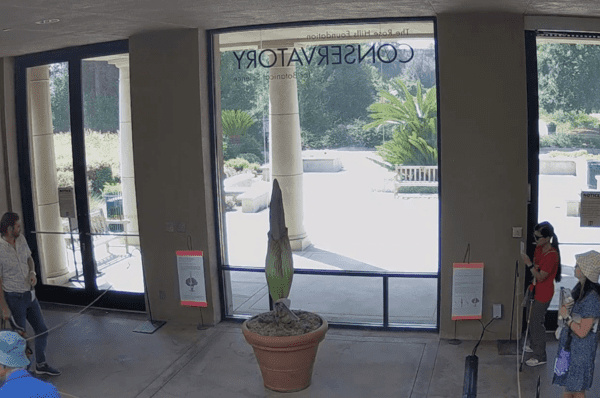
Another corpse flower is about to bloom at The Huntington Library, Art Museum, and Botanical Gardens in San Marino and its progress can be viewed online at www.huntington.org/corpse-flower.
The Amorphophallus titanum, also known as a Titan Arum, corpse flower and #StinkyPlant, has been called the world’s largest flower, but is technically an “inflorescence,” or a cluster of flowers. It can reach more than 8 feet in height when it blooms, opening to a diameter of 4 feet.
This one was 52.25 inches tall Tuesday, two inches taller than the day before, and 56.25 inches on Thursday, 1.75 inches taller than the previous day.
At the peak of its growth, it can grow up to 6 inches in one day. A daily growth chart is posted on the website.
When in one of its ultra-rare blooms, it gives off an odor akin to rotting flesh, attracting insects that pollinate the flowers deep inside.
According to Huntington spokeswoman Susan Turner-Lowe, the blooming plant produces two key gases — dimethyl disulfide and dimethyl trisulfide — that also are present in decomposing animals and vegetables.
What prompts a particular plant to start the blooming process largely remains a mystery, Turner-Lowe said, but the corpse flower tends to bloom during hot weather.
When a corpse flower was first displayed at the Kew Royal Botanic Gardens in the late 19th century, at least one Victorian woman was said to have swooned when she got a whiff of the bloom.
The flower was first displayed in the United States in 1937 at the New York Botanical Garden.