

California, 24 other states and the District of Columbia filed a lawsuit Tuesday challenging the Trump administration’s halt to food assistance during the nearly monthlong federal government shutdown.
The lawsuit filed in federal court in Massachusetts alleges the administration is using the shutdown as an excuse to unlawfully withhold November funding for the Supplemental Nutrition Assistance Program, or SNAP, despite having available funds, according to court documents. The U.S. Department of Agriculture under President Donald Trump has announced November SNAP benefits will cease because of the shutdown. As a result, 5.5 million Californians including 1.9 million children will lose access to $1.1 billion in food assistance.
“While Donald Trump parades around the world trying to repair the economic damage he’s done with his incompetence, he’s denying food to millions of Americans who will go hungry next month,” Gov. Gavin Newsom said in a statement. ‘It’s cruel and speaks to his basic lack of humanity. He doesn’t care about the people of this country, only himself.”
According to California Attorney General Rob Bonta, the USDA has available funds sufficient to cover all or a large portion of November SNAP benefits as agency sits on billions of dollars in contingency funds.
“Let’s be clear about what’s happening: For the first time ever, SNAP benefits will not be available to the millions of low-income individuals who depend on them to put food on the table,” Bonta said in a statement. “November SNAP benefits can and must be provided, even with the government shutdown. USDA not only has authority to use contingency funds, it has a legal duty to spend all available dollars to fund SNAP benefits.”
Bonta accused the Trump administration of politicizing food assistance.
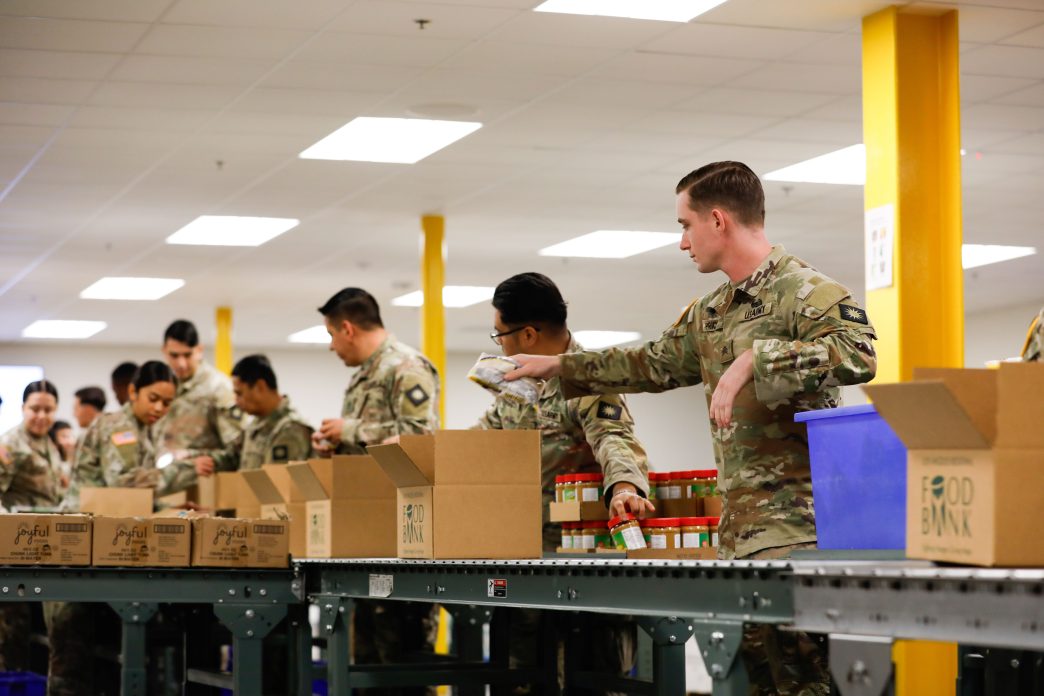
“With the holidays around the corner, we are seeing costs for groceries continue to increase and food banks facing unprecedented demand,” Bonta said. “We are taking a stand because families will experience hunger and malnutrition if the Trump administration gets its way.”
The White House referred a request for comment to the administration’s Office of Management of Budget, which did not immediately respond.
USDA officials blamed the shutdown on Democrats who were aware that SNAP funding was about to run out and accused the opposition of using the families who rely on food aid as political pawns.
“We are approaching an inflection point for Senate Democrats,” a USDA spokesperson said in an email to HeySoCal.com. “Continue to hold out for the Far-Left wing of the party or reopen the government so mothers, babies, and the most vulnerable among us can receive timely WIC and SNAP allotments.”
According to the lawsuit, on Sept. 30 the USDA issued a Lapse of Funding Plan acknowledging that Congress intended for SNAP benefits to continue during a government shutdown and that the department has multiple years of contingency funds available totaling $6 billion.
Nine days after the shutdown’s Oct. 1 start, the USDA directed state agencies to put an indefinite hold on November benefits while it began “the process of fact finding and information gathering to be prepared in case a contingency plan must be implemented,” according to a letter the department sent to states.
After no additional guidance for two weeks, a group of attorneys general requested an update on the USDA’s contingency plan, court documents show. The same day, Oct. 24, the USDA formally suspended SNAP benefits indefinitely.
“In a separate USDA memo, it wrote that USDA cannot legally use the $6 billion contingency fund to provide SNAP benefits — the opposite of what it said previously,” according to Bonta’s office. “It also said it could not use that money because it might be needed for disaster relief in the event of a future hurricane or tornado, even though the agency has previously said it could use contingency funds to cover SNAP benefits during a funding lapse.”
SNAP provides monthly food benefits to low-income families in all 50 states, the District of Columbia, Guam, Puerto Rico and the U.S. Virgin Islands. California’s version of SNAP is called the CalFresh Program run by the state Department of Social Services.
More than 63% of CalFresh participants are children or elderly, and many veterans — nearly 85,000 in California in recent years — live in households that depend on SNAP for their nutrition needs, according to Bonta’s office.
The lawsuit argues that under federal law, the USDA must provide food assistance and cannot suspend all benefits indefinitely while sitting on a multibillion-dollar contingency fund. Administration officials’ refusal is contrary to federal law and violates the Administrative Procedures Act, or APA according to court documents.
An Oct. 24 USDA statement countered that “SNAP contingency funds are only available to supplement regular monthly benefits when amounts have been appropriated for, but are insufficient to cover, benefits. The contingency fund is not available to support (fiscal year) 2026 regular benefits, because the appropriation for regular benefits no longer exists” as a result of the shutdown.
USDA officials also said “the contingency fund is a source of funds for contingencies, such as the Disaster SNAP program, which provides food purchasing benefits for individuals in disaster areas, including natural disasters like hurricanes, tornadoes, and floods, that can come on quickly and without notice.”
The attorneys general and governors’ lawsuit noted that the USDA has historically funded SNAP benefits during prior lapses in appropriations.
“In doing an about face and suspending November SNAP benefits without adequately considering the impacts on states, among other things, the agency violated the APA’s requirement to engage in reasoned decision-making,” according to Bonta’s office.
Bonta is co-leading the lawsuit with the attorneys general from Arizona, Massachusetts and Minnesota. Gas from Connecticut, Colorado, Delaware, the District of Columbia, Hawaii, Illinois, Maine, Maryland, Michigan, Nevada, New Jersey, New Mexico, New York, North Carolina, Oregon, Rhode Island, Vermont, Washington and Wisconsin also joined the coalition along the governors of Kansas, Kentucky and Pennsylvania.
SNAP recipients nationwide totaled 41 million last year, according to the nonprofit Center on Budget and Policy Priorities. USDA data shows nationwide SNAP benefits averaged $8.3 billion per month in 2024.
The lawsuit’s court filing is available on the California attorney general’s website.