

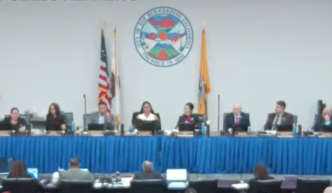
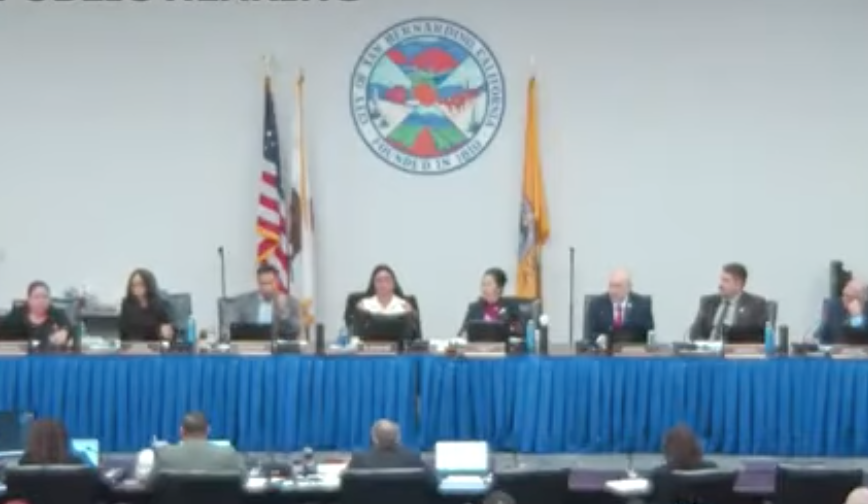
San Bernardino moved a step closer to banning camping on public streets and parks Wednesday, when the City Council introduced an ordinance that would restrict where unhoused residents may sleep and store belongings.
The ordinance amends the municipal code to prohibit camping and obstruction of public rights of way, including within set distances of driveways, fire hydrants, building entrances, schools and other facilities.
City Attorney Albert Maldonado told the council that portions of the measure dealing with encampment cleanups had been removed because the city already follows an existing procedure for those operations.
Some restrictions include 500 feet of distance from colleges, schools, day care centers and cancer treatment facilities, 20 feet from public driveways and other facilities and 10 feet from sidewalk ramps, electric vehicle charging stations and automatic teller machines, according to the ordinance.
The proposal drew sharp opposition from residents and advocates who argued it criminalizes poverty without providing housing.
“Where are they supposed to be? They don’t have a home,” one speaker told council members, adding that the ordinance “does nothing but push a problem under a rug.” Another commenter, who described being periodically homeless since age 18, called the restrictions “eugenics” and cited a housing waiting list of 150,000 people.
Councilwoman Sandra Ibarra defended the city’s record, saying the city has expanded from roughly 100 shelter beds to more than 900 and has partnered with nonprofits to provide services to unhoused residents.
“Homelessness doesn’t just affect our city or Victorville,” she said, urging advocates to press other jurisdictions to do similar work.
“We have Fontana that recently came on board, Colton and Redlands, to address homelessness,” Ibarra added. “If anybody says that there’s no services provided, just know that we have taken serious steps to help people get the help that they need.”
The council introduced the ordinance Wednesday, with a second reading and final adoption are scheduled for Nov. 4.
Homelessness in San Bernardino decreased from the 1,535 people in 2025 to 1,172 this year, according to the most recent count of unhoused residents. That’s a nearly 24% drop.
In a separate and somewhat contentious item, the council adjusted the mayor’s salary to an amount equal to double the salary of a council member, $92,400 in base pay and a monthly automotive stipend. The move came after the Elected Official Compensation Advisory Commission recommended restoring the mayor’s pay to 50% of a Superior Court judge’s salary, roughly $122,000.
Councilman Theodore Sanchez, who proposed tying the mayor’s pay to twice the council’s salary, argued the council should retain discretion over its own compensation decisions rather than cede them to an outside body.
“If the council ever decides to increase their salary, the mayor salary is tied into that,” Sanchez said. “If the council decides that times are tough and we need to cut our pay, then the then the mayor’s pay will also be dropped.”
Councilman Fred Shorett seconded the motion, calling the process that produced the commission’s recommendation “absolutely ludicrous.”
Shorett said he did not support having an elected mayor when the council amended the City Charter in 2016 “because there’s many, many cities here in the region that operate with a mayor pro tem or a mayor that’s elected among the (council members). … It is just absolutely ludicrous, though, to think that our mayor’s compensation should be considered equal to somebody that’s in San Diego or or or San Jose. We use the median house income.”
Ibarra said for the mayor to make half of what a county judge receives “is too much for our city, especially with our budget shortfalls that we are seeing happening now. … Fiscally, that is not responsible. I’m not comfortable with saying give (Mayor Helen Tran) half the salary of a superior court judge. The mayor does not serve a whole county, she serves only one city in the whole county.”
The council also reallocated nearly $632,000 in American Rescue Plan Act funds to Navigation Center construction and over $102,000 to the Seccombe Lake Park project, moving money before a Dec. 31 federal spending deadline.
Mayor Pro Tem Kimberly Knaus questioned why graffiti abatement funds had gone unspent, and staff explained two new graffiti trucks could not be delivered in time.
The AI platform Civilio assisted this report.