

By Maya C. Miller, CalMatters
This story was originally published by CalMatters. Sign up for their newsletters.
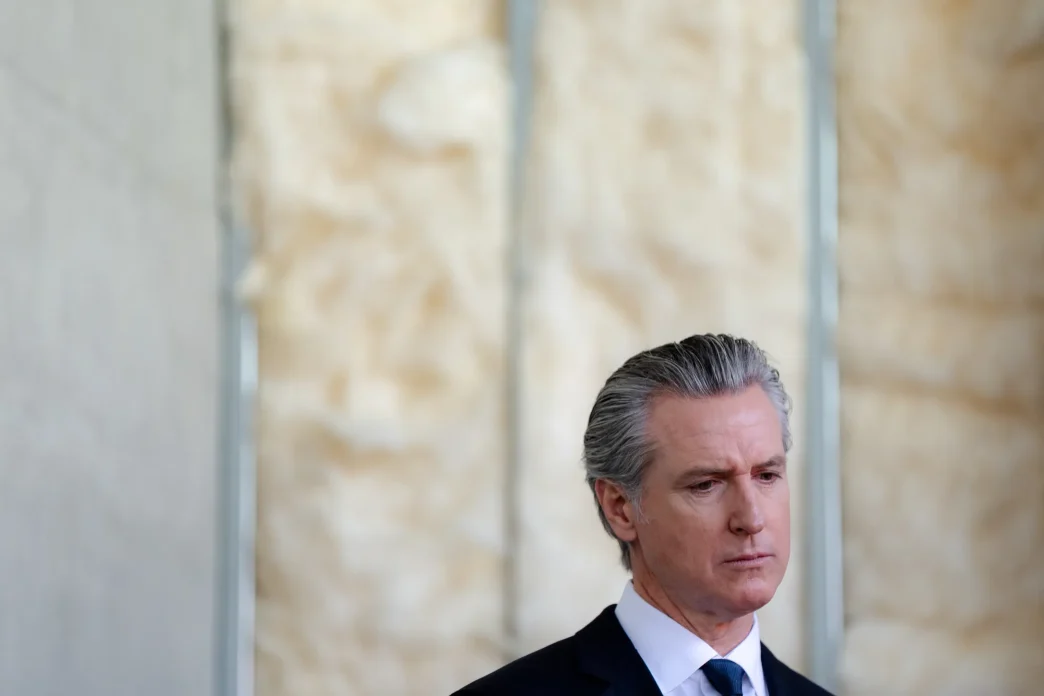
Despite his signature last-minute maneuvering, Gov. Gavin Newsom couldn’t secure his final major deal with the California Legislature.
The Democratic governor, who terms out in January, wanted to reduce how much utilities must pay after their equipment sparks wildfires by eliminating the ability of insurance companies to sue utilities to recoup costs.
But on Tuesday, after weeks of pushback from lawmakers and survivors of the Los Angeles-area wildfires, the Assembly killed a compromise Newsom had previously agreed to, throwing into question whether the governor would call a special session to hammer out a deal before he leaves office.
The bill before the Assembly, Senate Bill 492, amounted to a collection of “half measures,” Assembly Speaker Robert Rivas told reporters after the chamber adjourned. “I think Californians expect a lot more than half measures,” he said. (Senate Pro Tem Monique Limón said her chamber was prepared to pass the deal.)
The unsuccessful last-minute scramble, and ultimately the deal’s death, illustrates the limits of a lame-duck governor’s power in his last legislative session — even for one as high-profile and ambitious as Newsom.
The governor himself acknowledged the fumble.
“Simply put, this measure did not meet the gravity of this moment,” Newsom said in a statement. “California cannot settle for half measures.”
‘Jamming’ the Legislature
Newsom has become accustomed to pushing priorities through the Legislature in the days before a deadline, a practice known as a “jam” in Sacramento. The move has previously helped Newsom score carveouts to the state’s landmark environmental law and a measure to fast-track infrastructure construction
“Jamming the Legislature” involves closed-door negotiations with interest groups and legislative leadership, from which compromise legislation emerges often just days or hours shy of the deadline.
Lawmakers are then left with little time to make amendments or hold public hearings, and opponents have little opportunity to object.
Late last week, a Newsom aide conceded in a memo to legislative leaders that the governor’s measures “do not appear to have a path” and instead presented a narrower set of reforms that the administration and legislative leaders agreed upon. Still, Newsom’s office balked at the suggestion that the governor capitulated to lawmakers’ and wildfire victims’ demands.
“All other outstanding issues are off the table,” his office wrote in the memo obtained by CalMatters. Last Friday, share prices of the state’s three major investor-owned utilities tumbled. On Monday, the companies’ stock continued to plunge; Southern California Edison and Pacific Gas & Electric saw more than 20% declines.
‘Too late to do anything’
Some lawmakers expressed frustration at the compressed timeline on Monday night during an informational hearing on the wildfire bill in the Assembly utilities committee.
“Here we are with a bill, where we’re being yelled at that it’s inadequate, where most of the members of this committee didn’t actually get to see what was in it until the final days before it was too late to actually do anything on it,” said Assemblymember Chris Rogers, a Democrat representing Ukiah.
The deal state lawmakers killed had already been stripped of several major provisions that Newsom wanted: no change to how insurance companies could recoup money from utilities, and no changes to other damages he wanted to limit utilities from paying, such as to fire victims and local governments.
“I have a sell-by date. I get it,” Newsom acknowledged to reporters on Monday during a surprise visit to the Capitol. “I’m not going to be here to solve this, but it needs to be solved.”
The governor stated that the final version of SB 492 “did not address the underlying structural problem driving this crisis,” and he pointed to utilities’ plunging stocks as evidence. He urged lawmakers to pick up the issue next year and work with the next administration.
Jams worked, mostly
In the past, Newsom’s last-minute jams have proven fruitful. Last year, private negotiations over a Newsom-backed package of energy policies tied to the state’s carbon emissions-trading program dragged out so long the Legislature extended its session by a day.
But this year, Newsom was forced to drop several of his priorities amid lawmaker opposition.
He failed to push through a deal to fast-track a shipyard in the East San Francisco Bay for the tech billionaire-backed group California Forever, amid heavy resistance from some county leaders and only lukewarm support from the state lawmakers who represent the area. (Newsom said Monday that the Solano County supervisors’ vote to effectively kill the proposal this year “made no damn sense.”)
He was also forced to back away from an eleventh-hour attempt to exempt a Santa Monica housing project from the regular coastal development process, a move that would have benefitted one of his longtime donors whom Newsom had appointed to state commissions.
And vocal opposition from transportation advocates, environmentalists and the oil industry led Newsom to abandon a plan to divert millions of dollars in road funding to Phillips 66’s Rodeo oil refinery in Contra Costa County.
Last-minute deals raise hackles
Some lawmakers and advocates were rankled over the last-minute dealmaking. Assemblymember Alex Lee, a San Jose Democrat, even offered Newsom a jar of “last-minute jam” in a tongue-in-cheek tribute to his “assertive leadership style with us in the Legislature.”
“Legislators want a governor who is present and that they can work with,” said Tim Rosales, a Los Angeles based political strategist for GOP causes and candidates. “Newsom has never had that kind of relationship with the Legislature and really has been focused pretty specifically on himself. I think that’s probably rubbed a lot of legislators the wrong way.”
Solano County Supervisor Mitch Mashburn, after voting against l the California Forever proposal, said the only urgency was the concern about “whether the governor was going to jam it down our throats.”
“I ain’t really that afraid of the governor,” Mashburn said. “The governor doesn’t get to make law. The Senate and the Assembly get to make law. I don’t know that he’s got the juices and backbone to get that done. And so, I think that we have time.”
Lobbyist Chris Micheli said the notion of Newsom’s waning power has been “overplayed.” Micheli, a Capitol lobbyist since former Gov. Pete Wilson’s administration, argued that Newsom has tremendous power to sign or veto hundreds of bills over the next month.
He said lawmakers largely rejected Newsom’s proposals this year out of fundamental philosophical disagreements rather than personal defiance.
“They win some, they lose some, every single year,” he said, speaking of governors. “I don’t see it any more pronounced this year.”
Katelyn Roedner Sutter, who lobbies on behalf of the Environmental Defense Fund, agreed that a lot of Newsom’s priorities could have been ironed out if the governor’s office had started negotiating the wildfire package sooner and planted seeds earlier in the year about changing subrogation rules.
“There’s been a lot of talk about how this has been an issue ever since this governor has been in office,” said Roedner Sutter, speaking of investor-owned utilities and wildfire liability. “It’s been a growing issue for years. So we really should’ve started on this much sooner.”
‘Big complex things’
Sen. Josh Becker, a Menlo Park Democrat who was closely involved in the negotiations and authored the eventual wildfire legislation, was among the lawmakers more interested in Newsom’s proposals. He told CalMatters that lawmakers this year “ran out of time” to address those issues in depth.
Still, he said he didn’t fault Newsom for pushing the proposals late in the session.
“These are big, complex things that take time,” he said. “I’m not going to fault the governor one way or another on this. He could have done nothing.”
Asked about the lawmakers’ opposition to his proposals last week, Newsom said many newer members of the Legislature didn’t understand the complex interplay between utilities and insurance companies.
Newsom on Monday again refused to rule out the possibility of a special session, a move that would put more time on the clock, but only if lawmakers were willing to play along.
“I’m just not going to leave without trying,” the governor said last week before paraphrasing a famed football coach. “I feel like Lombardi or something: ‘Did you lose? No, we just ran out of time.’ I wish I had a few more months here.”
Newsom told reporters that critics who suggest his influence is waning as a lame duck “haven’t paid any attention — literally no attention.”
“We landed 90 planes on some of the toughest issues as relates to chatbot bills and child safety — a lot, a lot of issues,” Newsom said. “I decided to take a last at-bat on the toughest issue that I could,” he added, referring to wildfire liability. “And the good news is we made progress.”
Jeanne Kuang, Kate Wolffe, Nadia Lathan, Levi Sumagaysay and Yue Stella Yu contributed to this report.
This article was originally published by CalMatters and was republished under the Creative Commons Attribution-NonCommercial-NoDerivatives license.