

The Ontario City Council on Tuesday signaled a willingness to slow the city’s rapid warehouse growth and to widen utility help for low-income households, while also moving to phase out irrigation of decorative turf.
Councilman Jim Bowman asked colleagues to consider a formal hold on new warehouse construction, framing it as a chance to reassess how much logistics development the city has absorbed.
“I think that’s worthy of an opportunity to stop the forward motion and think about what we’re doing for a while and contemplate what the future really looks like or should look like, and whether we really want to be part of that with our name on it,” Bowman said.
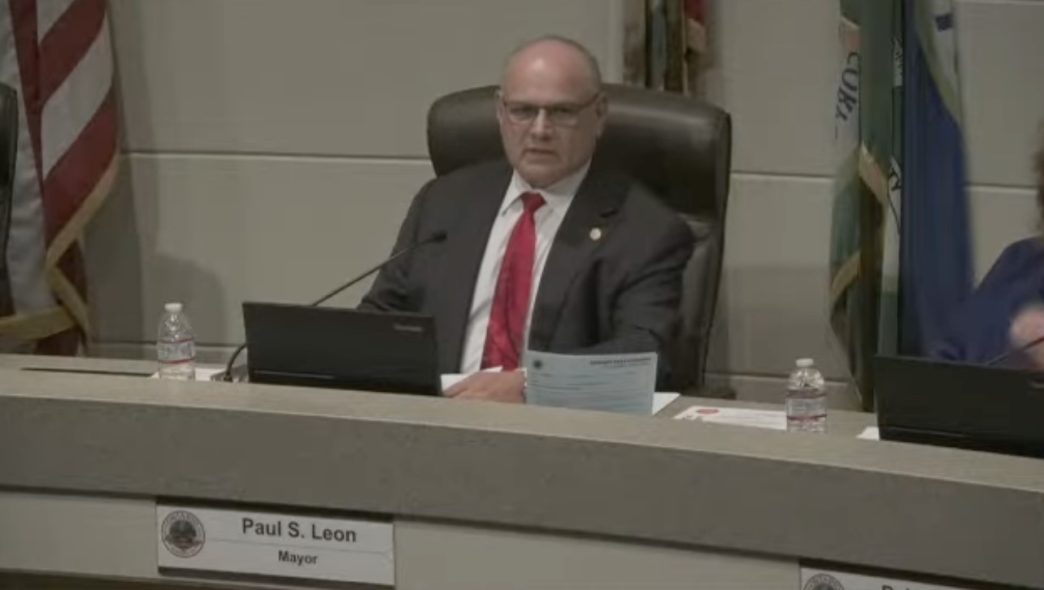
Mayor Paul S. Leon pushed back gently, suggesting the council first study where warehouses currently stand before committing to a moratorium.
“A lot of times when it comes to warehouses, I know that the media plays into that whole idea of and the din of social media saying there’s too many,” Leon said. “I think that what we’re doing right now in the city of Ontario is we have warehouses where they belong. …
“I’d love to see the report on what we’re doing and have a briefing here in front of all of us and then go from there,” the mayor said.
City Attorney Ruben Duran cautioned the council that the Brown Act, the state’s open-meetings law, limits how much a non-agendized topic can be debated on the spot. He urged council members to direct staff to bring the matter back through formal procedure.
City Manager Scott Ochoa recommended the council instead revisit its recently adopted general plan, the city’s long-range guidelines for land use, as the cleanest vehicle for a possible policy change. The council reached a consensus to review the general plan rather than take immediate action on a moratorium.
“I was speaking more in the area of a resolution, which is an opportunity to evaluate where we’re at in the process of moving forward from this point,” Bowman said before agreeing to hold off on a moratorium resolution and wait for a future briefing from the city manager’s staff.
Separately, Leon pressed for broader affordability relief, noting the city counts roughly 187,000 to 200,000 residents with a median household income of $89,000 and rent above $2,000 a month for a typical apartment. He said about 12% of residents live below the poverty level.
Leon pointed to a $15-a-month discount on combined water, sewer and refuse bills now available only to qualifying low-income seniors and residents with disabilities, and said he wants it extended to everyone below a certain income level. He noted that last year’s utility rate hearing enrolled just 230 households in assistance programs out of more than 53,000 households citywide.
“I’m not actually asking this council tonight to approve a single dollar of new spending, but I would think that we should look at whether we should expand these programs or not,” Leon said.
He asked staff to return within 60 days with a report on how the city’s assistance programs are performing.
“When our residents tell us that affordability is an issue, we need to listen,” Leon said. “There are things that we can do a little bit that are reasonable to make Ontario a little bit more affordable. We cannot control the price of milk, the price of gas, the price of real estate. That is not within the city’s ability to control, but we can control a few little things that can make life a little bit easier.”
The council also introduced an ordinance updating the city’s water conservation plan to comply with AB 1572, a state law that bars using potable water to irrigate nonfunctional turf on commercial, industrial and institutional properties, with phased implementation running from 2027 through 2031. The ordinance passed 5-0 on first reading.
According to a city staff report, the ordinance update establishes the following permanent water conservation requirements:
“Prohibit water runoff from landscaped areas onto streets, sidewalks, and other paved surfaces resulting from excessive irrigation or improperly maintained irrigation systems.
“Prohibit the washing of sidewalks, walkways, driveways, parking areas, and other paved surfaces, except when necessary for health or sanitary purposes. Any handheld hose used for such purposes must be equipped with a positive shutoff nozzle,” and
“Prohibit the use of potable water to irrigate nonfunctional turf on commercial, industrial, institutional, and certain common-area properties in accordance with the phased implementation schedule established by State law, beginning January 1, 2027.”
A public commenter urged the city to pair turf removal with native landscaping and stormwater capture, telling the council that rainfall “is not just something to drain away. It is a resource.”
The AI platform Civilio assisted this report.