

A federal judge Wednesday ordered President Donald Trump to return control of California National Guard troops deployed in Los Angeles to Gov. Gavin Newsom.
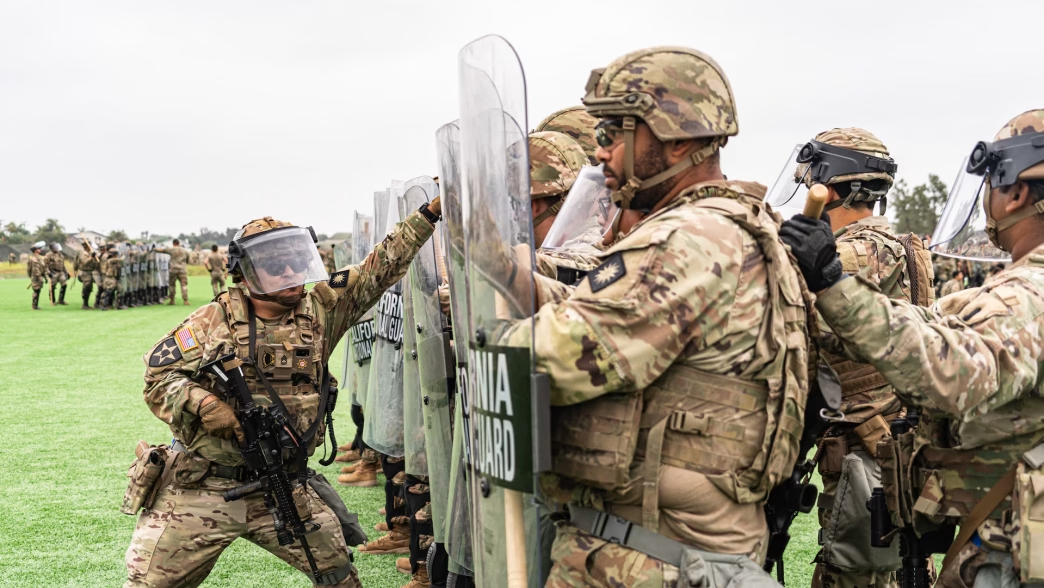
On June 7 despite Newsom’s objections, Trump began federalizing the state’s Guard soldiers to protect federal facilities and personnel involved with the administration’s nationwide crackdown on illegal immigration. Trump and Defense Department Secretary Pete Hegseth transferred to federal control a total of 4,000 members of the California National Guard — which according to Newsom’s office is 1 in 3 of the Guard’s total active members — to serve in a civilian law enforcement role on LA streets and other Southern California communities.
The state sued to challenge the federalization — now totaling about 300 troops — and the lawsuit is ongoing.
“The Founders designed our government to be a system of checks and balances. Defendants, however, make clear that the only check they want is a blank one,” Judge Charles Breyer wrote in his decision Wednesday. “Six months after they first federalized the California National Guard, Defendants still retain control of approximately 300 Guardsmen, despite no evidence that execution of federal law is impeded in any way — let alone significantly.
“What’s more, Defendants have sent California Guardsmen into other states, effectively creating a national police force made up of state troops,” according to Breyer. “In response to Plaintiffs’ motion to enjoin this conduct, Defendants take the position that, after a valid initial federalization, all subsequent re-federalizations are completely, and forever, unreviewable by the courts. Defendants’ position is contrary to law.”
Administration officials signaled a forthcoming appeal to Breyer’s decision, which takes effect Monday.
“President Trump exercised his lawful authority to deploy National Guard troops to support federal officers and assets following violent riots that local leaders like Newscum refused to stop,” White House spokeswoman said in a statement Wednesday. “We look forward to ultimate victory on the issue.”
California officials responded to the judge’s decision.
“Today’s ruling is abundantly clear — the federalization of the National Guard in California is illegal and must end,” Newsom said in a statement. “The President deployed these brave men and women against their own communities, removing them from essential public safety operations. We look forward to all National Guard servicemembers being returned to state service.”
Attorney General Rob Bonta had similar comments.
“Once again, a court has firmly rejected the President’s attempt to make the National Guard a traveling national police force,” said Attorney General Bonta. “For more than five months, the Trump Administration has held California National Guard troops hostage as part of its political games. But the President is not king. And he cannot federalize the National Guard whenever, wherever, and for however long he wants, without justification. This is a good day for our democracy and the strength of the rule of law.”
Trump initially ordered 2,000 California National Guard troops to Los Angeles on June 7, after raids began to enforce immigration laws were and were met with large-scale protests that led to occasional violence. The president argued that local law enforcement agencies were unable to effectively maintain the safety of immigration officials and federal vehicles and facilities.
Los Angeles and state officials opposed to the deployment noted that the National Guard soldiers did not help disburse demonstrators or break up protests, with their duties mainly restricted to guarding the downtown federal building. The Los Angeles Police Department and California Highway Patrol, not troops, quelled protests, Mayor Karen Bass and other local officials said.
Breyer, an appointee of President Bill Clinton and the younger brother of liberal former Supreme Court Justice Stephen Breyer, issued a similar ruling earlier this year declaring the Trump administration’s initial deployment order illegal. The 9th Circuit Court of Appeals overturned that decision.