


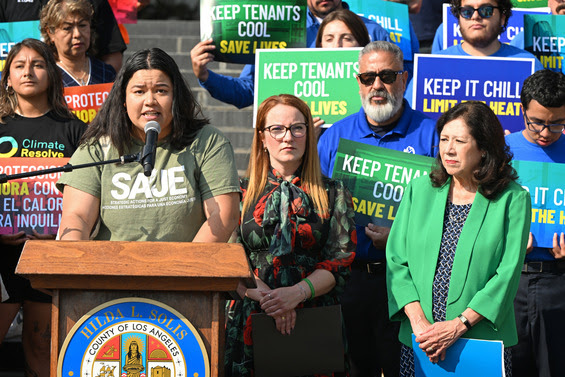
The Los Angeles County Board of Supervisors on Tuesday required all residential rental units in unincorporated areas to have a maximum indoor temperature of 82 degrees.
The ordinance, which passed on a 4-0 vote with Supervisor Kathryn Barger absent, also requires landlords to allow tenants to install portable cooling devices and other methods to control the temperature in rental units, including air-conditioners, fans and blackout curtains. That requirement is expected to take effect in 30 days, but enforcement of the overall 82-degree maximum temperature requirement will not begin until Jan. 1, 2027.
“We know that extreme heat is not just uncomfortable. It is deadly,” Supervisor Hilda Solis, who introduced the motion to amend the county’s Health and Safety Code, said in a statement. “As climate change accelerates, our communities are on the front lines of intensifying heat waves. This ordinance is a critical, life-saving policy that prioritizes the health and dignity of renters, many of whom are children, older adults, people with disabilities and immigrant working families living in aging buildings without cooling.”
The ordinance will require the maximum temperature of 82 degrees in all habitable rooms of a rental unit beginning Jan. 1, 2027.
An amendment by Supervisor Janice Hahn allows “small property landlords” to maintain the 82-degree limit “in at least one habitable room.”
Housing advocates and county residents who attended the meeting urged the board to reject the amendment so that the maximum temperature standard applies to all rental units in unincorporated areas.
Hahn countered that smaller landlords will be required to limit the temperature in all habitable rooms by Jan. 1, 2032. Hahn said her compromise gives smaller landlords “a longer onramp” to achieve the cooling goal.
In a statement following the board’s vote, Chelsea Kirk, director of policy and advocacy for Strategic Actions for a Just Economy, said Hahn “introduced this exception at the last minute, and it was supported by landlord lobbyist groups. Even more worrying, landlords can self-certify as ‘small landlords,’ and Los Angeles County does not have the resources to verify their claim.”
Kirk also noted concerns “that this exception will mean the ordinance is inequitably applied. In South Los Angeles and other areas with low-income renters of color, there are many older buildings owned by small landlords. Their renters especially need a right to cooling, as they are disproportionately impacted by extreme heat and live in properties that have not been upgraded to withstand climate change.”
In a statement to HeySoCal.com, Hahn said her amendment was “a compromise to address the concerns I heard from small mom and pop landlords who need more time to comply with this ordinance. I think it is better for tenants that they have at least one cool room rather than none at all,” the supervisor said. “Importantly, this compromise will sunset in 2032 when all landlords in unincorporated areas need to keep entire units below 82 degrees.”
The board also directed county staff to look for potential funding sources to help tenants and landlords lower the costs of complying with the updated code requirements.
Supervisor Lindsey Horvath, who seconded the motion to approve the new requirements, issued a statement following the vote.
“As climate change intensifies and temperatures rise, Los Angeles County is taking bold action to protect renters and safeguard community health,” Horvath said. “Setting a maximum indoor temperature of 82 degrees isn’t a luxury — it’s a basic right. Everyone deserves to feel safe in their own home. This ordinance puts us on a path to ensure entire units are protected from extreme heat and establishes a public health standard rooted in science, equity, and care. It’s a meaningful step toward climate resilience that protects renters, supports landlords, and puts people first.”
Despite SAJE’s opposition to the amendment easing requirements for landlords who own less than 10 units, the group welcomed the code update.
“By giving renters a legally protected right to install and operate air conditioning in their homes, this policy will save lives,” Jannet Torres, a climate justice organizer at SAJE, said in a statement. “It is an important step in ensuring our most vulnerable communities can survive extreme indoor heat as the planet continues to warm.”
SAJE member Mireya, a tenant who lives in Solis’ 4th District and did not share her last name for fear of being targeted by immigration enforcement agents, said in a statement, “Every summer, the heat gets worse and worse, making it hard to cook, to sleep, and even to breathe. Finally, there will be a way for me and many others to have relief and make sure we can stay healthy in our own homes when heat waves come.”
The Public Health Department’s letter to the board regarding the maximum temperature law is available on the county’s website.
Updated Aug. 7, 2025, 2:07 p.m.