

Six months to the day from the devastating Los Angeles wildfires, county officials on Monday announced a forthcoming rebuilding plan that includes financial help for residents, speeding up property inspections and moving formerly overhead utility lines underground.
This newly announced phase of the recovery effort is part of “LA County Forward: Blueprint for Rebuilding,” which is due for release in the weeks ahead. Officials said the plan reflects feedback from homeowners, renters, business owners, community organizations and other community members about their neighborhoods’ highest-priority needs.
“As we mark six months since these devastating fires, we recognize the historic actions taken to clear debris from thousands of properties in record time,” LA County Board of Supervisors Chair Kathryn Barger said in a statement. “But this is only the beginning. We must move into the next phase — rebuilding — with the same determination and urgency.”
With support from state and federal agencies, Barger said county’s rebuilding blueprint “will drive a swift, resilient recovery and ensure our communities emerge stronger than ever.”
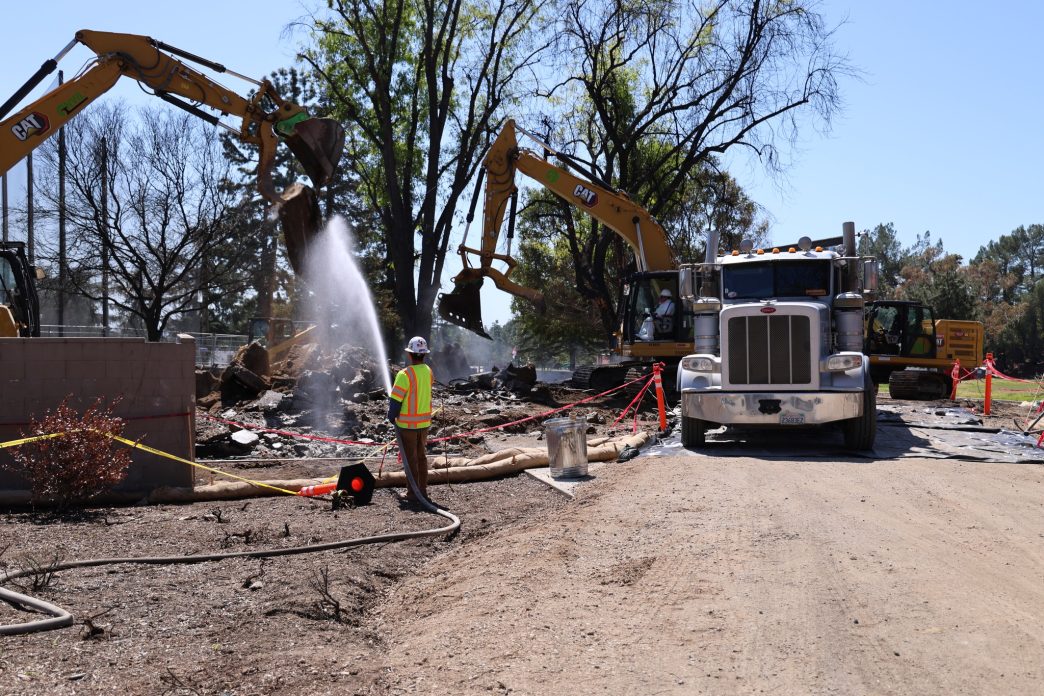
According to the county, strong coordination between state and local agencies and the U.S. Army Corps of Engineers led to in the fastest cleanup of disaster debris in California history. As the Army Corps completes its debris removal work and begins to demobilize, state and local officials will focus on accelerating the rebuilding process in an effort to make sure that progress continues.
State and federal agencies cleared ash and debris from the first 1,300 properties in just over 70 days, the governor’s office reported in March. Clearing 920 properties in similar terrain after the 2019 Woolsey and Hill fires took crews more than four months, which at the time was a record pace.
“Six months ago, the Palisades and Eaton Fires put our communities to the ultimate test. In the face of colossal devastation, we witnessed the unshakable resilience of the human spirit. Our residents stood strong, banded together, and reminded us all of the power of community,” Supervisor Lindsey Horvath said in a statement. “Thanks to a close partnership with Governor Newsom, governmental coordination at every level, and tireless County teams, we’ve already led the fastest debris removal in history.
“This is the spirit of Los Angeles County — and our momentum will continue,” Horvath said. “Together, we are not just restoring what was lost — we are building back stronger, safer, and more united than ever.”
The county’s rebuilding blueprint includes:
- Waiving requirements and lowering rebuilding costs — LA County officials since January have worked with their state and city-level counterparts to cut “red tape” and continue looking “for ways that the Newsom Administration can waive codes that do not impact life and safety, including requirements for rooftop solar and storage, electrification, and other new efficiency standards,” according to a county statement. “This will speed up the rebuilding process and save the average resident up to $30,000 in costs during construction, while giving individual homeowners choices about how they want to proceed on their individual construction projects.”
- Quicker property tax relief — Properties damaged or destroyed in the fires are eligible for tax reduction. “The county is taking extra steps to reach out and accelerate reassessments so that all property owners receive the tax relief they are entitled to,” officials said. Reassessments can save homeowners $3,000 to $10,000 annually that they can use to pay off reconstruction loans or fill insurance gaps. “The County Assessor has provided relief by reassessing and lowering tax bills for 17,100 parcels already — roughly 75% of those impacted by the fire,” officials said. Currently the county is processing 2,900 submitted claims with completion expected sometime this summer and plans to “support the roughly 3,000 property owners who have not yet filed claims.”
- Accelerating permitting and inspections — The county is hiring contractors to bolster its permitting and inspection staffs in an attempt to further reduce turnaround times and hasten approvals. “We have created an expedited permit review process for like-for-like rebuilds and pre-approved plans, launched a public dashboard that tracks permit turnaround times for full transparency, piloted self-certification for licensed architects and engineers, and deferred Department of Public Works and Department of Regional Planning permitting fees that can exceed $20,000 per household,” according to the county.
- Undergrounding overhead utilities — To reduce fire risk, county and state agencies are moving underground electricity, natural gas and telecommunications infrastructure. “Together with utility providers, we are aiming to build more modern, reliable and resilient infrastructure to meet the communities’ needs, both today and in the future, by burying more than 150 miles of power lines and telecommunications equipment underground,” officials said.
“We are committed to delivering a recovery that is efficient and anchored in the real needs of our residents — and we are counting on our key partnerships with the State and other essential stakeholders to get us there,” LA County Chief Executive Officer Fesia Davenport said in a statement.
The rebuilding blueprint also highlights six priorities for the next phase of reconstruction that aims to focus on the most significant challenges many residents face.
- “Supporting a feasible financial path to return: Helping families and businesses access needed financial support to cover gaps, lower costs and return home.
- “Accelerating permitting and inspections: Streamlining permitting and speeding up inspections so people can start rebuilding sooner.
- “Growing the pool of builders and materials to achieve scale and lower costs: Bringing down costs by scaling up the supply of builders and materials and expanding access to more affordable designs.
- “Ensuring critical infrastructure is in place: Making sure fundamental infrastructure is ready quickly, so homes have access to essential services such as water, gas, power and internet without delay.
- “Mobilizing the workforce and coordinating delivery: Training and hiring more workers to fill gaps for the rebuild, and coordinating logistics so rebuilding happens quickly and without bottlenecks.
- “Bringing back everyday services and public assets: Restoring essential services – like childcare and healthcare – and critical public infrastructure like parks and schools to make neighborhoods livable again.”
The not-yet-released blueprint’s executive summary is available on the county’s website.
The county also put online a fact sheet detailing fire recovery progress.