


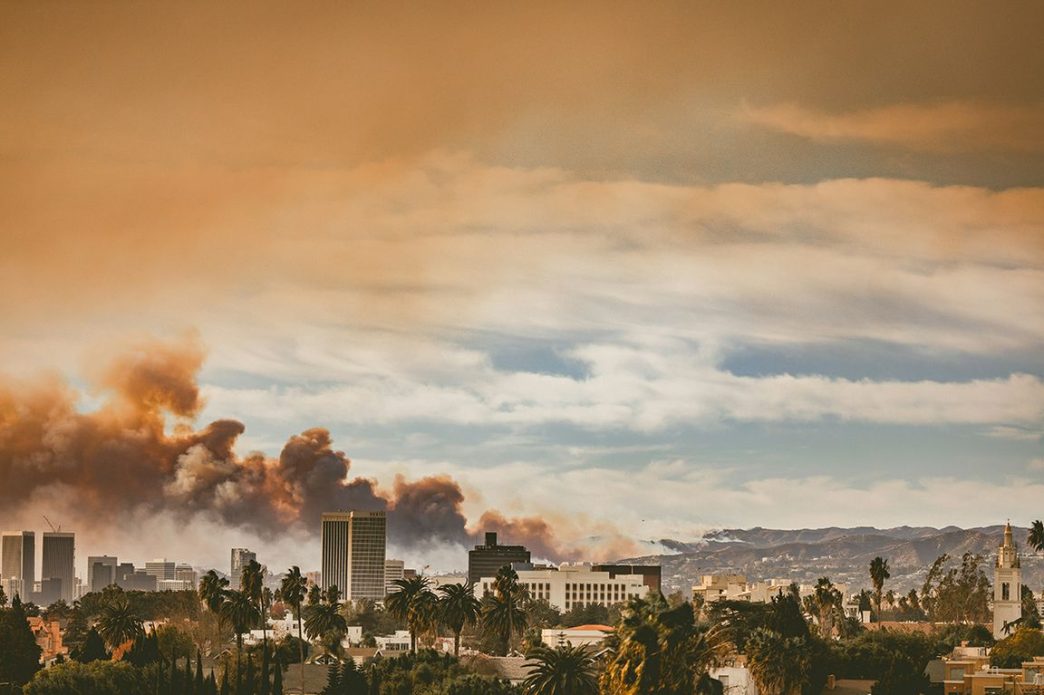
Toxic pollution soared through communities downwind of the Eaton Fire last year — including lead levels up to 250 times higher than normal — but pollution returned to background levels less than a week after the fire was extinguished, according to a recent UCLA study.
Researchers found highly elevated levels of arsenic, chlorine, bromine and copper during active burning, but no evidence that toxic smoke or heavy metals lingered in the air, with pollution levels remaining normal for months afterward.
“As wildland-urban interface fires like what the LA region experienced in January 2025 become more frequent, this study helps us better understand the immediate risks posed by smoke from these kinds of fires to surrounding communities,” Suzanne Paulson, a UCLA professor of atmospheric and oceanic sciences and one of the study’s authors, said in a statement Thursday. “Still, there’s more work to be done to better understand the dynamics of how burning in urban environments versus wildlands affects the makeup of the pollutants in the smoke these fires produce.”
Researchers analyzed air-quality data from monitoring locations at UCLA and the South Coast Air Quality Management District’s Huntington Park station, about 17 miles south-southwest of where the fire started in Altadena’s Eaton Canyon. They combined the data with satellite fire tracking and wind models to differentiate fire smoke from everyday urban emissions.
“In January 2025, the Eaton and Palisades fires burned over 18,000 structures and 15,000 hectares of urban and wildlands and blanketed parts of Southern California … in smoke and dust,” according to the study. “Here, we combine hourly and multihour metals, particulate matter, and gas data from two sites with meteorological and fire spatial extent data and several statistical methods to understand the fire impacts on air quality.”
The researchers said they could not clearly determine whether the contaminants originated from burning wilderness areas or urban structures.
“Elements like lead, arsenic, zinc, bromine and chlorine are expected to be higher in smoke from urban fires, but we found that they persisted even when the fires shifted away from the urban areas and into the wildlands,” UCLA doctoral student and study co-author Catherine Banach said in a statement.
Banach said potassium, which is an indicator of burning vegetation, did not correlate with higher smoke levels but rather with dust particles stirred up by winds.
“This drives home the complexity of these kinds of fires and the need for a better understanding of the area’s soils before using these indicators to assume the sources of their emissions,” she said.
Soil testing after the fire in neighborhoods downwind of the blaze showed toxins remained after the removal of contaminated turf and fire debris.
A survey in November of about 50 homes by Eaton Fire Residents United, a group of Altadena residents affected by January’s blaze, found 50% received access to asbestos testing and 90% had lead testing. About 36% of the homes tested positive for asbestos after the U.S. EPA and Army Corps of Engineers removed extensive amounts of contaminated soil and fire debris. Forty-five of the homes, about 96%, tested positive for lead post-remediation.
The laboratory analysis indicates thousands of homes in Altadena are unsafe for residents to return to, according to residents’ findings.
The Los Angeles County Department of Public Health last year also reported that levels of lead were above health screening thresholds in the soil at properties downwind from the Eaton blaze.
“The source of lead in the fire is reasonably expected to be from the burning of homes with lead-based paint, which was common prior to 1979,” according to the department. “Caltech reported that more than 90% of the houses in Altadena were built before 1975.”
Children, the elderly, pregnant women and adults who have existing health conditions are especially vulnerable to the toxicity of lead and other heavy metals.
Burned lithium-ion batteries, electronics, household appliances and other items release toxic substances into the environment.
Public Health provides more information on post-fire health concerns on the agency’s website.
The Eaton Fire devastated areas of Altadena, Pasadena and Sierra Madre in the foothills of the San Gabriel Mountains in the county’s northeast area. The wildfire, sparked by Southern California Edison electrical equipment during an extreme windstorm, claimed 19 lives, scorched over 14,000 acres and destroyed or damaged nearly 10,500 structures.
The financial cost of the damage is estimated in the tens of billions of dollars. Aon, a global professional services and consulting firm, estimated the cost of the fire at $25 billion.