

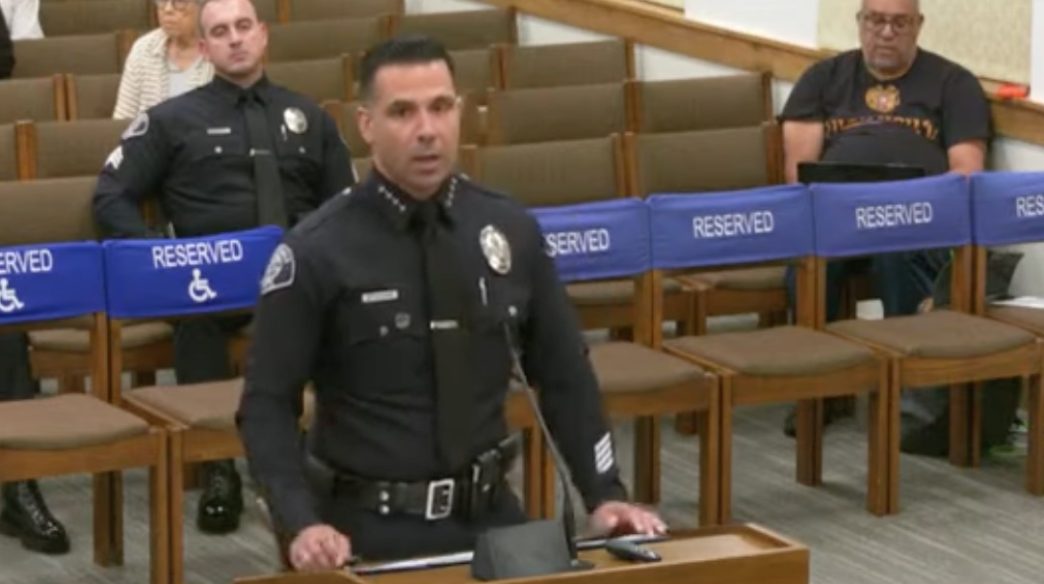
Glendale Chief of Police Robert William defended the city’s Flock Safety license plate camera network at the City Council meeting Tuesday, while multiple residents pressed the council to cancel the Flock contract or at least halt plans for 40 additional cameras.
William told the council his department operates 82 cameras that generate about 1.2 million reads per month, the city has been a Flock customer since 2020 and Glendale police have used automated license plate readers for about 20 years.
He framed the technology as a narrow investigative tool, not a surveillance system.
“It takes a picture of a license plate. It takes the date, the time and the location of where that picture was taken,” William said.
“It’s a small piece of the puzzle, it’s not the entire puzzle,” the chief added. “When we get these reads, when we get a picture of a license plate, that picture doesn’t tell us who that vehicle is registered to, where it’s registered to. It doesn’t give us any other information.
“The personal privacy information that is associated with a license plate is an entirely system different system outside of Flock under the California law enforcement telecommunication system,” William said.
His presentation came as more than a dozen speakers in person and by phone urged the council to pull back. Several cited reporting that other California agencies had shared license plate data with out-of-state and immigration-related agencies, and one speaker pointed to Mountain View’s accidental sharing with federal agencies as a cautionary example.
Officials said the department shares data with more than 300 other agencies and audits its system every two weeks, with no instances of misuse found to date. He added that Senate Bill 34, the 2016 state law governing automated license plate readers, prohibits sharing data with federal or out-of-state agencies, and that the vendors such as Flock are bound by the same restriction.
Council members did not take a vote on the cameras, instead reaching consensus to direct staff to return with answers and options on data sharing, retention periods, auditing and contract terms.
Councilman Alek Bartrosouf said he wanted tighter controls on which agencies receive Glendale’s data and how long it is retained.
“I don’t think that we should be expanding the program right now,” Bartrosouf said. “We need to really take a look at what this looks like and how it fits in our community, and I think there’s something to be said about having the community informed about what’s going on. We just haven’t had that discussion up until now. … We have a lot of work to do to kind of finalize where we’re going to be at with the use of Flock by GPD.”
William acknowledged the concerns while defending the tool’s value, citing a recent fatal hit-and-run in which the cameras helped identify a suspect within about two hours. He said detectives rely on the system as a first step in serious investigations, and that removing it would set the department back technologically.
Council members signaled they would revisit the issue after Glendale Police Department staff returns with a more detailed report on safeguards and data-sharing protocols.
The AI platform Civilio assisted this report.