



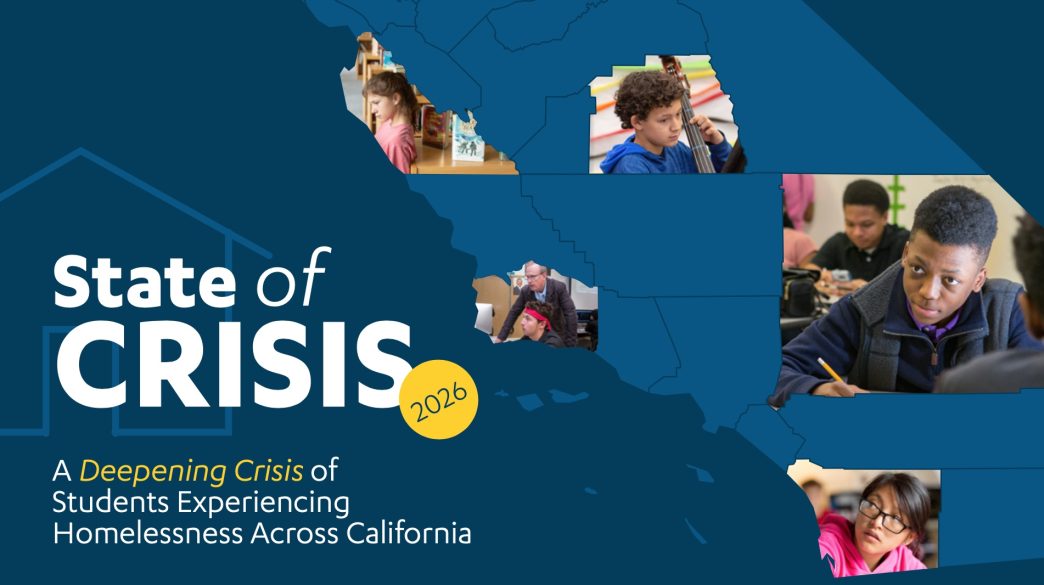
Students in California experiencing homelessness increased 10% since the 2018-19 school year to a record 298,254 in 2024-25, UCLA researchers reported Wednesday.
Southern California is home to seven of the 10 school districts with the highest numbers of students experiencing homelessness, according to a report titled “State of Crisis 2026: A Deepening Crisis of Students Experiencing Homelessness Across California” by researchers from the UCLA Center for the Transformation of Schools.
The report analyzed data from the California Department of Education for the 2017-18 through 2024-25 school years. Researchers looked at homeless student enrollment along with suspension, chronic absenteeism, academic achievement, graduation and college-going data.
Black and American Indian/Alaska Native students consistently had the highest and fastest-growing rates of homelessness, according to the report. In 2024-25, about 1 in 12 Black students and American Indian/Alaska Native students in the state experienced homelessness.
Researchers noted that racial disparities in student homelessness have persisted and widened over time.
Of the 10 school districts with the highest number of homeless students, seven were in Southern California. Northern California and the Central Coast accounted for the majority of the 10 counties that posted the highest rates of unhoused students.
Central Coast elementary school districts also accounted for have of the 10 districts with the highest rates of students experiencing homelessness, according to researchers.
Students experiencing homelessness continued to trail their housed peers in all educational outcomes that the report analyzed, including chronic absenteeism, suspension rates, academic proficiency, graduation and rates of college-enrollment.
“These numbers are particularly concerning given the extensive evidence documenting the harmful effects of housing instability on children’s development, health and educational outcomes,” Grace Kim, a research analyst at the UCLA Center for the Transformation of Schools and lead author of the report, said in a statement. “The report makes clear that student homelessness is not only a housing issue, but a complex educational and developmental crisis requiring sustained, coordinated public action.”
Researchers pointed out that California’s 2026-27 budget has a one-time $116 million budget allocation aimed at identifying K-12 students experiencing homelessness and supporting their success in school.
“This new funding is the largest dedicated state funding to prioritize housing-insecure youth in the country,” Joseph Bishop, executive director of the Center for the Transformation of Schools and an author of the report, said in a statement. “We look forward to working with our state’s policymakers and educators to ensure that California’s most housing-insecure students have an equitable opportunity to succeed. Our hope is that this new research can serve as a roadmap for prevention and systems change.”
The report is available on the UCLA Center for the Transformation of Schools website.
Nearly 11,000 homeless young adults and more than 61,000 unhoused K-12 students are estimated in Los Angeles County based on data from the Los Angeles Homeless Services Authority and UCLA CTS.
Between 2022 and 2024, LA County schools reported a 30% jump in student homelessness, UCLA researchers reported. Latino students accounted for 3 out of every 4 students experiencing homelessness, with high levels of student homelessness in eastern LA County and the San Gabriel Valley.
Nearly 12% of students experiencing homelessness in LA County in 2023-24 were Black, according to UCLA’s research. That number is marginally higher than the average statewide but substantially lower than the national proportion of Black students experiencing homelessness — 25% — recorded in during the 2022-23 school year.
The UCLA report on LA County student homelessness is also online.