

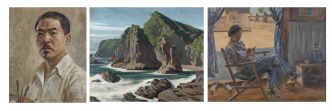
UC Irvine Langson Orange County Museum of Art presents “Tokio Ueyama: The Hollows Between Mountains,” the first major museum exhibition in California dedicated to the work of Japanese American artist Tokio Ueyama. The exhibition will be on view from Sept. 26 to Feb. 28.
Featuring newly conserved and never previously exhibited paintings alongside archival materials, “Tokio Ueyama: The Hollows Between Mountains” positions the artist within the artistic, intellectual, and political networks that shaped California, Japan, and the broader Pacific world during the first half of the 20th century. Ueyama’s work is shown alongside paintings by the California Impressionists with whom he regularly exhibited throughout his lifetime, re-creating a key context in which he operated. A two-year collaboration with UC Irvine’s East Asian Studies Department and a Tokyo-based translator has produced the first English-language translations of Ueyama’s personal papers and the critical reception he received in the Japanese press of Little Tokyo, Los Angeles, and Japan.
Born in Japan in 1889, Ueyama immigrated to the United States in 1908 to study art at the San Francisco Institute of Art and the Pennsylvania Academy of the Fine Arts. He settled in Los Angeles’s Little Tokyo, where he became a respected member of Southern California’s plein air movement. His luminous landscapes and technically accomplished portraits and still lifes were regularly exhibited alongside California’s leading Impressionist and Post-Impressionist artists such as William Wendt, Guy Rose, and Alson Skinner Clark. Yet Ueyama was also associated with experimental modernists, including Edward Weston, Diego Rivera, and Paul Landacre, among others.
Rising anti-Japanese discrimination and, ultimately, the wartime incarceration of Japanese immigrants and Japanese Americans profoundly shaped Ueyama’s life and career, delaying recognition of his artistic contributions.
“At UC Irvine Langson Orange County Museum of Art, we are committed to advancing new scholarship on California art and expanding the histories through which it is understood,” said Kathryn Kanjo, executive director. “’Tokio Ueyama: The Hollows Between Mountains’ sheds light on the experiences of Japanese immigrants whose contributions have until now remained outside dominant narratives of American art. It also reveals how California Impressionism and plein air painting was connected to other parts of the world as distant as Japan, demonstrating that California’s global cultural reach is not a uniquely contemporary phenomenon.”
“Tokio Ueyama: The Hollows Between Mountains” explores how Ueyama’s work operated between nations, artistic traditions, and momentous historical events, offering a window into the hopes and challenges of the Japanese immigrant experience in California. The exhibition showcases Ueyama’s personal art collection, tracing his artistic and political milieu, which extended well beyond the boundaries of Little Tokyo. Highlighting the cross-pollination between art and poetry within Little Tokyo’s art scene, the exhibition presents the newly translated free-form haikus of Boshicho Okamura, Ueyama’s lifelong friend and collaborator. Its subtitle, “The Hollows Between Mountains,” draws from Okamura’s verses reflecting on the liminal position of the Japanese diaspora, in between nations.
The exhibition is organized by Michaëla Mohrmann, assistant curator at UC Irvine Langson Museum. “Ueyama was a cosmopolitan artist whose Post-Impressionist works participated in several transpacific discourses about aesthetics, politics, and race that the exhibition illuminates for the first time,” she noted. “The multivalence and cross-cultural references of Ueyama’s work give us a nuanced understanding of the Japanese immigrant experience in the United States—an experience defined by the discrepancy between the Japanese diaspora’s dreams of belonging and its marginalization during the interwar period.”
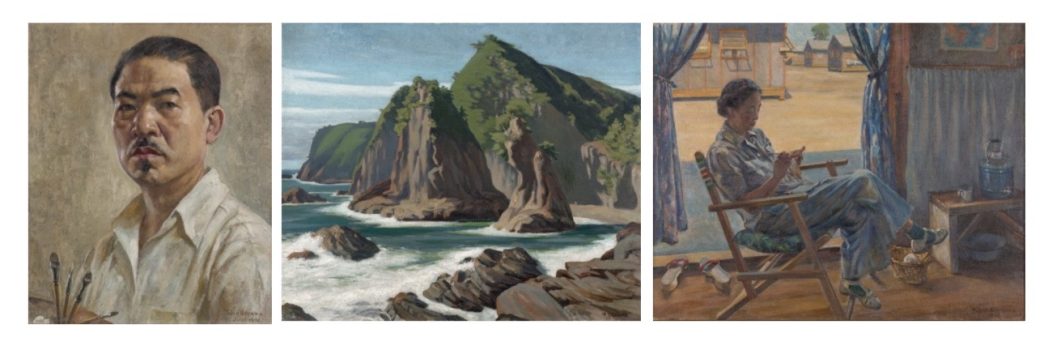
Focusing on the three genres that defined Ueyama’s practice—landscape, still life, and portraiture—the exhibition demonstrates how his academic training informed his aesthetics while revealing how these works also reflect the dreams and challenges of the Japanese immigrant community. The show situates Ueyama’s paintings within California Impressionism for the first time, juxtaposing them with works by plein air painters from the museum’s collection. It highlights how Ueyama’s critical reception was overdetermined by a reductive “East versus West” binary that the artist’s work resisted.
With poet Okamura, Ueyama cofounded Shaku-do-sha, a progressive collective of Japanese immigrant artists and writers. The group supported emerging artists in Little Tokyo and beyond, expanding the horizons of the neighborhood’s cultural scene while defying the era’s de facto segregation. Ueyama’s openness to modern art is shown through works by artists he knew or supported, including Edward Weston, Paul Landacre, and Henrietta Shore.
The exhibition also considers the impact of Ueyama’s international travel. On a trip to Mexico in 1925, Ueyama met such avant-garde figures as Diego Rivera, José Clemente Orozco, and Miguel Covarrubias. He was introduced to Mexican muralism and its revolutionary politics, which cemented his own communist beliefs. A 1936 visit to Japan exposed him to the transformations within yōga—Japan’s tradition of Western-style oil painting—which had become intertwined with the nation’s imperial and colonial ambitions. These experiences complicate conventional readings of Ueyama as solely a California Impressionist, revealing an artist whose work moved between multiple artistic traditions and audiences.
The exhibition concludes with works produced during Ueyama’s incarceration at the Granada Relocation Center (Amache) in Colorado following the forced removal of Japanese immigrants and Japanese Americans during World War II. Despite the conditions of confinement, Ueyama continued to paint the surrounding landscape and organized art classes with fellow artist Koichi Nomiyama, underscoring the persistence of artistic practice and community under extraordinary circumstances.
Through new research and previously unexplored archival materials, “Tokio Ueyama: The Hollows Between Mountains” positions Ueyama as a central figure in the transpacific history of California art and offers a new perspective on the cultural exchanges that shaped modern art in the state.