

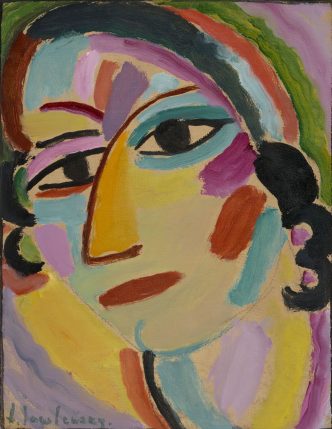
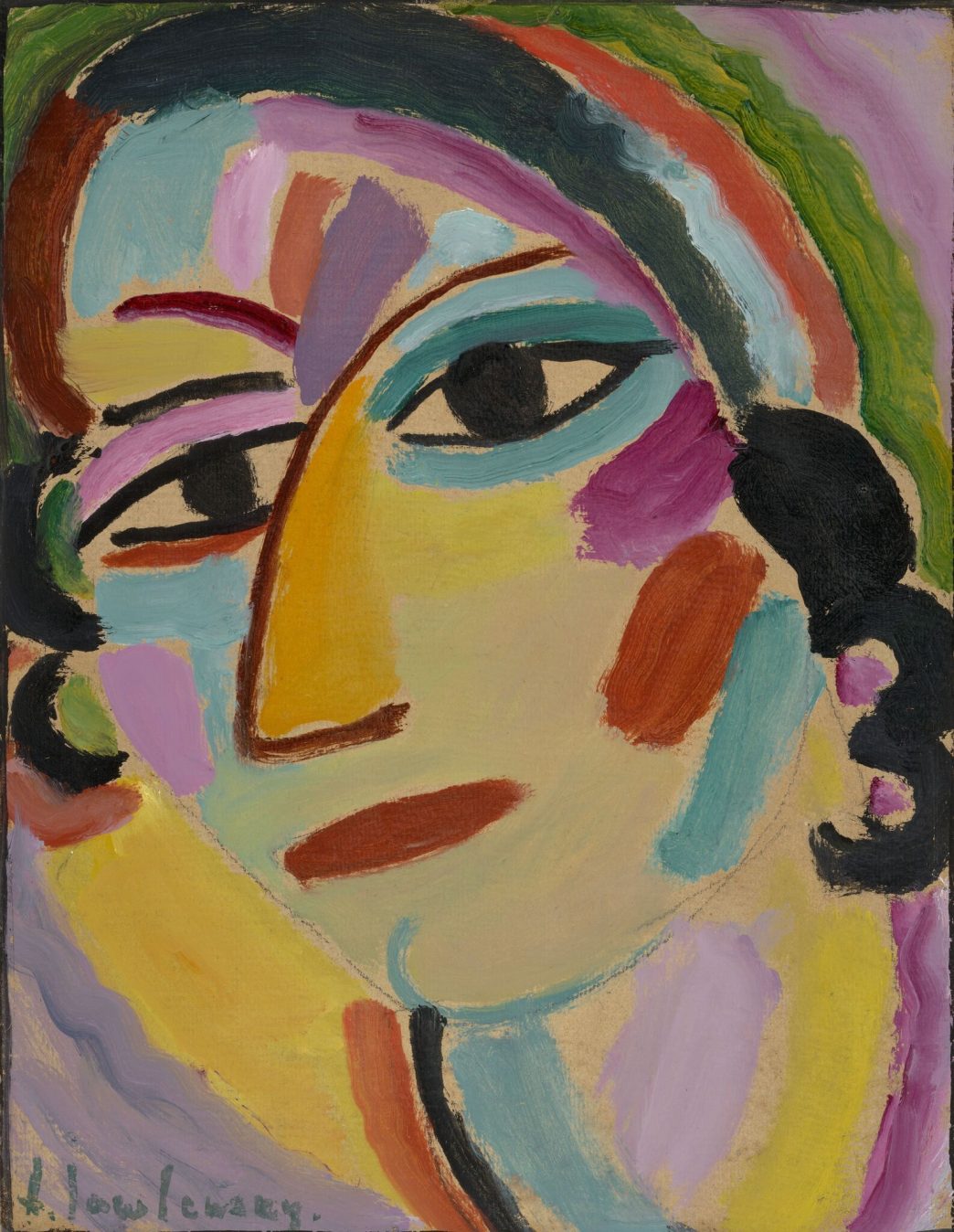
An intimate exhibition at the Norton Simon Museum, called “Dear Little Friend: Impressions of Galka Scheyer,” focuses on the art dealer and promoter’s close relationship with the artists she represented.
On view from Feb. 20 through July 20, it features works of art gifted to her by Alexei Jawlensky, Maynard Dixon, Peter Krasnow and Beatrice Wood, among others; the show is curated by Gloria Williams Sander.
Culled from Scheyer’s archive, the exhibition offers a close look at the significant role the German-born collector played in bringing European modernism to the United States and promoting the so-called “Blue Four” — Lyonel Feininger, Alexei Jawlensky, Paul Klee, and Vassily Kandinsky.
The title “Dear Little Friend” comes from the affectionate salutation Feininger adopted in his letters to Scheyer and captures the personal connection and collaborative spirit that defined her activities in Europe and California. Alongside the artwork are correspondence and ephemera that testify to her dedication to art and to her artists, as well as the excitement she generated in pursuing her mission.
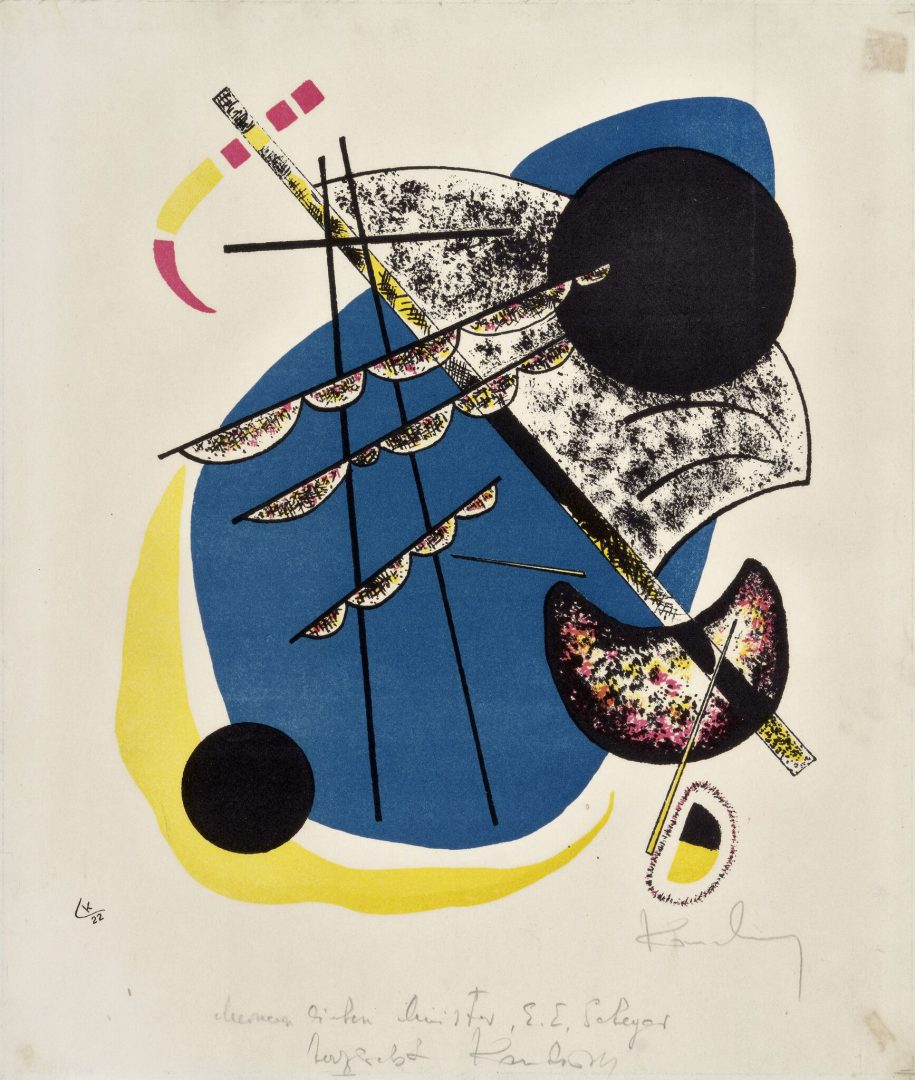
In her lifetime Scheyer accumulated more than 450 works of art, according to Sander. All of the Blue Four’s work belonged to her and some were on consignment from the artists; what remained unsold at her death were returned to the artists or their estate. Composed of paintings and works on paper of various sizes and media — including illustrated letters — they could not be displayed simultaneously and would have been stored for rotation in exhibits and salons.
Scheyer bequeathed her collection to UCLA with the proviso that the university meet the same conditions of a 1944 gift of her friend Walter Arensberg’s modern art collection. Arensberg’s donation required UCLA to provide a building for his collection within five years; additionally, Scheyer stipulated that the university must publish a modest catalogue of her collection. When UCLA failed to meet the conditions, the fate of the Scheyer collection was left to a committee.
In 1953, the committee entrusted Scheyer’s collection of 450 works by the Blue Four and other modern artists (plus a cache of 800 documents) to the Pasadena Art Institute, which evolved into the Pasadena Art Museum and moved to a new building on Colorado Boulevard. The late Norton Simon took over the facility in 1974 and fulfilled the Scheyer trust’s provisions by publishing a catalogue of the collection.
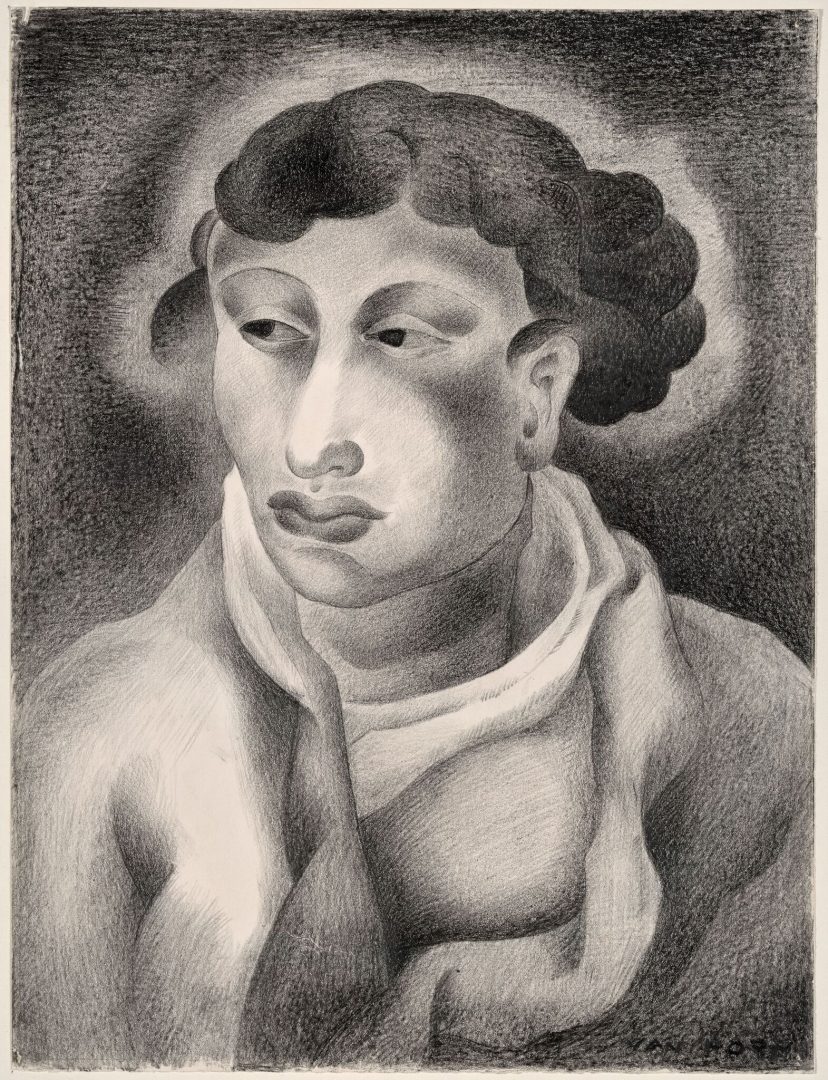
Born Emilie Esther in Braunschweig, Germany, in 1889 to a middle class Jewish family, Scheyer studied art and music. She had dreamed of becoming an artist but in 1915, after seeing the paintings of Alexei Jawlensky at an art exhibition in Switzerland, decided to be an art promoter instead. Thus, her career as an art dealer was born. She organized shows for him in Munich, Berlin, and various cities around Germany to drive interest in his work. Jawlensky gave her the moniker “Galka,” the Russian word for jackdaw — a gregarious, intelligent crow.
“It was Jawlensky who introduced her to Paul Klee, Vassily Kandinsky, and Lyonel Feininger, all of whom were on the faculty of the Bauhaus in Germany — a forward-looking university of art design and architecture,” explains Sander during a walkthrough of the exhibition. “They all became friends. This was in the 1920s when times were tough in Germany politically and economically. Artists were having trouble showing and selling their work so Galka decided to go to the United States to promote them.”
“They banded together and took on the name ‘The Blue Four,’” Sander says further. “They all had different artistic styles, but they wanted to give her a sort of rubric to help her organize exhibitions. ‘Blue’ has a long-standing importance for modernism in Europe and the United States; it’s considered to be a spiritual color.”
However, when Scheyer arrived in the U.S. she realized getting a foothold in the modern art world was a challenge. It was through a combination of fate and opportunities that she came to California and held her first show called “The Blue Four” at Stanford University in October of 1925. It was such a phenomenal success that the San Francisco Examiner proclaimed her the “Prophetess of the Blue Four.”
“The reaction — not only to the works that she was showing, but also to her charismatic delivery and lecturing — was immense,” states Sander. “In March of the following year, Roi Partridge, who was the chairman of the art department at Mills College, wrote to let her know how much he enjoyed her show and lecture and invited her to come to Mills. And Scheyer was able to augment her income through speaker fees.”
Scheyer promoted herself and the Blue Four using marketing brochures printed with the Blue Four logo of four blue stripes and contained endorsements and her skills as a lecturer and art dealer.
“Galka was one of the most amazing art impresarios in the United States in the early 20th century,” Sander pronounces. “She was a single woman in a profession as an art dealer inhabited by men, which was an unusual task she set for herself. The Galka Scheyer archive is a testament of her activism in the United States on behalf of four European artists whom she represented from the 1920s to the 1940s in trying to seed a taste for European Modernism and Abstraction. It was new art that was not conventional in California at that time, when it was very conservative and the prevailing art style was still in the Impressionism and post-Impressionism. Artists came here to paint the beautiful landscape.”
“It was a real blessing for modern artists when Galka came to California,” continues Sander. “One of the first artists she met when she arrived in 1925 was Maynard Dixon. Most people would think of him as the artist who painted landscapes of the western United States and its native peoples. He had a modernist outlook in his flat spaces and cool colors. He loved Galka’s lectures and her style and introduced her to his wife, Dorothea Lange, who did those memorable photographs of people in desolate lands and plains during the Depression. It was Dorothea who took the photograph that Galka used for her brochure. Dorothea was a good friend of modernist photographer Imogen Cunningham, who was married to Roi Partridge and who was also a printmaker.”
In a matter of months Scheyer found herself in an intellectual, creative community in the Bay area. It provided the foothold she needed in promoting the art of the Blue Four. Dixon and Scheyer maintained a friendship after she moved to Los Angeles. One of the paintings in the show is Maynard’s stylized drawing of Galka on which he inscribed, “To Mme Moderne Kunst” which means “To Mrs. Modern Art.”
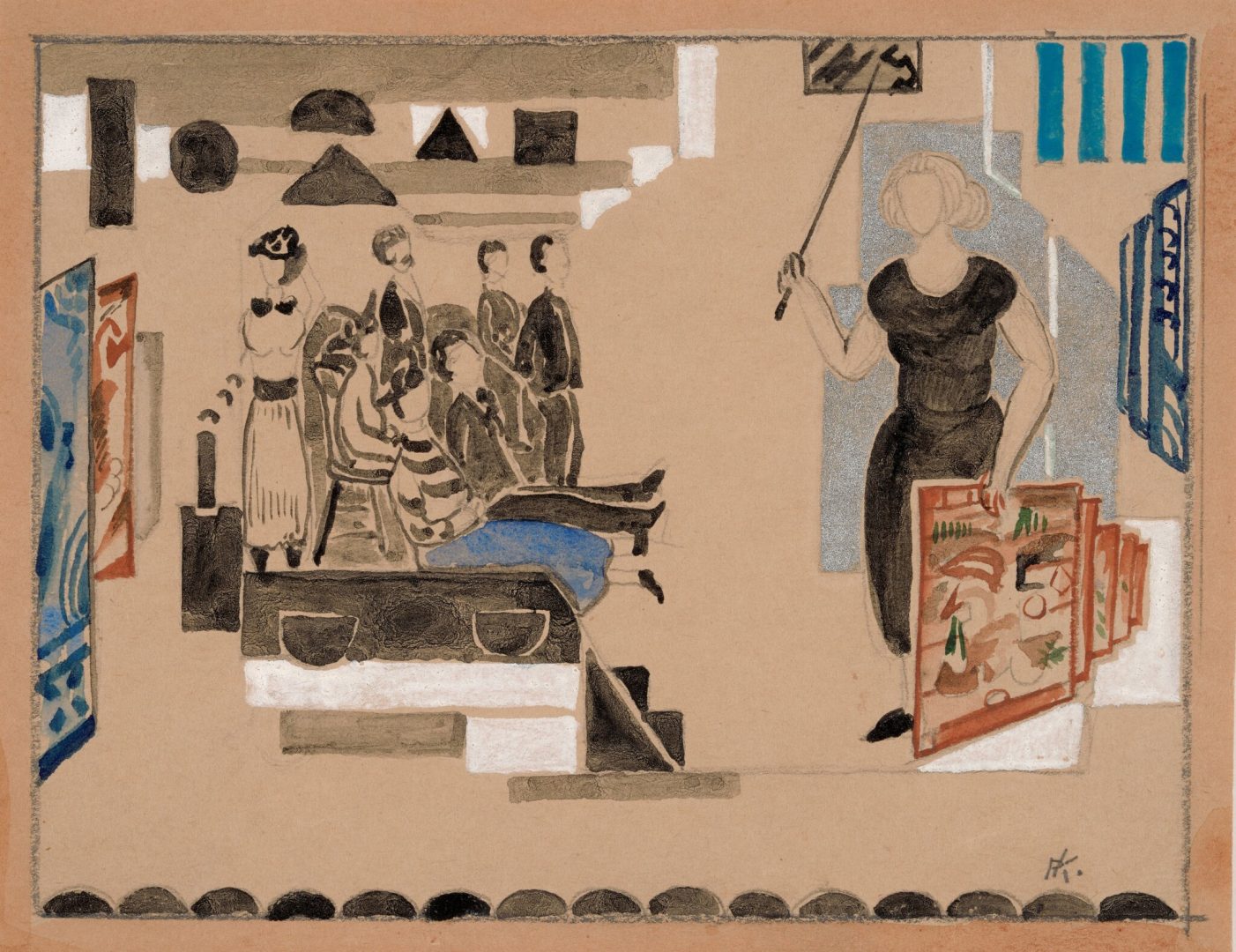
“This is one of the most iconic images from the collection that shows Galka,” Sander explains as she points to another artwork. “It’s by an artist named Peter Krasnow, who’s Ukrainian-born but came to the United States in 1907. He attended the University of Chicago but he really wanted to come to the West Coast. His painting shows Galka at what many people would recognize at that time if they knew her. She has a pointer in her hand and teaching a rapt audience. The scene is a combination of realism and fantasy, and he named it ‘Recalling Happy Memories.’”
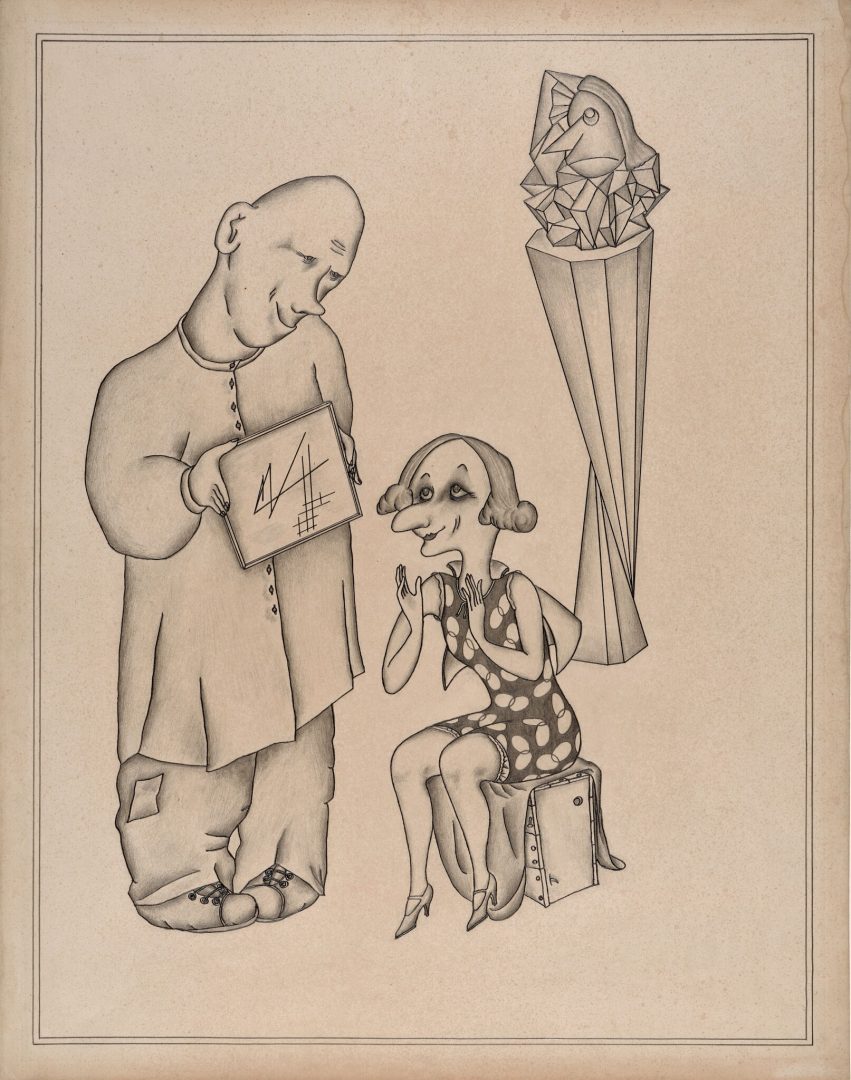
Another artwork in the exhibition is from Edward Hagedorn. “He was a self-taught artist from Berkeley,” explains Sander about the next painting. “Hagedorn was practicing a style that wasn’t getting much traction for him despite shows he held in artist associations and print clubs. But when he saw the Blue Four material at the Oakland Gallery show that Galka held in 1926, he was amazed. He saw an avenue for himself to move forward. They became friends and he did this beautiful drawing of Galka sitting on a wood chest and behind her is a pedestal. She’s thrilled to be looking at an artwork — on which there’s a number 4 — that a gentle giant is showing her. You can see the affection that is communicated in their glances.”
The film industry was taking off in Los Angeles in the 1920s when Scheyer met Josef von Sternberg, a renowned Hollywood director. He asked her to show him some of the pieces she was selling and he bought $600 worth of artwork. That confirmed that LA was the place for her and she made plans to move. The sale, which was massive at that time, enabled her to purchase a parcel of land and she asked the modernist architect Richard Neutra to build her home in the Hollywood Hills.
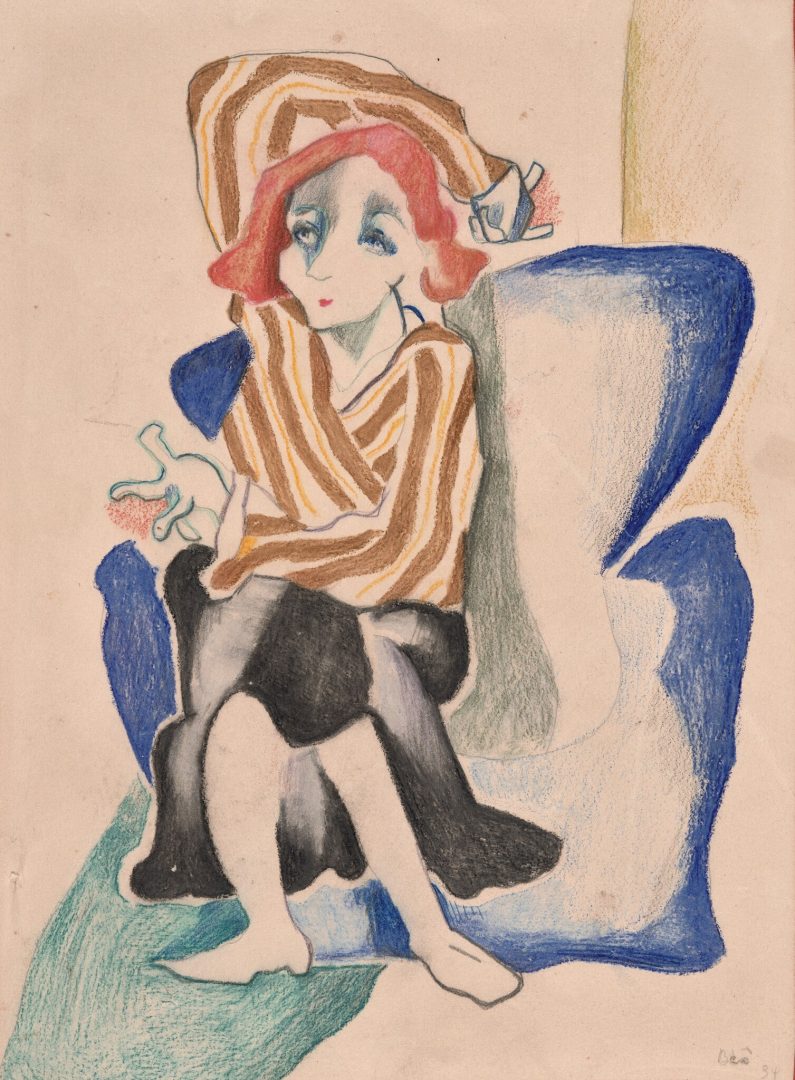
“In 1927 Galka met Beatrice Wood, a renowned ceramicist in Los Angeles, who was a friend of Walter and Louise Arensberg, who had a home in LA and lived in New York,” Sander relates. “They were the first collectors of modern art in the United States and had salons that Beatrice and Galka would frequent. Wood created a piece that showed Galka holding court.”
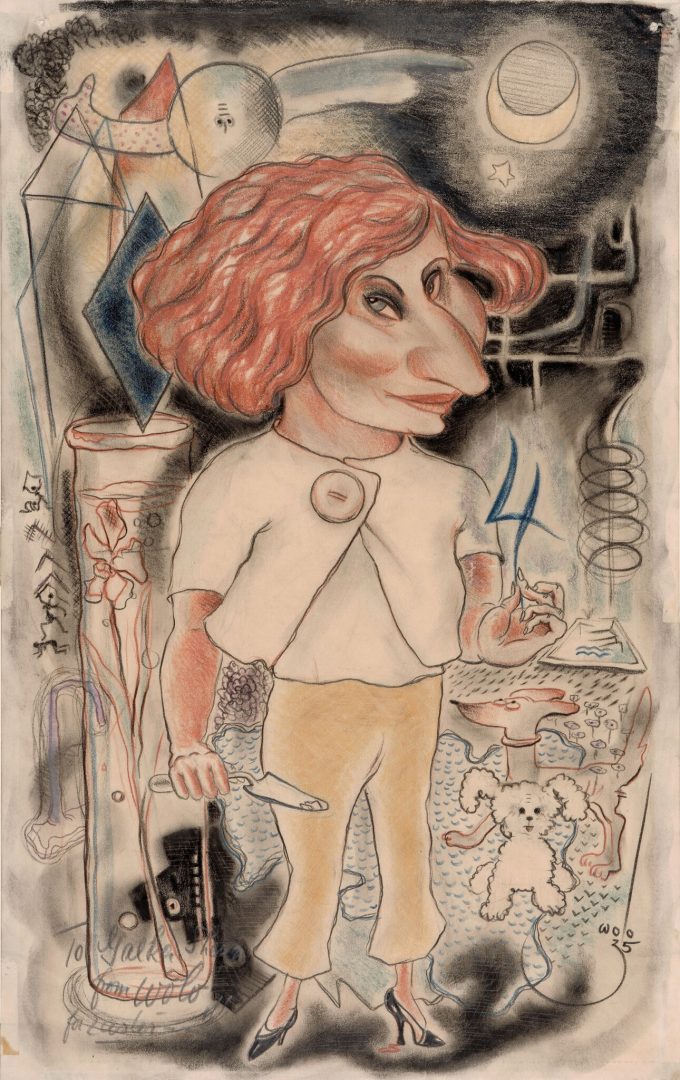
One artwork in the exhibition is from Trutzschler. “Swiss caricaturist Wolo Trutzschler came to the United States, and went to Chicago for a bit,” informs Sander. “He made money doing caricatures of people at cabaret and selling the art to newspapers. He decided to come to LA in the late 1920s and lived on Olvera Street and was part of the German émigré community. He met Galka and created a piece depicting her in her milieu — she’s holding a number 4 and a trowel in her other hand because she loved to garden. Next to her is her poodle, whom she called Blue-Blue.”
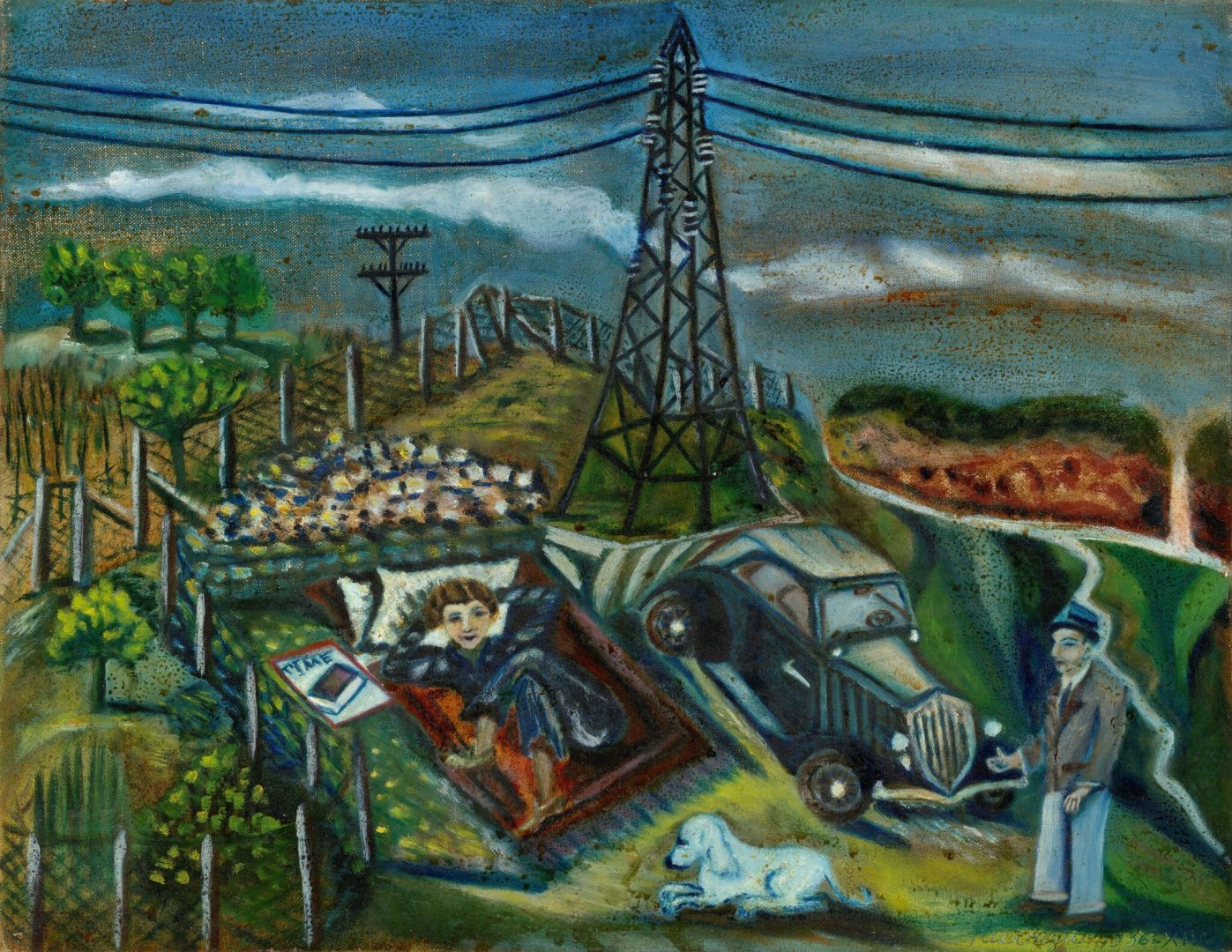
That Scheyer made numerous connections is evident in the exhibition’s displays. “Galka met Angelo Ravagli who married Frieda Lawrence, the former wife of D. H. Lawrence,” says Sander. “The Ravaglis lived in New Mexico but they started coming more frequently to Los Angeles in the 1930s. Through Galka, they made the acquaintance of a rare book dealer in LA who became the exclusive publisher of the manuscripts of D.H. Lawrence in the United States. As a thank you gift to Galka, Ravagli made a drawing showing her lying on a rug on a hill where her house would have been, with her poodle by her side.”
Scheyer mounted more than 60 exhibitions from 1925 to 1944, including one-man shows (i.e. Feininger or Klee). They include traveling exhibits around California and the U.S. held at museums, galleries, and university art galleries. Additionally, she hosted salons at her home that had art displays and lent artwork to the salons and parties of other clients. The artworks she loaned to Marlene Dietrich in March 1929 (a list of which is included in the exhibition case), is an example of one such informal installation.
The last part of the exhibition shows Scheyer’s house. “I wanted to bring people’s attention to her house because it’s inseparable from her work — and her spirit in many ways,” explains Sander. “Galka worked with Neutra to build a house that’s open to nature but with plenty of wall space. She had moveable screens on which to hang works of art for special shows and every room in her home displayed the art of the Blue Four. She had salons where people discussed art. She was the first resident at the top of the hill and was able to get permission from the city to name the street Blue Heights Drive. And the number she took for the house was 1818 because eight is divisible by four.”
“Galka lived there until her death in 1945,” Sander states. “It was sold in 2024 to a German art collector and business man and it will be the home of the newly established Blue Heights Art & Culture whose mission focuses on fostering contemporary artistic creation and hosting curated exhibitions within this historically significant, modernist space.”
Sander hopes viewers of the exhibition take away that “Galka Scheyer served as a powerful catalyst for the West Coast art scene, bridging the gap between bold new trends and a growing audience. Her work was driven by kinship, not just commerce. The portraits, artworks, and letters on display are more than artifacts; they are tokens of gratitude from a community that responded to her vision with enduring friendship.”
Over eight decades after Scheyer’s death, she will continue to be a source of inspiration for artists who will take part in the Blue Heights Art & Culture’s residencies. Through exhibitions like “Dear Little Friend: Impressions of Galka Scheyer” and “Maven of Modernism: Galka Scheyer in California” before it, the Norton Simon Museum is ensuring that her legacy as an ardent lover of art lives on.