

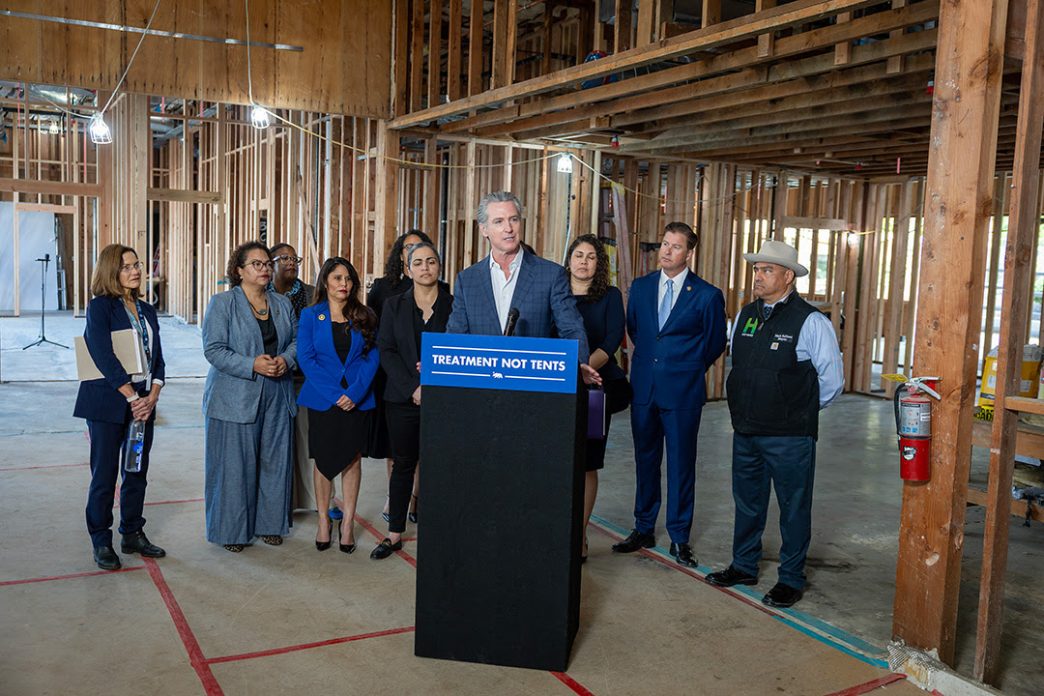
State officials on Monday announced ramped up efforts and more funding to help the most populous counties implement legislation that expands supportive housing and behavioral health services for mentally ill Californians experiencing unsheltered homelessness.
Touting the first statewide drop in unsheltered homelessness in more than 15 years — a 9% decline — Gov. Gavin Newsom also noted new accountability measures to speed up the adoption of CARE Court and awarded $291 million to expand supportive housing and behavioral health services.
The Community Assistance, Recovery, and Empowerment Act is intended to accelerate housing and treatment expansion under voter-approved Proposition 1. Supporters of the legislation say it aims to move mentally ill people out of the criminal justice system, off the streets and into treatment and supportive housing.
State funding for the initiative also comes from the Homeless Housing, Assistance and Prevention, or HHAP program.
Newsom designated 10 counties that are leading the state in successful implementation and identified another 10 — including Los Angeles, Orange, Riverside and San Bernardino counties — that are not effectively implementing CARE Act services to help get chronically mentally ill people off the streets and into supportive housing facilities.
“Care and accountability go hand in hand — full stop. Through CARE Court, we have seen inspirational stories of recovery and resilience, but many counties continue to lag behind their peers,” Newsom said in a statement. “Local leaders have a moral and legal obligation to deliver this transformational tool for those who need it most. We will not accept failure and excuses when lives are on the line.”
The CARE Act took effect in 2023 and is a first-in-the-nation approach to empower individuals with untreated or undertreated schizophrenia and other psychotic disorders to receive the treatment and housing needed to recover and thrive, officials said. Navigating the mental health system and maintaining a consistent treatment plan is difficult for many people suffering from mental health disorders.
The CARE Act enables mentally ill people to connect with a team of support providers, under the guidance of a civil court judge, to ensure those who need voluntary treatment do not have to go through the process alone. Officials said that while CARE Court is overseen by a civil court judge, it is not punitive, but instead structured to optimize chances for the CARE participant’s success. The A petition submitted by the individual, a family member, first responder or mental health professional starts the process for process for receiving assistance from the program.
Eight counties, including Los Angeles, Orange and Riverside, initiated programs in 2023, and all 58 counties in the state started programs by December 2024.
Since then, over 3,800 CARE Act petitions have been submitted to courts, according to Newsom’s office. Counties have reported more than 4,000 CARE diversions, which are cases involving individuals considered for CARE who have connected with services without needing to engage the court. More than 1,851 people have continued through the CARE Court process.
“The CARE Act reflects California’s belief that compassion and accountability must go hand in hand,” California Health and Human Services Agency Secretary Kim Johnson said in a statement. “It offers people living with severe mental illness a real path to treatment and stability, while making clear that every county has a responsibility to deliver. When CARE is implemented effectively, lives change, and we are committed to ensuring that promise is realized statewide.”
The governor designated 10 counties as “CARE Champions”:
- Humboldt
- Tuolumne
- Marin
- Napa
- Merced
- Sutter
- Alameda
- Santa Barbara
- San Mateo
- Imperial
These counties have successfully implemented the CARE Court and have the highest rates of petitions on a per capita basis for the 12 months of 2025, the first full year in which all 58 counties were required to participate in the legislation’s requirements, according to Newsom.
Newsom also identified 10 underperforming counties slated to get additional support through the state’s CARE Improvement and Coordination Unit.
- Santa Clara
- San Bernardino
- Orange
- Los Angeles
- Kern
- Riverside
- Yolo
- Monterey
- Fresno
- San Francisco
Referring to “decades of neglect” dating back to Gov. Ronald Reagan’s administration closing state hospitals with “no adequate alternative provided, leaving people most in need of help to fall into the criminal justice system or homelessness,” Newsom’s office noted the “generational impact.” Individuals with untreated psychosis are 10 times more likely to experience homelessness and 16 times more likely to be incarcerated, officials reported.
Residents can track how their community is addressing mental health, homelessness and housing issues online at accountability.ca.gov. The website also contains new information about CARE Act implementation by county.
Alameda County’s CARE program led by Judge Sandra Bean serves as an example of proactively implementing the CARE Act, according to the governor’s office.
Judge Bean provided a recent update on a CARE Court participant and the wraparound services provided to her.
“Since she’s been in CARE court, there has been a dramatic turnaround, and she’s just really doing well, and it was so nice to hear her talk about how much she trusted and cared about her caseworker, and she felt really that her needs were met,” Bean said in a statement. “And frankly, the one turnaround point, I think, for her was getting housing, and that individual was helping her get her Social Security, so she could have income, and they were applying for low-income housing, and so just having someone really advocate for her that she perceived as being as part of the court system just really, really changed this person’s life.”
The CARE Act combines with other efforts to improve California’s behavioral health system. Proposition 1, advanced by Newsom and approved by voters in 2024, aims to help local communities provide vital care and housing for those with mental health disorders or need substance use treatment. Prop 1 provides a $6.4 billion Behavioral Health Bond for housing, services and treatment for veterans and people experiencing homelessness. Proposition 1 funding also goes to the Homekey+ program, providing $2.25 billion to serve individuals with mental health or substance use challenges and veterans.
Officials estimate funding from Proposition 1 bonds will create 6,800 residential treatment beds and 26,700 outpatient treatment slots for behavioral health through the California Department of Health Services.
Newsom also announced Monday $131.8 million in Homekey+ awards for eight affordable housing communities to create 443 additional homes with on-site managers for Californians, including veterans, experiencing or at risk of homelessness and living with behavioral health challenges. The projects are located in the cities of Stockton and Santa Fe Springs and Los Angeles, Contra Costa, Tehama and Yuba counties.
“Homekey+ and Proposition 1 programs continue to expand the availability of affordable homes and vital supportive services for Veterans and Californians who are experiencing homelessness and living with behavioral health challenges,” Business, Consumer Services and Housing Agency Secretary Tomiquia Moss said in a statement. “The supportive housing projects being awarded today will greatly improve lives and ensure that they have a home where they can thrive.”
CalVet Secretary Lindsey Sin said in a statement, “These new Homekey+ projects are helping turn the promise we make to our veterans into something tangible: a place to heal, rebuild, and belong. This work reflects California’s deep commitment to those who served, and the strength of our partnerships in delivering real solutions. … Every new Homekey+ project brings us closer to a future where every veteran has the stability, dignity, and support they deserve.”
Also announced Monday, $159 million in HHAP Round 6 funding is going to 20 regions in the state, adding to the $419 million granted earlier this year to the Los Angeles, San Diego and San Francisco regions. A total of $578.9 million was awarded over the last year as part of HHAP Round 6, and another $181 million is expected to be awarded in the coming weeks.
HHAP grants come with requirements that municipalities have a compliant housing element and mechanisms to withhold funding from local governments that fail to demonstrate progress, officials said.
HHAP Round 7 totaling $500 million is set for fiscal year 2026-27, contingent on further enhanced accountability and performance requirements.
“HHAP Round 7 will build accountability metrics further to ensure grantees make meaningful investments in housing solutions and adopt housing policies that will increase downstream housing supply, a critical tool in preventing future homelessness,” according to the governor’s office.