

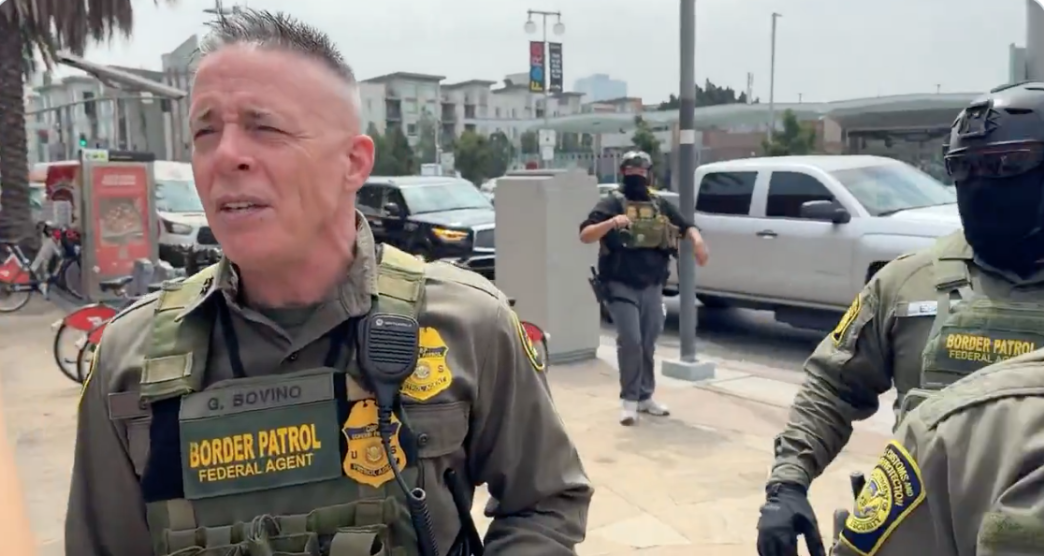
The U.S. Supreme Court on Monday gave a go-ahead to federal agents’ “roving patrols” in the Los Angeles area targeting people suspected of breaking federal immigration laws.
The nation’s highest court voted 6-3 to grant the Trump administration’s emergency appeal to overturn an LA federal judge’s ruling in July. The lower court ordered immigration enforcement agents to cease stopping and detaining suspects based on criteria such as being present at businesses known to hire workers who are immigrants, languages spoken and skin color, race or ethnicity.
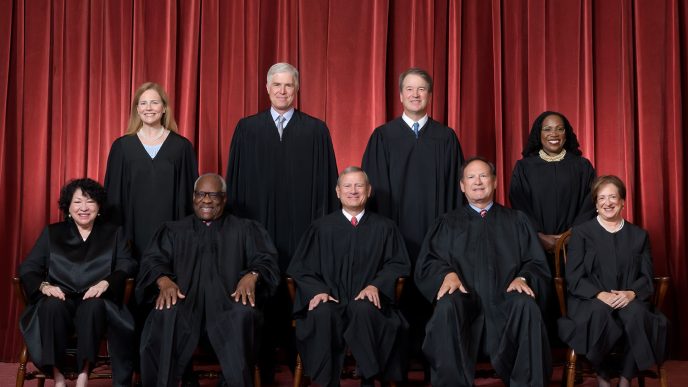
Justice Brett M. Kavanaugh voted with the majority and cited federal law in his majority opinion: “immigration officers ‘may briefly detain’ an individual ‘for questioning’ if they have ‘a reasonable suspicion, based on specific articulable facts, that the person being questioned … is an alien illegally in the United States.’”
Kavanaugh wrote that “apparent ethnicity alone cannot furnish reasonable suspicion” but it can be have relevance when combined with other factors.
“Immigration stops based on reasonable suspicion of illegal presence have been an important component of U.S. immigration enforcement for decades, across several presidential administrations,” according to Kavanaugh.
U.S. District Judge Maame E. Frimpong issued a temporary restraining order July 11 barring immigration enforcement actions based on race or ethnicity, language, location or employment. A San Francisco panel of the U.S. 9th Circuit Court of Appeals upheld the district court’s order.
Kavanaugh, who President Donald Trump nominated to the Supreme Court in 2018, is among the six justices appointed by Republican presidents.
The court’s three liberal justices cast the dissenting votes.
Justice Sonia Sotomayor wrote that the Trump administration “has all but declared that all Latinos, U.S. citizens or not, who work low-wage jobs are fair game to be seized at any time, taken away from work, and held until they provide proof of their legal status to the agents’ satisfaction.”
Sotomayor’s dissenting opinion also took aim at some of Kavanaugh’s points.
“Immigration agents are not conducting ‘brief stops for questioning. … They are seizing people using firearms, physical violence, and warehouse detentions,” Sotomayor wrote. “Nor are undocumented immigrants the only ones harmed by the Government’s conduct. United States citizens are also being seized, taken from their jobs, and prevented from working to support themselves and their families.”
The U.S. Justice Department’s appeal argued that the injunction “threatens to upend immigration officials’ ability to enforce the immigration laws in the Central District of California by hanging the prospect of contempt over every investigative stop of suspected illegal aliens.”
Solicitor Gen. D. John Sauer wrote in his appeal, “Reasonable suspicion is a low bar — well below probable cause.” Agents can take into consideration “the totality of the circumstances,” including that “illegal presence is widespread in the Central District (of California), where 1 in every 10 people is an illegal alien.”
Mohammad Tajsar, senior staff attorney at the ACLU Foundation of Southern California, was critical of the ruling and the administration’s effort to overturn the LA judge’s order prohibiting roving patrols.
“When masked, armed immigration agents abducted people off the streets of Southern California simply because they appear to be Latino or low- wage workers, the entire nation saw how the federal government’s reckless and cruel raids frayed the fabric of one of America’s most vibrant and diverse regions,” Tajsar said in a statement. “The federal government has now gone running to the Supreme Court asking it to undo a narrow court order — applicable in only one judicial district — that merely compels them to follow the Constitution. We look forward to making our case to the Supreme Court that the federal government cannot deprive individuals of their liberty without justification, regardless of their immigration status.”
The raids targeting car washes, garment factories, Home Depot stores and other places where day laborers gather disrupted immigrant communities in Southern California for weeks starting June 6 through July.
The Supreme Court decision Monday stems from a lawsuit filed July 2 in which Southern California residents, workers and advocacy groups accused the U.S. Department of Homeland Security of “abducting and disappearing” community members via illegal stop and warrantless arrest tactics, then detaining individuals at a federal facility in unlawful conditions in addition to denying detainees access to legal counsel.
Day laborer and lead plaintiff Pedro Vasquez Perdomo, 54, of Pasadena, has said he was waiting to be picked up for a construction job at a Metro bus stop in Pasadena on the morning of June 18 when he and two others were surrounded by armed men wearing masks, arrested and taken to a facility in Los Angeles. He was detained there for three weeks before being granted bond and released.
The men who arrested Vasquez Perdomo allegedly never identified themselves, never told plaintiffs they were immigration officers, never stated that they had arrest warrants and never informed the plaintiffs of the basis for their arrests, according to the lawsuit.
Frimpong’s order had applied in an area that included the counties of Los Angeles Orange, Riverside, San Bernardino, Ventura, Santa Barbara and San Luis Obispo.
The case is in early phases. A hearing on a preliminary injunction is scheduled for this month.
Trump has vowed to conduct the largest mass-deportation campaign in U.S. history. Administration officials assert that the roundups focus on people suspected of violent crimes.
“On day one, I will launch the largest deportation program of criminals in the history of America,” then-President-elect Trump said last November.
U.S. Department of Homeland Security Secretary Kristi Noem on Aug. 26 said Border Patrol and Immigration and Customs Enforcement agents have made 5,000 arrests in the LA area since June.