

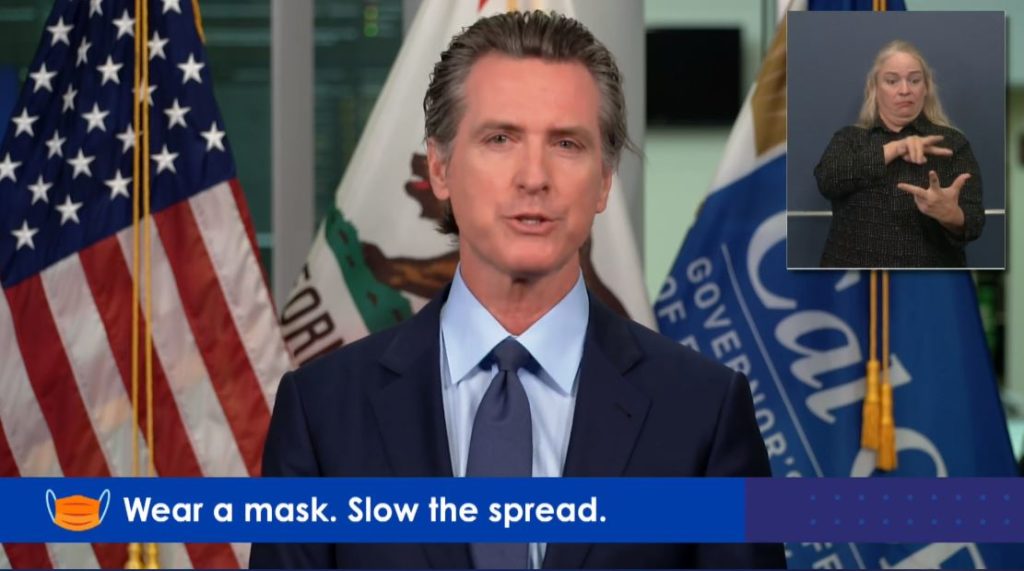
Responding to significant increases in positive test results, hospitalizations and ICU admissions, Governor Gavin Newsom announced Monday further mandates to mitigate the spread of COVID-19.
The State has immediately expanded closures previously only required for counties on the state’s monitoring list to the entire state. Effective Monday, all counties must close indoor operations in these sectors:
- Dine-in restaurants.
- Wineries and tasting rooms.
- Movie theaters.
- Family entertainment centers (for example: bowling alleys, miniature golf, batting cages and arcades).
- Zoos and museums.
- Cardrooms.
Additionally, bars, brewpubs, breweries, and pubs must close all operations both indoor and outdoor statewide, unless they are offering sit-down, outdoor dine-in meals. Alcohol can only be sold in the same transaction as a meal.
“This virus is not going away anytime soon,” he said. “I hope all of us recognize that if we are still connected to some notion that somehow when it gets warm, it’s going to go away, or somehow it’s going to take summer months or weekends off, this virus has done neither. It’s incumbent on all of us to recognize, soberly, that COVID-19 is not going away anytime soon until there is a vaccine and/or an effective therapy.”
Counties that have remained on the County Monitoring List for three consecutive days — including Los Angeles, Riverside, San Bernardino and Orange counties — will be required to shut down the following industries or activities unless they can be modified to operate outside or by pick-up.
- Fitness centers.
- Worship services.
- Protests.
- Offices for non-essential sectors.
- Personal care services, like nail salons, body waxing and tattoo parlors.
- Hair salons and barbershops.
- Malls.
The following counties have remained on the County Monitoring List for 3 consecutive days:
- Colusa.
- Contra Costa.
- Fresno.
- Glenn.
- Imperial.
- Kings.
- Los Angeles.
- Madera.
- Marin.
- Merced.
- Monterey.
- Napa.
- Orange.
- Placer.
- Riverside.
- Sacramento.
- San Benito.
- San Bernardino.
- San Diego.
- San Joaquin.
- Santa Barbara.
- Solano.
- Sonoma.
- Stanislaus.
- Sutter.
- Tulare.
- Yolo.
- Yuba.
- Ventura.
Imperial County is open to the essential workforce only (Stage One). Alameda and Santa Clara County do not have an attestation and can only open industries open statewide.
Newsom noted that while the increase in testing has led to growth in positive cases, the positivity rate has recently trended down. However, new positive cases are averaging 8,211 a day and hospitalizations have jumped 27.8% and ICU admissions have risen 19.9% over the past 14 days.
“Until we have a vaccine or effective therapy, we have no choice but to continue taking steps to mitigate the spread of the virus,” said Newsom. “Californians must adapt to new behaviors if we are to slow the spread.”