


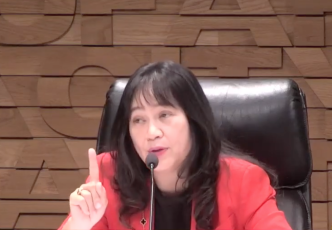
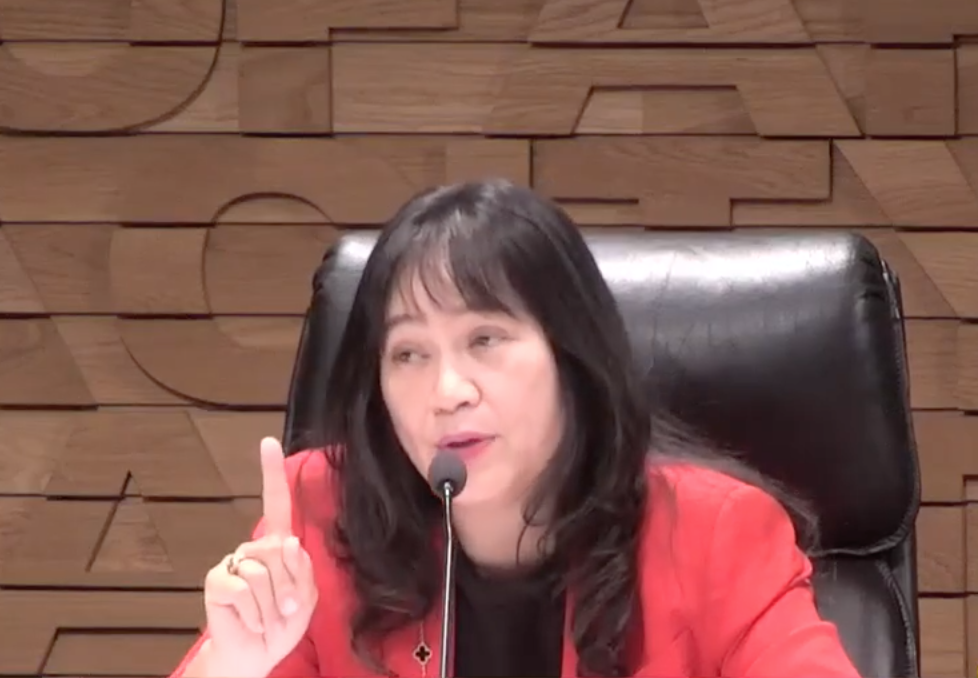
The Arcadia City Council questioned Councilwoman Sharon Kwan about her unpaid board role with a Texas oil company partially owned by Chinese investors, a discussion that ended with no formal action but laid bare the political fault lines running through the city ahead of the November election.
Kwan, who requested the public hearing herself, told the council she receives no compensation for the position.
“I do not receive any compensations for being a board member, of this Texas oil company. I do not receive shares. I do not receive a payroll. I do not receive consulting fees. I receive nothing. Zero. Not even a penny,” she said. She described the company as 50% owned by Chinese investors and 50% by American investors, and argued there was no conflict of interest because the firm does not do business in Arcadia.
In September an infographic circulating online reported Kwan has seats on the boards of directors of “U.S. subsidiaries of a major Chinese energy company,” Shandong Xinchao Energy Corp.
According to the digital flyer that Mayor Pro Tem David Fu said he “received online” of unknown origin, Kwan was appointed in July to the boards of five U.S. subsidiaries of Shandong Xinchao. Two months prior, Inner Mongolia Yitai Coal Co. acquired controlling interest in Shandong Xinchao, leading to a board shake-up and eventual lawsuits in Delaware and Nevada.
In May, Arcadia Mayor Eileen resigned after she was convicted of secretly participating in a Chinese intelligence operation that disseminated propaganda in the U.S. and groomed candidates to run for elected positions in local governments.
Recent campaign materials have shown connections between Arcadia council members Michael Cao and Paul Cheng and a West Covina-based Chinese-language media mogul who is a registered agent of the People’s Republic of China. Su was a campaign donor and producer of election materials for Cheng and Cao, respectively.
Su, CEO of EDI Media whose home and office were raided in late July, also donated $500 to Wang’s 2022 campaign.
At the hearing Tuesday evening, Fu pressed Kwan on whether she had provided any documents supporting her claims of no ties to Chinese state-controlled businesses, and he referenced litigation in Delaware in which she was named as a defendant.
Kwan responded by invoking her son’s top secret security clearance.
“In order for my son to have this access, he needs to get clearance,” she said, adding that the CIA investigates family members and that “if the apple gets clearance, I can 100% assure you that the tree is also getting clearance”.
Councilman John Han presented slides tracing the corporate ownership chain, showing that Yutai, based in Inner Mongolia, owns 50.1% of Xingtao Energy in Beijing, and citing provisions of Chinese company and energy law that require Communist Party organizations within companies and government supervision.
“The company law states very clearly, any organization of the Communist Party of China shall be set up in a company to carry out the activities of the party,” said Han, who the council appointed to Wang’s seat after her resignation.
Councilman Michael Cao questioned Kwan about her board duties, fiduciary responsibilities, terms of service, and who paid for her travel.
Kwan responded, “I feel like they want me (as a board member) because I’m bilingual … I can understand the Chinese investor culture at the same time be able to bridge the American investor with them.”
She said she serves without compensation and pays her own travel expenses to attend board meetings.
Mayor Paul P. Cheng closed the discussion.
“I will not follow you,” he told Kwan. “I will not be part of a company that needs to be beholden to the Chinese government. I I think it’s wrong. I’m disappointed that you would say that and that you would spend forty five minutes to brag about it. With that being said, I think we’ve all heard enough, and I think we can just move on.”
He added that he was disappointed Kwan spent 45 minutes on the matter.
The energy company discussion followed a public comment period dominated by election-year allegations that council members had ties to the Chinese Communist Party, accusations Cheng and Cao both rejected by citing their military service. Cheng, who said he was born in Taiwan and serves as a JAG officer in the state guard, called the claims racially insulting.
“I think that the reason why people are using this is because non-Asians cannot tell Asian people apart, and that is very insulting,” Cheng said. “I’ve said that that’s very ignorant, and I don’t appreciate that.”
In a separate item near the end of the meeting, Kwan asked to place a future agenda item discussing what she described as a “$500,000 donation” from Taiwan to the Arcadia Fire Department via the firefighters union.
“Is there any specific requirement for them to pass through the money to the fire department?” Kwan asked.
City Manager Dominic Lazzaretto said the funds were donated to a third party not controlled by the city, and City Attorney Michael J. Maurer said the donation was not a proper basis for council discussion, and no future item was approved.
“At the last (council) meeting, the city manager explained that they do have limitations as a nonprofit as to what they can use their funds for, but it’s not an arm of the city, it’s not a city board, it’s not appropriate for this discussion.”
The AI platform Civilio assisted this report.