



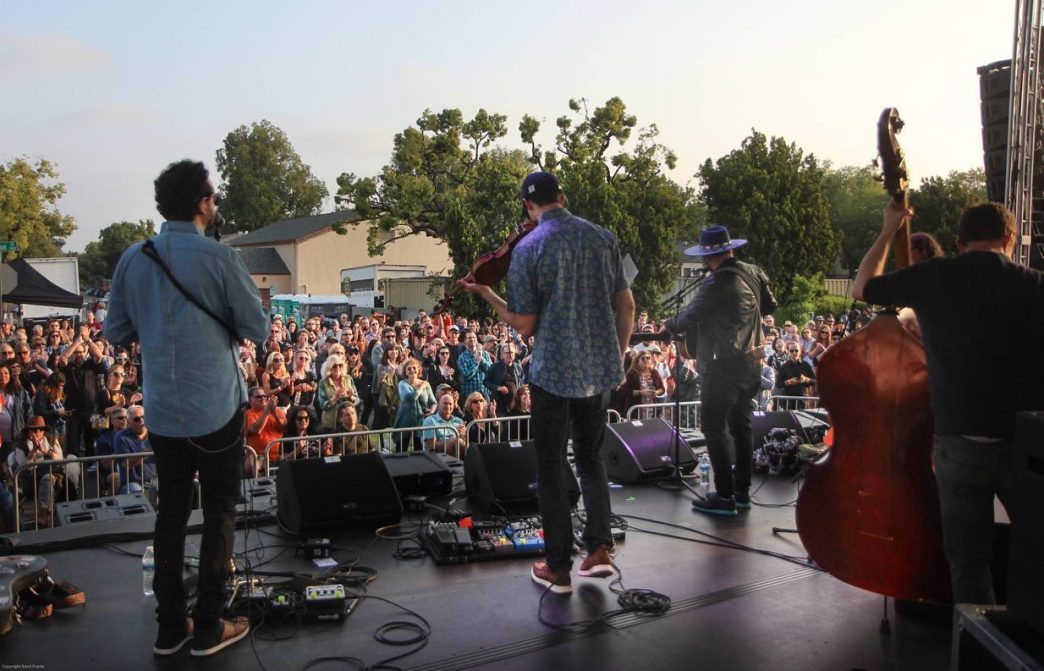
South Pasadena is moving toward replacing its decades-old, subjective noise rules with measurable decibel limits, after the City Council spent more than an hour last week debating how loud is too loud in a city where a considerable number of homes sit near parks and live-music venues.
The council took no vote, instead directing staff to return with a first-reading ordinance after further analysis of transitional zones where commercial and residential properties meet. Senior Planner Steven Peterson framed the Sept. 22 update as a shift from rules that rely on “a sensitivity of a reasonable person being disturbed by the noise” to objective standards that can be enforced consistently.
The proposed framework divides the city into noise zones and sets daytime limits from 7 a.m. to 10 p.m., with quieter nighttime standards. City staff members conducted 27 field measurements around town and found that 70% exceeded limits first proposed in May — ranging from 50 to 80 decibels in various property zones — prompting them to raise the thresholds by 5 to 10 decibels, Peterson reported. Under the revised numbers, about 18% of measurements still exceeded the standard, which he said “sounds more appropriate.”
Peterson reported readings of about 50 decibels in a residential area on Monterey Road, 64 decibels at the dog park and 73 decibels outside a busy Irish pub on Mission Street. Noise was measured at a 10-minute average, he confirmed.
Staff also “reviewed the noise ordinances adopted by our neighboring cities of San Gabriel, Pasadena, Alhambra and San Marino to evaluate how South Pasadena’s recommended new standards compare,” Peterson said. “Direct comparison is difficult because the other jurisdictions generally use different regulatory approaches, measurement locations and enforcement criteria. But of the jurisdictions we reviewed, San Marino’s ordinance is most comparable to South Pasadena’s proposed ordinance. … We found that San Marino’s standards are very similar to what we are proposing.”
The council debate centered on whether raising limits to accommodate daytime activity would unfairly extend loud levels into the evening.
Mayor Sheila Rossi questioned whether a reading at the Arroyo dog park justified raising limits across all of Zone 2, noting that open space “down in the Arroyo” is different from parks “in the middle of a neighborhood.”
“Are we increasing the, noise levels in Garfield Park and Via Del Rey to accommodate the dog park instead of saying that that maybe what’s in the arroyo can tolerate a higher sound?” Rossi said.
Councilman Jon Primuth raised the concern of whether “a child’s birthday party in the daytime would violate the city’s noise ordinance.”
“If the birthday party is louder than a band performing in a bar and the measurements taken closer than maybe 30 or 40 feet from the interior where the band is performing, then it would potentially violate it,” Lead Code Enforcement Officer Andrew Rodriguez responded. “But under normal circumstances, I don’t believe it would.”
Residents pressed the council on quality-of-life impacts. One speaker described a “4 ton air mover” that has made his home in the 300 block of Monterey Road “unlivable” for six months, with constant vibration that registers at 47 to 49 decibels, a relatively low reading.
Another speaker said noise from a nearby venue with “incessant drumming” that continues until 11 or 12 at night could be exempt from proposed decibel limits. A third urged the council not to raise proposed allowable limits, arguing that violations “will only increase and get worse.”
City Manager Todd Hileman said the goal is not to ticket residents over one-off events such as birthday parties, but to give staff objective guidelines for following up on persistent complaints. He said enforcement focus is on “perpetual.. complaints that that continue to come through in a more consistent manner, where residents’ quality of life is being impacted, and we need some objective way to prove our case.
“We’re trying to put a little bit more science behind this, but there’s always going to be the art of people working with each other, too,” Hileman added. “I don’t think we can write an ordinance that tightens that down too much.”
Staff is also drafting standard procedures emphasizing courtesy notices and voluntary compliance before any “punitive” citation.
The AI platform Civilio assisted this report.