

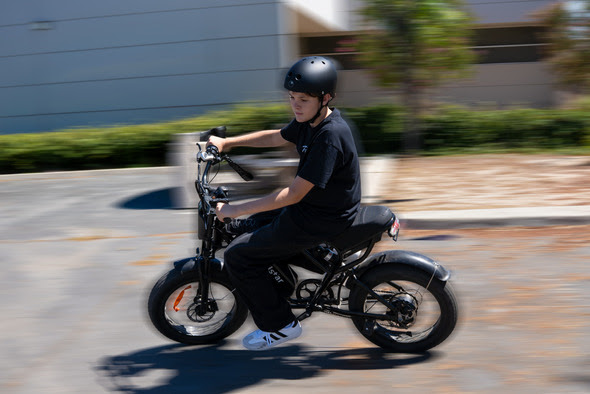
With school out and summer in full swing, people of all ages are enjoying the outdoors on e-bikes, but a significant increase in injured youths has prompted the Riverside University Health System to urge riders to follow safety guidelines.
Some of the hundreds of injuries related to riding electric bicycles are “serious and even fatal,” according to an RUHS statement.
Data from across the county shows a spike in emergency room visits for collisions or falls involving e-bikes, from 224 in 2023 and 494 in 2024 to 958 in 2025. So far this year, at least 416 incidents have been reported in the county.
An electric bike was involved in at least one fatality in 2024 and two deaths last year, according to Riverside County Coroner’s Bureau.
“E-bikes move faster and are much more powerful than traditional bicycles, so the injuries can be much more serious,” Dr. Michael Mesisca, RUHS department chair of emergency medicine, said in a statement. “Blunt head trauma, rib fractures, collapsed lungs and lacerations are more in line with what we’re seeing in the Emergency Department, particularly among teens and young adults. Those injuries can have dire, sometimes permanent impacts.”
Riders 10 to 24 years old are most likely to be involved in accidents, according to RUHS.
Emergency department visits among 10- to 14-year-olds in the county have more than doubled, from 155 in 2024 to 339 in 2025, officials reported. The number of emergency visits by 15- to 24-year-olds during the same period have also more than doubled, increasing from 122 ER visits to 248.
Officials said e-bike incidents likely are being undercounted as hospital workers try to accurately record injuries amid the rapid emergence of various types and speeds of motorized bicycles.
“Unfortunately, too many youngsters riding around our communities on e-bikes are making dangerous choices by driving too fast, not wearing a properly fitted helmet or not following the rules of the road,” county Board of Supervisors Chairwoman Karen Spiegel said in a statement. “It’s time for all of us to slow down and commit to safety guidelines that will save lives.”
Officials suggested e-bike users follow these safety tips:
- “Wear bright-colored or reflective clothing, along with elbow and knee pads.
- “Follow traffic signals, stop signs and right-of-way rules.
- “Maintain a measured rate of speed.
- “Take part in training courses,” including online instruction.
- “Wear a certified, properly fastened helmet.”
The parents of young riders should familiarize themselves with electric bicycles and consider the protective equipment and training a child or teen needs to ride safely, Mesisca said.
Ruhealth.org has information about local training sessions and techniques for talking to kids about e-bike practices.
The RUHS “guide helps parents start important conversations about safe riding, smart choices, and how to keep everyone protected,” according to the county’s primer for talking to kids about e-bike riding.
The guide emphasizes the importance of wearing helmets, bike maintenance, how to handle unsafe situations and the importance of setting rules and talking about the responsibility to not ride recklessly.
Riders who take the suggested e-bike safety “promise to make safe choices on my e-bike/scooter so I can protect myself, my friends, and my community.”
On Aug. 15, 2022, Gov. Gavin Newsom signed Assembly Bill 1946 into law, requiring the California Highway Patrol to develop statewide safety and training programs based on evidence-based practices for users of electric bicycles.
Most e-bikes reach speeds of 20-28 mph.
A “class 3 electric bicycle,” or “speed pedal-assisted electric bicycle,” is a bike with a speedometer and motor that provides assistance only when the rider is pedaling, according to an online training program the county suggests. Motor assistance stops when the bike reaches 28 mph.
Unlike classes 1 and 2, a Class 3 operator must be 16 or older. California law requires Class 3 bike riders and passengers to wear helmets.
The law classifies an “eMoto” as a bike with a more powerful motor in excess of 750 watts and capable of speeds over 28 mph, sometimes as fast as 50 mph.
“They are designed by the manufacturer for off-highway use only, and are illegal to operate on public roadways, bikeways, bicycle paths or trails,” according to the training course. “Legally, eMotos are only allowed to operate on private property or off-highway vehicle parks.”
According to the federal Consumer Product Safety Commission, on flat riding surfaces non-electric bikes usually average 7-15 mph, and expert cyclists can reach speeds near 30 mph. Downhill bicycle speeds can exceed 50 mph.
For pedal cyclists on non-electric bicycles, ER visits due to an unintentional injury average about 1,865 visits a year countywide, according to RUHS officials citing data from the California Department of Public Health.
“Although this number is much higher than e-bike emergency visits, the number of injuries has remained consistent and is not increasing as exponentially as we are seeing with e-bikes,” RUHS spokeswoman Kerri Mabee told HeySoCal.com.
Injury types that usually require the most emergency room visits annually at medical facilities in Riverside County include falls, which average 53,265 visits a year; being struck by an object, average of 20,051 visits a year; and motor vehicle incidents, averaging 17,849 visits.
Updated July 10, 2026, 8:32 a.m.