

Weather forecasters Thursday said a powerful El Niño in the Pacific Ocean will likely bring heavy rains to Southern California this winter.
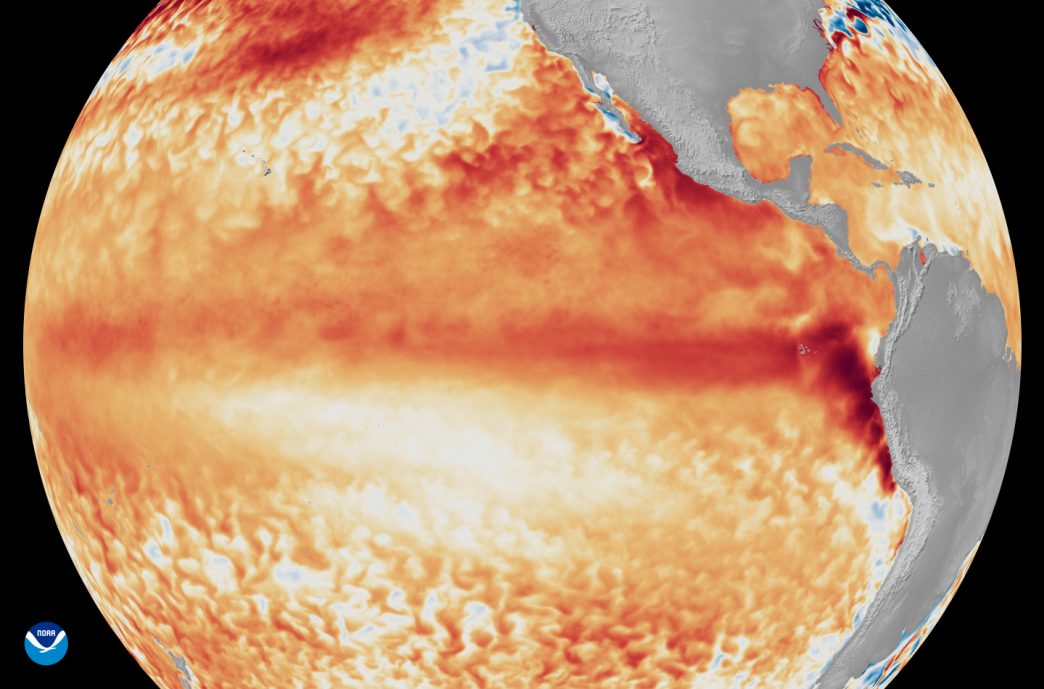
According to the National Weather Service’s Climate Prediction Center, El Niño 2026 could rank as one of the strongest in the last 75 years as above-average surface temperatures have been recorded in the central and eastern Pacific. Forecasters said conditions favorable to an El Niño year are expected to intensify in the coming months.
“There is a 63% chance of a very strong El Niño during November-January that would rank among the largest El Niño events in the historical record going back to 1950,” the NWS reported.
El Niño traditionally results in significantly more rain throughout Southern California.
“Even very strong El Niño events do not lead to the expected impact everywhere, but stronger events can more significantly tilt the odds in favor of expected outcomes,” according to the NWS. “In summary, El Niño conditions are present and expected to strengthen into the Northern Hemisphere winter 2026-27.”
Typical impacts of El Niño include stormier weather in the southern United States leading to more rain and snow and higher risk of floods during high tides on the West Coast. Harmful algae blooms that sicken sea animals are another potential impact for the West Coast.
El Niño usually causes the jet stream to make a southern shift over the northern Pacific, resulting in drier conditions in areas such as the Northern Rockies and the Ohio and Tennessee valleys. Southern regions, however, receive stormier conditions.
“Every El Niño is not the same; each one is unique with its own imprint on our weather,” NWS Director Ken Graham said in a statement. “Advanced monitoring and an improved understanding of El Niño patterns allow the NWS to better predict and better prepare the public and our core partners for what is to come.”
The National Oceanic and Atmospheric Administration declares the formation of an El Niño, Spanish for “little boy,” when temperatures in the equatorial Pacific are 32.9 degrees Fahrenheit above average for several consecutive months. The agency also monitors the atmosphere above the equatorial Pacific for a pattern called the Walker Circulation, which is a large east-to-west air flow driven by the temperature and pressure differences between the warm western and cool eastern ocean waters. Forecasters declare an El Niño when the Walker Circulation breaks down and warm water shifts eastward toward South America.