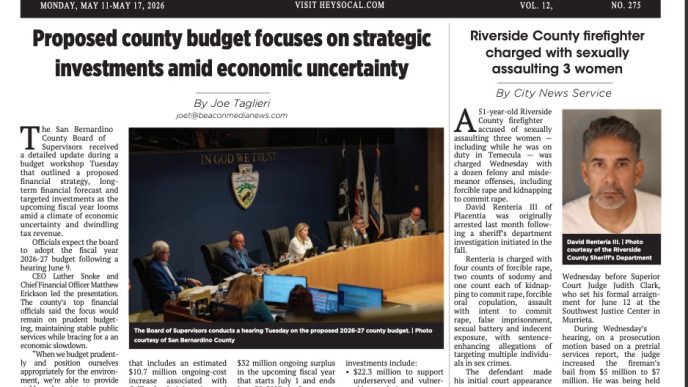


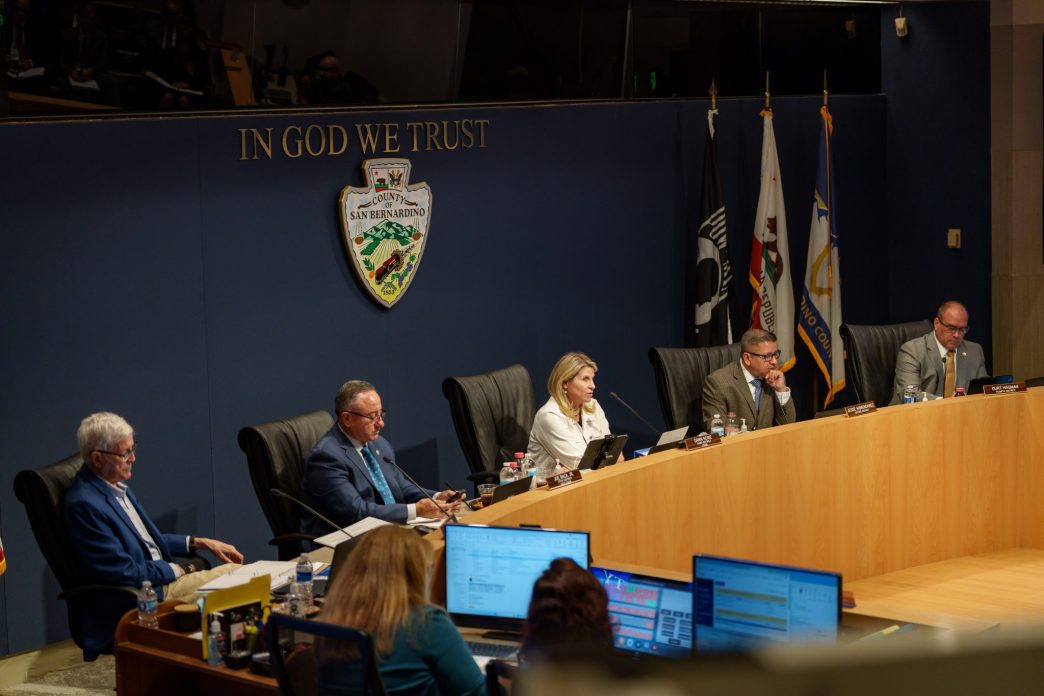
The San Bernardino County Board of Supervisors received a detailed update during a budget workshop Tuesday that outlined a proposed financial strategy, long-term financial forecast and targeted investments as the upcoming fiscal year looms amid a climate of economic uncertainty and dwindling tax revenue.
Officials expect the board to adopt the fiscal year 2026-27 budget following a hearing June 9.
CEO Luther Snoke and Chief Financial Officer Matthew Erickson led the presentation. The county’s top financial officials said the focus would remain on prudent budgeting, maintaining stable public services while bracing for a an economic slowdown.
“When we budget prudently and position ourselves appropriately for the environment, we’re able to provide stable and consistent community services,” Snoke said.
Economic headwinds
Officials noted emerging financial pressures facing local governments, including slower growth rates for assessed property value, uncertainty about the availability of federal and state grant funding, economic impacts resulting from geopolitical risks, litigation costs and increasing law enforcement liability exposure at times resulting in multimillion-dollar lawsuit payouts.
After nearly a decade of annual assessed valuation growth averaging 6.8%, officials expect significantly slower property tax growth of around 2.23% in 2026-27 — the lowest projected growth rate since 2012.
The county is also keeping close watch on the potential impacts of federal House Resolution 1, or the One Big Beautiful Bill Act that includes an estimated $10.7 million ongoing-cost increase associated with CalFresh administration and an additional $10 million set aside for future federal funding uncertainties.
Added to the federal pressures, officials continue to prepare for rising costs associated with the county’s workforce payroll and providing public services:
- “Up to $228 million ongoing projected for future labor agreements through 2030-31;
- “Up to $52.5 million ongoing for mandated human services programs, including foster care, adoptions and In-Home Supportive Services;
- “Continued set-aside of $8.7 million ongoing for potential law enforcement and detention needs tied to Proposition 36 impacts.”
Five-year forecast
Erickson presented the five-year general fund forecast. He said that while the county is projecting a $32 million ongoing surplus in the upcoming fiscal year that starts July 1 and ends June 30, 2027, the future may hold operating deficits if revenue growth continues at the current slow pace.
The five-year forecast is designed to identify potential future challenges early while maintaining flexibility to adjust spending priorities as economic conditions evolve, according to the county.
“Although we are facing some challenges going into the next several fiscal years, we’ve positioned ourselves through prudent budgeting to address those challenges,” Erickson said.
Targeted investments
Despite slower growth projections, the county is proposing about $273.7 million in targeted investments for 2026-27.
Primarily one-time expenditures, the proposed investments include:
- $22.3 million to support underserved and vulnerable populations;
- $77.2 million for county facility and operational capital improvements;
- $57.5 million for technology modernization and county system upgrades;
- $27.8 million to address public safety and community concerns;
- $43.7 million toward financial security reserves and contingency funding, which includes the law enforcement liability reserve reallocation;
- $7.9 million to support land use permitting and advanced planning services;
- $5.5 million for community improvement and infrastructure projects;
- $26.5 million for various department needs and mandates;
- $4.2 million for community services including animal care, emergency services, and the Etiwanda Preserve; and
- $1.0 million for economic development including tourism and regional airport enhancements;
The budget presentation also highlighted initiatives:
- “A proposed $5 million investment toward a reentry-focused ‘New Beginnings Campus’ near Glen Helen aimed at reducing homelessness and recidivism among formerly incarcerated individuals;
- “Ongoing funding support for the future Animal Care Center in Bloomington;
- “Funding for sheriff and district attorney facility improvements in the High Desert and mountain communities;
- “Creation of a new enterprise system replacement reserve to support future countywide technology modernization efforts.”
Erickson observed, “Despite some of the challenges ahead, we still have an extraordinary amount of targeted investments planned for next fiscal year.”
Supervisors also discussed how the county can continue leveraging state and federal partnerships, one-time funding opportunities and strategic financial reserves to support long-term spending priorities while preparing for slower revenue growth in the future.
Law enforcement liability costs
Another key focus of the budget workshop was addressing the rising costs of law enforcement legal liability that the county and its contract cities are experiencing. Increasing costs associated with lawsuits and claims statewide have upped the pressure on the county’s liability reserves, officials said.
To address the issue, the proposed plan is to allocate $20 million from the General Fund Liability Reserve to strengthen the county’s law enforcement liability funding levels.
Officials also recommended a $5 million one-time subsidy from the General Fund Liability Reserve to help offset approximately 50% of premium increases facing 14 contract cities for Sheriff’s Department services.
The board unanimously approved the recommendation for staff to include the liability reserve allocations in the Recommended 2026-27 Budget, which will return for formal adoption next month.