


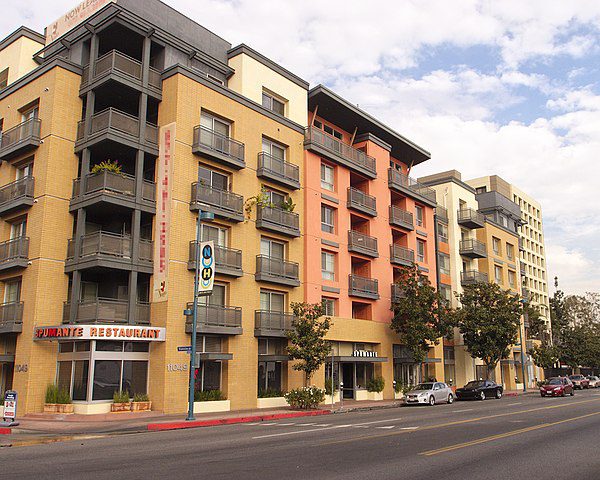
The average residential rent in Los Angeles County has fallen to the lowest level in four years, but housing affordability remains elusive for many residents, according to a report released Wednesday.
The median monthly rent cost fell to $2,520 in the first quarter of this year, down $97, or 3.7%, from 2025 and significantly under the peak of the 2022 pandemic-era spike, Realtor.com reported.
Despite the recent cost decline, economists said rents remain high relative to incomes. A household must earn over $107,000 annually in order to rent a typical residential housing unit in the region.
“Los Angeles is a market in transition,” Realtor.com Chief Economist Danielle Hale said in a statement. “Supply has finally caught up, giving renters more options and more negotiating power than they’ve had in years. But falling rents don’t automatically mean affordable rents.”
Within Los Angeles city limits, the median asking rent was $2,682 in the first quarter of 2026, down 3.5% from 2025, according to the report.
A significant gap remains between current asking rents and what many tenants actually pay. The median contract rent was $1,804 in 2024, more than $1,000 lower than currently listed rental costs.
Analysts noted that disparity has contributed to the number of renters staying in place, with more than 86% of tenants remaining in the same unit year over year.
Policy changes enacted in December and scheduled to take effect in July are also expected to shape the market. Los Angeles’ new Rent Stabilization Ordinance will limit annual rent increases to a maximum of 4%, down from a previous 8% cap, and apply to about 75% of rental units in the city totaling roughly 650,000.
“The new cap is meaningful protection for the renters it covers,” Realtor.com Economist Jiayi Xu said in a statement. “But rent control is a double-edged policy. The same financial incentives that keep tenants safely housed in below-market apartments also make it harder to move, for a new job, a bigger space, a different neighborhood. With the gap between staying and switching already exceeding $1,000 a month, that lock-in will only deepen.”
The result is a reduction of available housing inventory, as fewer tenants move out of units renting below market rates. Xu said this reduced turnover is likely to intensify competition for the limited number of rental units that do become available, pushing rents higher throughout the market and increasing the likelihood of bidding wars among prospective tenants.
Market trends varied across LA County, with higher-priced coastal areas seeing some of the steepest median rent declines. In Beverly Hills, median asking rents dropped 9.3% to $4,574, while Santa Monica saw a 2.6% drop to $4,187.
Even higher-end markets such as Malibu saw rent cost declines, down 3.6% to $14,871.
Inland and transit-oriented communities, however, held steady or experienced increases. Pasadena rents jumped 5.8% to $2,823, while Long Beach saw a 2.4% rise to $2,624.
Culver City rents were relatively flat, up 0.2% to $2,821.
Analysts said the divergence indicates changing demand, with renters attracted toward relatively more affordable areas and neighborhoods with transit access, while higher-cost coastal markets are adjusting after pandemic-era rent spikes.
Smaller units, primarily residences with zero to two bedrooms, have seen the most noteworthy rent decreases.
The median rent for these units fell to $2,241, representing a year-over-year drop of $135, or 5.7%. In contrast, larger units with three or more bedrooms experienced a more modest decline of $103, or 2.8%, bringing the median rent to $3,585.
On rent control, analysts observed that it “involves a notable trade-off” for tenants.
“Similar to the rent-freeze proposed in New York City, the protections that shield tenants from unaffordable rent increases can also reduce mobility — as households become reluctant to vacate below-market units, effectively locking them in place even when their housing needs change,” according to the report.
The most recent American Community Survey in 2024 fond that 86.5% of renters in Los Angeles remained in the same unit they occupied one year ago, up from 79% in 2010. Nationally, 69.3% of renters stayed in place in 2010 and 78.4% in 2024.
Data for the report is from all rentals advertised on Realtor.com. Rental units include apartments as well as private rentals involving condos, townhomes and single-family houses. We use rental sources that reliably report data each month within LA county.
The full report is available online.
Realtor.com bills itself “as the No. 1 site trusted by real estate professionals … delivering consumer connections and a robust suite of marketing tools to support business growth.” The website is operated by News Corp.