


The astronauts of NASA’s Artemis II test mission to the moon — the first such trek in over 50 years — are back on Earth after setting a record for traveling farther than any previous human spaceflights.
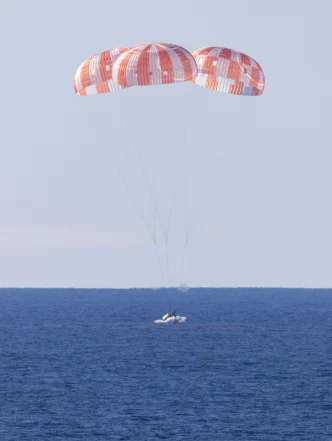
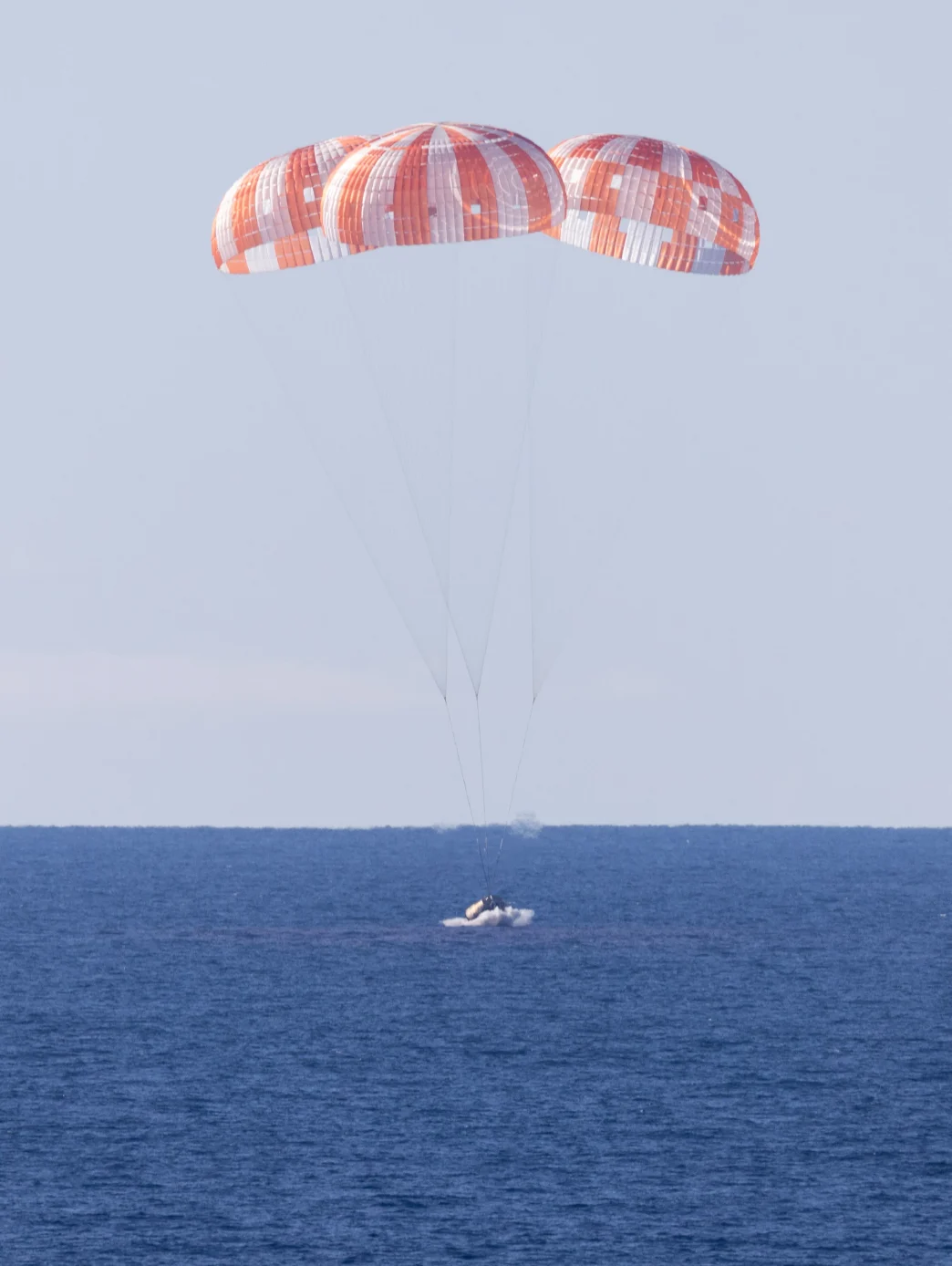
NASA astronauts Reid Wiseman, Christina Koch and Southern California native Victor Glover along with Canadian Space Agency astronaut Jeremy Hansen splashed down at 5:07 p.m. Friday off the coast of San Diego. Their nearly 10-day journey took them a record 252,756 miles from Earth.
“Reid, Victor, Christina and Jeremy, welcome home, and congratulations on a truly historic achievement,” NASA Administrator Jared Isaacman said in a statement. “Artemis II demonstrated extraordinary skill, courage, and dedication as the crew pushed Orion, (Space Launch System) and human exploration farther than ever before.”
Isaacman added that “as the first astronauts to fly this rocket and spacecraft, the crew accepted significant risk in service of the knowledge gained and the future we are determined to build.”
The focus will now shift to “assembling Artemis III and preparing to return to the lunar surface, build the base, and never give up the moon again,” Isaacman said.
After splashing down in the Pacific Ocean, the astronauts were met by a NASA and U.S. Navy team that assisted them out of the spacecraft in open water and transported them via helicopter to the USS John P. Murtha for medical examinations, NASA officials said. The crew members were expected to return to the Johnson Space Center in Houston on Saturday.
President Donald Trump and Gov. Gavin Newsom was among those who hailed the Artemis II crew’s safe return.
“Congratulations to the Great and Very Talented Crew of Artemis II. The entire trip was spectacular, the landing was perfect and, as President of the United States, I could not be more proud! I look forward to seeing you all at the White House soon. We’ll be doing it again and then, next step, Mars!” Trump posted on truthsocial.com.
“Here in California, we’re proud to anchor the historic NASA Artemis II mission — and proud of our state’s role in making this mission a success,” Newson said in a statement. “For the over 16,000 California workers, 500 companies, and three NASA centers who worked on the mission, the crew splashing down off the California Coast is a full-circle moment and point of immense pride. Artemis II is a unifying moment for all of us here on Earth that we can shoot for the stars and strive for a brighter future, for all.”
Artemis II flew 694,481 miles in total, circumventing the moon to the side that does not face Earth and surpassing the previous distance record that Apollo 13 astronauts set in 1970.
The mission launched on NASA’s SLS rocket April 1 at 6:35 p.m. from the Kennedy Space Center in Florida. With 8.8 million pounds of thrust at liftoff, the U.S.-built rocket propelled the crew inside the Orion spacecraft into orbit.
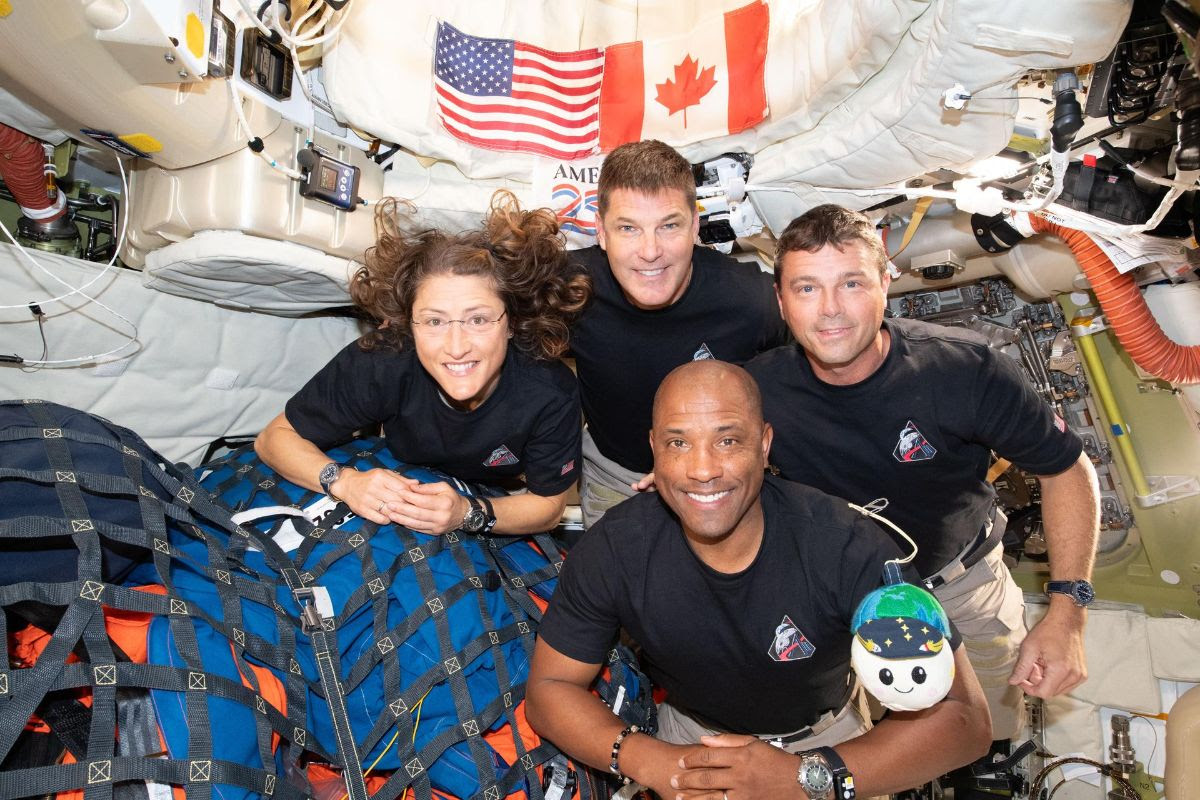
During the first day in space the astronauts and Earth-based engineers checked out the spacecraft, which the crew named Integrity, to confirm all systems were properly working ahead of the approach to the moon.
On the second day of the test flight, Orion’s service module fired its main engine, placing the astronauts on a trajectory that brought them as close as 4,067 miles above the lunar surface.
“The Artemis II crew is home. The entry, descent and landing systems performed as designed and the final test was completed as intended,” NASA Associate Administrator Amit Kshatriya said in a statement. “This moment belongs to the thousands of people across 14 countries who built, tested and trusted this vehicle. Their work protected four human lives traveling at 25,000 miles per hour and brought them safely back to Earth.”
Cameras mounted on the spacecraft enabled NASA engineers this week to examine its exterior for any signs of damage or irregularities that could have threatened a safe return. During reentry, spacecrafts must endure extreme heat and pressure as they pass through Earth’s atmosphere, placing it among a mission’s most demanding, risky stages.
Kshatriya said Artemis II has proven “the vehicle, the teams, the architecture, and the international partnership that will return humanity to the lunar surface. Reid, Victor, Christina, and Jeremy carried the hopes of this world farther than humans have traveled in more than half a century.”
With astronauts aboard for the first time, engineers put the Orion spacecraft through a full in‑flight evaluation, according to NASA. The crew tested Orion’s life support systems, confirming the $1 billion vehicle can sustain humans in deep space.
During several piloting demonstrations, crew members took manual control of the spacecraft, flying it to validate how it handles and collecting data that will guide future rendezvous and docking operations with human-driven landers during future missions.
The crew performed tests to inform how NASA will fly future moon missions, including evaluations of how Orion operates during crew exercise, emergency equipment and procedures, the Orion crew’s survival system spacesuits and other important spacecraft systems.
The Artemis II mission also supported scientific investigations to help NASA prepare astronauts to live and work on the moon as the agency builds a lunar base and also looks toward Mars, officials said. Experiments such as the AVATAR investigation into how human tissue responds to microgravity and the solar radiation present in a deep-space environment are gathering health data for understanding and possibly mitigating the risks of long-duration missions.
During their lunar flyby Monday, the astronauts captured more than 7,000 images of the lunar surface and a solar eclipse, during which the moon blocked the sun from Orion’s view, according to NASA. The photos show earthset and earthrise, impact craters, ancient lava flows, the Milky Way galaxy and surface fractures and color variations across the lunar surface.
The crew also documented the topography along the terminator — the boundary between lunar day and night.
“Low-angle sunlight casts long shadows across the surface, creating illumination conditions similar to those in the South Pole region where astronauts are scheduled to land in 2028,” according to NASA.
The Artemis II astronauts also proposed potential names for two lunar craters and reported flashes from meteoroid impacts on the night side of the moon.
Glover, the pilot of Integrity, was born in Pomona, went to Ontario High School and graduated from California Polytechnic State University, San Luis Obispo. He is the first person of color on a lunar-mission crew.
Glover, 49, spent more than five months aboard the International Space Station in 2020-21, traveling there aboard SpaceX’s first full crew rotation flight by a U.S. commercial spacecraft. That work made him the first Black crew member on the ISS.
He also was a test pilot at Naval Air Weapons Station China Lake in the Mojave Desert and has a master’s degree from Air University at Edwards Air Force Base.
With the completion of Artemis II’s mission, NASA and its partners now will turn attention to preparing for Artemis III next year. A new Orion crew will test integrated operations with commercially built Moon landers in low Earth orbit, which is 1,200 miles or less from the surface.
Officials said NASA will send Artemis astronauts on increasingly challenging missions to explore more of the moon for scientific discovery, economic benefits and to establish a lasting human presence on the moon while laying the groundwork for American astronauts to be the first on Mars.
More information on the Artemis II mission is available from NASA’s website.
Updated April 13, 2026, 9:07 a.m.