

Monrovia city officials delivered annually remarks at the State of the City event Tuesday, promoting citywide unity while noting the past year’s accomplishments and ongoing challenges.
Key areas of concern were the Monrovia Unified School District’s financial crisis caused by rising costs and declining enrollment, issues related to housing, homelessness and mental health care access and local small businesses and residents alike struggling to keep up with inflation. Officials also noted the impacts that state and federal policies have on cities, such as the destabilizing effects of trade wars and aggressive federal immigration enforcement.
Officials touted a wide range of accomplishments over the past year, including park and infrastructure upgrades, the municipal government’s strong financial position and various efforts to address the list of challenges and concerns.
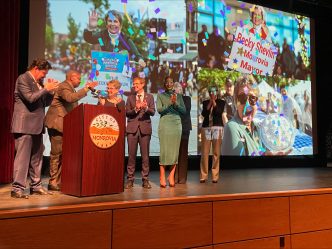
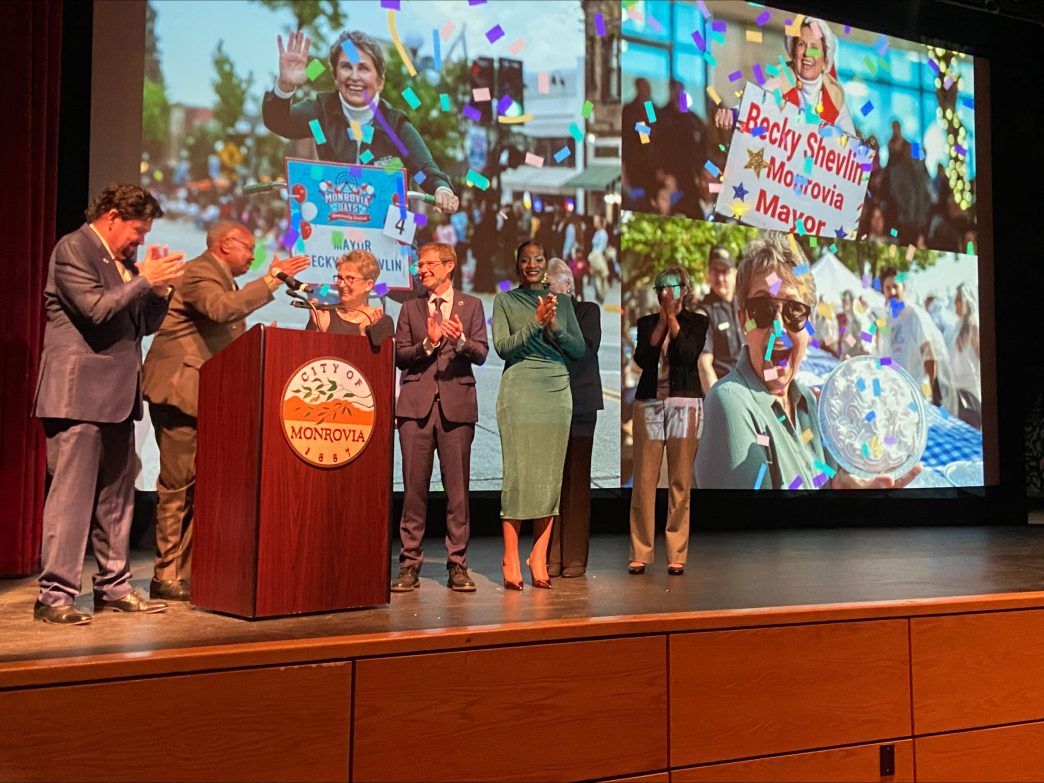
“What makes, and will always make Monrovia special are the people,” Mayor Becky Shevlin told attendees Tuesday evening at the at the Louise K. Taylor Performing Arts Center. “Our community members — your time, your effort and your passion — make our city a place where everyone belongs. Recently, I love Barbara Gholar’s invocation … ‘Unity does not mean sameness.’ That message is echoed by (Councilman Larry Spicer’s) comments of ‘better together,’ which bring us to where we are today.
“We’re not perfect, but together. … From this perspective we understand that unity embraces diversity, it fosters collaboration while respecting individual differences and encourages understanding, unity strengthens communities by bringing together our many strengths and ideas, and again, working together to make a difference.”
Shevlin and fellow council members, along with Treasurer Janet Wall and City Clerk Alice Atkins, delivered remarks on a wide range of city issues.
Councilman Edward Belden noted the impact of federal and state polices on local governance.
“When we last gathered at LOOK Cinemas last year to discuss the state of our city, our efforts were focused on wildfire victims in our neighboring communities,” Belden recalled. “The Palisades and Eaton fires were the most destructive in Los Angeles County history and a transition in Washington, D.C.
“No matter how great of a community we have here in Monrovia, what happens in Washington and Sacramento does impact us here.”
Belden addressed President Donald Trump’s aggressive crackdown on illegal immigration.
“We recognize and sympathize with those members of our community that are living in fear and are pain or have been traumatized and feel threatened by our own federal government,” Belden said.
The councilman since 2024 recalled the death last year of Carlos Roberto Montoya Valdez, who was fatally struck as he attempted to cross the 210 freeway while fleeing immigration agents at the Monrovia Home Depot.
“We have requested copies of investigative reports and will continue seeking transparency from our State Government into the death of Mr. Montoya,” said Belden. “And we have met with those who wish to honor Mr. Montoya with a tribute and provided necessary information for their consideration. If we wish to honor the legacy of someone, results require more than attending meetings and telling the city to do something. We must all roll up our sleeves and work together.”
Belden spoke of the connection between federal trade policy and the local economy.
“Trade wars and tariffs affect the cost of goods and materials used by manufacturers and the costs of items car dealerships in Monrovia,” he said. “Government shutdowns affect the timeliness of funding, grant reimbursements, and even communication across government agencies. Several of our successful non-profit organizations have lost federal funding for programs that support Monrovians with the greatest needs. Residents are receiving notices that housing subsidies and stipends are ending with zero alternatives.
“Staffing cuts at federal agencies like FEMA create unique challenges,” the councilman continued. “Consider this: After completion of the Canyon Park Repair Project, the City anticipates that at least $15.1 million is eligible for state and federal reimbursements. To date, we have received only $4.1 million.”
Mayor Pro Tem Tamala Kelly highlighted the reopening of Canyon Park and library upgrades despite the funding uncertainty.
“In the face of challenge and adversity, we should all ask ourselves this question every day, ‘what can we do?'” said Kelly, a council member since 2022. “A wise mother once said, ‘Prosperity tries the fortunate; adversity…the great.” Our community grows, prospers, and excels when we go through difficult times.
“After 5 long years, on June 27, we welcomed the community back to the park. For 5 years — half a decade — the park was closed. We survived a wildfire, a pandemic, and two floods,” Kelly said. “We encountered delays and hurdles beyond our control. The experience was awful, and we hope it never happens again. But the park has reopened and is better than ever.”
The park has new utilities, roads and parking lots, as well as new fiber and wireless connectivity and a renovated the Nature Center, Kelly said.
“The park was the buffer that protected our homes from the fire,” she added. “It was a sanctuary for animals and wildlife that survived the Eaton Fire. It is a sacred place, and it is welcome to all.”
Councilmen Larry Spicer and Sergio Jimenez discussed the city’s efforts to address the region wide housing shortage and homelessness.
“Collaboration has always been our strength,” Spicer began. “In fact, if you remember our 2024 All‑America City theme, “’Better together,’ you know that phrase captures exactly what makes Monrovia special.”
The councilman since 2013 noted efforts to encourage job creation and workforce development with infrastructure improvements and job placement programs, as Monrovia and cities throughout Southern California address homelessness and housing issues.
“We’ve also strengthened our support for mental health,” Spicer said. “Through our partnership with Care Solace, anyone and I repeat, anyone can get connected to mental health resources.”
Last year Care Solace helped more than 4,200 people, answered nearly 1,000 calls, provided over 4,200 services and connected people to health care within one to five days on average, with a 90% success rate, Spicer reported.
“This program complements our partnership with the San Gabriel Valley Council of Governments’ Crisis Assistance Response and Engagement Team SGV CARE which works alongside the Monrovia Police Department to better respond to mental health‑related calls,” the councilman said.
“Over the past several years, the Police Department has averaged 184 annual calls for mental health evaluations. Last year, that number dropped by 16%,” Spicer said. “That improvement is the result of proactive work officers and clinicians following up with individuals, checking on treatment progress, and connecting people to services.”
Since the program started, officers have made 331 in‑person contacts and 325 follow‑up calls, according to Spicer.
“Their efforts earned the Monrovia Police Department the 2025 Excellence in Community Policing Award from the Police Officers Association of Los Angeles County,” Spicer said. “We are incredibly proud of their work.”
The Pathway Home Project “brought the city, Los Angeles County, and a local hotel owner together to create temporary housing for people experiencing homelessness,” Spicer said. “The results were remarkable: 57 individuals came off the street, received wraparound services, food, and medical care, and later this month, every one of them will transition into permanent supportive housing in Baldwin Park. The hotel will return to its original use, and the program will close as a success story proof that collaboration can solve even the most complex challenges.
“We know we won’t ‘solve’ homelessness entirely, but we are doing our part,” Spicer said. “The annual Point‑in‑Time Count isn’t perfect, but it is important. And when you look at Monrovia’s numbers, you can see the progress we’re making and with continued effort and your support, we will keep moving forward.”
Jimenez, elected to the council in 2024 he was appointed to the panel in ’22, recalled, “At the start of the year, there was much concern about, not one but two large housing projects at the edge of Old Town. … We fielded countless calls from residents regarding density, traffic, construction and much more. What’s worse, we knew that state law allows such developments, and failure to comply with it would certainly result in a litigation loss for the city. …
“In March, we learned that the owner of the Oak Park Apartments considered selling the 156-unit development and the rights to develop its planned six-story, 296-unit proposal,” Jimenez said. “The city worked quietly behind the scenes to find a suitable partner on the project, resulting in partnerships with Foothill Affordable Housing Foundation and the Foundation for Affordable Housing. Together, a proposal would include purchasing the property and converting 100% of the units to affordable housing. The new owners will refresh the exterior later this year, but the six-story, dense project proposal has been abandoned.
“And what did our community get in return? A 100% affordable housing project and preservation of the current building. The new owners didn’t even displace the tenants, I sure hope we see more of these.”
Jimenez cautioned that “the trade-off for building more affordable housing usually results in reduced parking and increased density,” he said. “We must be careful when we consider these tradeoffs.”
The councilman pointed to the recently approved 701 S. Myrtle Avenue Plan and Development Project.
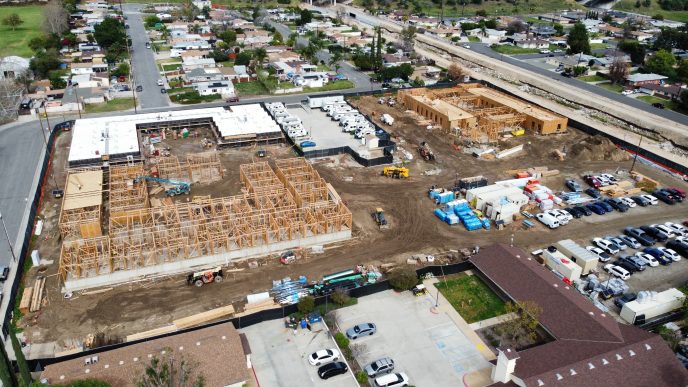
“The city’s General Plan calls for the creation of walkable, mixed-use projects along South Monrovia,” Jimenez said. “At the corner of Myrtle and Olive, a new housing project will bring 204 new housing units to Old Monrovia. … At least 20 of these homes will be set aside as affordable for low-income households. The project will also include a public plaza … with places to sit, shade trees and decorative paving for everyone to enjoy.”
Jimenez noted the council’s approval of an Inclusionary Housing Ordinance, which requires market-rate residential developments to include affordable housing units, and updated rules for Accessory Dwelling Units “to make it easier for any homeowner to add these much-needed homes to their properties,” the councilman said. “By reducing barriers and streamlining the review process, residents now only need a building permit to get started. … Homeowners can save both time and money while helping to provide more housing options in Monrovia.”
Shevlin looked ahead to projects currently in development.
“The Community Center is in plan check, and we expect to break ground later this year,” she said of the planned renovation project. “While there are still details to finalize, we are excited about the opportunity to acquire the (historic mountainside sign known as the) ‘Big M.’ We are already working on preserving the Anderson House and look forward to protecting the 1892 Victorian at 222 E. Cypress. And of course, we’re just beginning to discuss how to address a closed middle school, a downtown theater and even a large manufacturing facility in Ducommun.”
The entire State of the City event is available on the city’s YouTube page.