

During his visit to this year’s World Economic Forum in Davos-Klosters, Switzerland, Gov. Gavin Newsom emphasized California’s stability “amid federal chaos” as he announced a benchmark in electric vehicle sales.
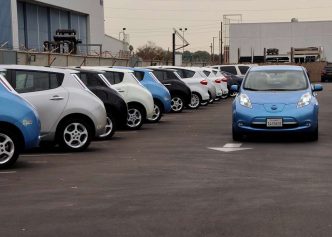
According to the governor’s office, California has surpassed 2.5 million cumulative new sales of zero-emission vehicles, or ZEVs — far exceeding the state’s goal of 1.5 million ZEVs by 2025.
“California didn’t reach 2.5 million zero-emission vehicles by accident — we invested in this future when others said it was impossible,” Newsom said in a statement. “While Washington now cedes the global clean vehicle market to China, California is ensuring American workers and manufacturers can compete and win in the industries that will define this century.”
Officials said the sales milestone is the result of decades of California pioneering the clean-car market, leading to a solid foundation that continues to drive electric-vehicle sales and the world’s fourth-largest economy, “despite the Trump administration’s efforts to derail our clean transportation future.”
Since the end of 2019, cumulative new ZEV sales in California have increased more than 300%, driven by effective clean transportation policy and various ZEV incentives, according to Newsom’s office. California stands as the nation’s undisputed leader in emission-free transportation, proving that consumer demand for electric vehicles remains strong despite federal headwinds.
“No state in the union can match California’s five-year growth in ZEV sales,” California Energy Commissioner Nancy Skinner said in a statement. “This serves as a reminder of how far we’ve come thanks to historic levels of state investment and Californians’ strong demand for clean cars. Each quarter, even in the face of increasing federal headwinds, tens of thousands of consumers are purchasing a ZEV in the Golden State, enjoying a great driving experience, and knowing they never have to go to a gas station again.”
Officials noted the state’s commitment to establishing a robust network of ZEV infrastructure.
“While the federal government reversed and put up roadblocks, the global zero-emission vehicle market surged ahead last year,” California Air Resources Board Chair Lauren Sanchez said in a statement. “Governor Newsom’s new rebate proposal sends a clear message: California isn’t slowing down, we’re still leading the pack. It’s not just about clean air, it’s smart economic policy.”
ZEV market resilience
During last year’s fourth quarter after federal tax credits expired Sept. 30, Californians bought 79,066 new ZEVs, which was 18.9% of new car sales statewide, according to the governor’s office. Prior to the tax credit expiration, sales surged in the third quarter of 2025 to 29.1% of new car sales, “likely softening sales in the fourth quarter as a result,” officials said.
As the loss of federal support set off a nationwide decline in EV sales — from 10.5% in Q3 to 5.8% in Q4, according to Cox Automotive — California’s market stayed resilient.
“This resilience reflects a market turning point,” according to Newsom’s office. “After decades of strategic state investment in charging infrastructure, consumer incentives, and manufacturer standards, California has built a strong, mature, resilient ZEV ecosystem grounded in policy certainty and sustained investment. Consumers are buying electric vehicles in part because the technology works, the vehicles perform, and the charging infrastructure continues to grow rapidly.”
Despite the lack of financial incentives from federal government, ZEV sales were strong in Q4. Officials noted the ZEV market’s diversity, and electric vehicles’ cost-effectiveness.
“With 149 ZEV models available in California in Q4 of 2025, consumers are buoyed by the diversity in the ZEV market,” according to the governor’s office. “Not only do ZEVs produce zero tailpipe pollution, but they are also fun and powerful to drive, and cost less to operate and maintain compared to gas-powered vehicles.”
Officials suggested this website for prospective ZEV buyers: ElectricForAll.org.
Clean transportation spending
State officials are “doubling down” on clean transportation spending.
In his Jan. 9 budget, Newsom proposed launching a $200 million incentive program to accelerate ZEV adoption and respond to the loss of the federal tax credit. According to the governor’s office, the move would support “American automotive innovation at a critical moment — just as the Trump administration has abandoned the good-paying jobs of this global market.”
According to Newsom, after ess than a year in office President Donald Trump’s tariff policy has driven away the United States’ second-largest trading partner, pushing Canada toward deeper economic ties with China and surrendering America’s top global spot in electric vehicle manufacturing.
“Competing to win the future requires investing in clean energy technologies, strengthening partnerships with allies like Canada, and reducing dependence on China in critical sectors,” officials said.
“Instead, the Trump administration repealed key parts of the Inflation Reduction Act and Bipartisan Infrastructure Law, and imposed broad tariffs that have raised costs for American consumers while straining relationships with close allies,” state officials continued. “Despite Donald Trump’s efforts to cede the clean energy economy to China, California is ensuring American workers and manufacturers can compete and win in the industries that will define this century.”
The Trump administration has said tariffs will bolster the nation’s global economic leadership.
“I always say ‘tariffs’ is the most beautiful word to me in the dictionary,” President Donald Trump said at a rally hours after his inauguration in January 2025. “Because tariffs are going to make us rich as hell. It’s going to bring our country’s businesses back that left us.”
In an interview with Time magazine, the president said, “We’re a department store, a giant department store, the biggest department store in history. Everybody wants to come in and take from us. They’re going to come in and they’re going to pay a price for taking our treasure, for taking our jobs, for doing all of these things.”
The state’s zero-emission commitment extends beyond consumer incentives, official said. In the latest Clean Transportation Program Investment Plan Update, the California Energy Commission allocated $98.5 million for light-duty, zero-emission vehicle infrastructure for fiscal year 2025-26. The funding will focus on Level 1 and Level 2 charging in locations with longer vehicle dwell times, including at-home charging with a focus on multifamily residences.
The Energy Commission is also continuing to study infrastructure needs statewide, officials said. The following is planned for release later this year:
- New and ongoing ZEV infrastructure funding opportunities driven by the $98.5 million from the Clean Transportation Program;
- The third Electric Vehicle Charging Infrastructure Assessment, as mandated by Assembly Bill 2127, which will assess the state’s infrastructure needs to meet EV demand; and
- The next Electric Vehicle Infrastructure Deployment Assessment, as mandated by Senate Bill 1000, to assess whether charging infrastructure is disproportionately deployed.
EV infrastructure
The governor’s office touted efforts to tear down barriers that keep ZEVs off the roadways, speeding up charging station installations and deploying infrastructure in difficult-to-reach and low-income areas.
“Becoming an EV driver in California is increasingly getting easier,” according to state officials. “There are now over 200,000 public and shared EV charging stations statewide. EV chargers can be found at grocery stores, park-and-ride lots, and even gas stations, whereas shared EV chargers can be found at apartment complexes, workplaces, doctors’ offices, sports facilities, and other parking areas with some level of restricted access. This statewide network of public and shared private chargers is in addition to the estimated 800,000 EV chargers installed in California homes.”
California’s climate leadership
Pollution is down and the economy is up, according to Newsom. Greenhouse gas emissions in California have dropped 21% since 2000 — even as the state’s GDP increased 81% in that same time period on the way to becoming the world’s fourth largest economy.
Officials also boasted about California’s clean energy records. In 2023 the state was powered by two-thirds clean energy, the largest economy in the world to achieve that level. California has also run on 100% clean electricity for part of the day almost every day last year, officials said.
Since the beginning of the Newsom administration in 2019, battery storage has surged to nearly 17,000 megawatts — a more than 2,100% increase, and over 30,000 megawatts of new resources have been added to the state’s electricity grid. California now has 33% of the storage capacity estimated to be needed by 2045 to reach 100% emission-free electricity.