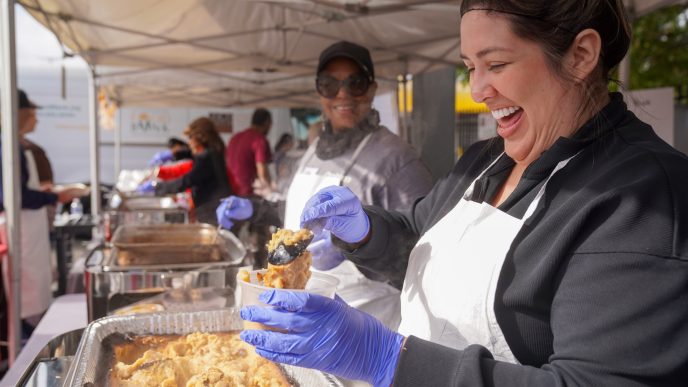


California residents who receive food assistance can expect full November benefits, officials confirmed this week following a more than monthlong federal government shutdown that disrupted benefit payments and other services.
Full funding to states for food assistance programs would resume within 24 hours of the government reopening, a USDA spokesperson said.
The California Department of Social Services administers CalFresh, the state’s food aid program funded through the U.S. Department of Agriculture Supplemental Nutrition Assistance Program.
“California remains committed to ensuring that vulnerable Californians have access to the food support they need to the greatest extent possible,” CDSS spokesperson Theresa Mier said in a statement. “While SNAP benefits were delayed, we anticipate that currently all recipients should be receiving full SNAP benefits.”
Mier said the food aid delay resulted from the “Trump Administration’s decision to oppose the issuance of benefits during the shutdown” and estimated all CalFresh “recipients should be receiving full SNAP benefits in November and the coming months.”
On Thursday the USDA published post-shutdown guidance for state agencies, directing them to “take immediate steps to ensure households receive their full November allotments promptly.”
Last weekend the USDA ordered states to distribute 65% of November benefits to recipients, but that reduction is no longer in effect, says the department’s latest policy memo.
“State agencies should immediately resume issuing combined allotments for November and December for newly certified applicants who apply after the 15th of the month,” according to the memo from Patrick Penn, the USDA deputy under secretary in charge of the Food and Nutrition Service division.
Penn warned that while the 2026 appropriations act restores funding to the SNAP contingency fund, “as with this year, amounts are not anticipated to be sufficient to provide full funding for allotments for November 2026 in the event of a lapse of appropriations next year,” according to his memo. “States are strongly encouraged to begin the process of upgrading systems and updating state procedures as necessary to allow for more rapid distribution of reduced allotments in the event that available appropriations are insufficient to provide full allotments in any month.”
The House of Representatives passed and President Donald Trump signed fiscal year 2026 appropriations legislation Wednesday after several Senate Democrats broke the stalemate Tuesday and voted for the spending package.
Among other disruptions, the shutdown caused a halt in food assistance funding to states that led to lawsuits seeking to require the Trump administration to use contingency funds during the shutdown. A Supreme Court decision late Friday stayed a Rhode Island judge’s order that the administration resume paying full benefits.
On Nov. 8, the USDA ordered states to pay 65% of benefits to the nearly 42 million Americans who get SNAP benefits.
The spending plan combines three full-year funding measures into one legislative package that has a stopgap funding bill to reopen the government through Jan. 30.
Opponents of the budget deal have said a key point of contention in the shutdown debate was the lack of funding for health care subsidies under the Affordable Care Act that significantly reduce recipients’ monthly payments.
The cost of those policies have risen since open enrollment began Nov. 1 because the pandemic-era subsidies are set to expire at the end of this year.
California Sens. Alex Padilla and Adam Schiff, along with Senate Minority Leader Charles Schumer, D-New York, voted against ending the stalemate.
“That funding bill has nothing in it to help people afford their health insurance,” Schiff said on social media. “That bill has nothing in it that’s going to bring costs down. That bill has nothing in it that’s going to make sure that people with preexisting conditions can afford their health insurance. We owe our constituents better than this.”
Republicans said Democrats used the shutdown in an attempt to prevail in the policy dispute over health care funding for low-income earners.
“They knew it would cause pain and they did it anyway,” House Speaker Mike Johnson, R-La., said.
“This is a great victory for the American people, and it shows that the Senate can work,” Maine Republican Sen. Susan Collins said after the shutdown’s end.
The Democratic senators who voted for the spending package known as the Continuing Appropriations, Agriculture, Legislative Branch, Military Construction and Veterans Affairs, and Extensions Act were Catherine Cortez Masto from Nevada; Dick Durbin from Illinois; John Fetterman, Pennsylvania; Maggie Hassan, New Hampshire; Tim Kaine, Virginia; Jacky Rosen, Nevada; and Jeanne Shaheen. New Hampshire Sen. Angus King, the Maine independent who caucuses with the Democrats, also voted yes.
Sen. Rand Paul, R-Kentucky, was the lone Republican to vote against the spending plan.
LA County Democratic Party Chair Mark Ramos issued a statement Monday on the vote to reopen the government.
“Leadership takes courage. Thank you to our (California) leaders, Senators Schiff and Padilla, for voting no on a bad deal and for keeping their promise to the American people,” Ramos said.
“Americans will remember who acted on our behalf, and who betrayed us. Last week, voters in California overwhelmingly made it clear that we are ready to fight back,” he added. “The Los Angeles County Democratic Party stands with our leaders in opposing the GOP budget proposal and holding the line on the government shutdown.”
LA County District 1 Supervisor Hilda Solis condemned the halt to food assistance.
“The federal government’s failure to release food benefits has created an avoidable crisis for millions of families,” Solis said in a statement. “It’s unimaginable that a federal judge has to tell the President of the United States to feed people. In Los Angeles County, we are stepping up to ensure that families have access to food and dignity during this difficult time.”
More information on CalFresh is available on the CDSS website.
The federal shutdown began Oct. 1 and was the longest stoppage in U.S. history.
Updated Nov. 17, 2025, 8:50 a.m.