

The more than one-month federal government shutdown appeared to be nearing its end Monday after several Senate Democrats indicated they would vote for the spending package.
The shutdown caused a halt in food assistance funding to states that led to lawsuits seeking to require the Trump administration to use contingency funds during the shutdown. A Supreme Court decision late Friday stayed a Rhode Island judge’s order that the administration resume paying full benefits.
On Saturday, the USDA, which administers the Supplemental Nutrition Assistance Program, ordered states to pay 65% of benefits to the nearly 42 million Americans who get SNAP benefits.
“States must not transmit full benefit issuance files to EBT processors,” according to the USDA’s memorandum Saturday. “Instead, States must continue to process and load the partial issuance files that reflect the 35 percent reduction of maximum allotments detailed in the November 5 guidance.
“To the extent States sent full SNAP payment files for November 2025, this was unauthorized,” the memo continued. “Accordingly, States must immediately undo any steps taken to issue full SNAP benefits for November. …
“Failure to comply with this memorandum may result in USDA taking various actions, including cancellation of the Federal share of State administrative costs and holding States liable for any overissuances that result from the noncompliance,” according to the memo.
The Senate was scheduled Monday to continue considering legislation to end the shutdown.
Former Los Angeles Mayor Antonio Villaraigosa and current gubernatorial candidate criticized the seven Democratic senators who voted to move the spending deal forward.
“Healthcare costs are skyrocketing because Republicans chose their billionaire donors over middle-class Americans — and now, after a 40-day gov shutdown, some Senate Democrats are willing to cave on a “deal” that has no concessions on healthcare costs,” Villaraigosa, a Democrat, posted Sunday on social media. “We all deserve better.”
The spending plan combines three full-year funding measures into one legislative package that has a stopgap funding bill to reopen the government through Jan. 30.
Opponents of the budget deal have said a key point of contention in the shutdown debate was the lack of funding for health care subsidies under the Affordable Care Act that significantly reduce recipient’s monthly payments.
Senate Majority Leader John Thune, R-South Dakota, said he supports a separate vote by the second week of December, after the government reopens, to extend the health insurance subsidies offered through HealthCare.gov and state-run insurance marketplaces.
The cost of those policies have risen since open enrollment began Nov. 1 because the pandemic-era subsidies are set to expire at the end of this year.
Former Orange County Rep. Katie Porter, another Democrat running for governor, also criticized the senators’ defections from the party line.
“Democrats need to use our power, just like we did on Election Day last week, to deliver for Americans,” Porter wrote Sunday on social media. “With Californians set to see their health care premiums double next year, we’d be naive to give in and take Republicans at their word. This deal falls short.”
Senators voted 60-40 to end the Democratic-led filibuster on the government funding bill, which is the required three-fifths majority.
California Sens. Alex Padilla and Adam Schiff, along with Senate Minority Leader Chuck Schumer, D-New York, voted against ending the stalemate.
“That funding bill has nothing in it to help people afford their health insurance,” Schiff said on social media. “That bill has nothing in it that’s going to bring costs down. That bill has nothing in it that’s going to make sure that people with preexisting conditions can afford their health insurance. We owe our constituents better than this.”
The Democratic senators who voted to end the shutdown were Catherine Cortez Masto from Nevada; Dick Durbin from Illinois; John Fetterman, Pennsylvania; Maggie Hassan, New Hampshire; Tim Kaine, Virginia; Jacky Rosen, Nevada; and Jeanne Shaheen, New Hampshire. Sen. Angus King, the Maine independent who caucuses with the Democrats, also voted yes.
Sen. Rand Paul, R-Kentucky, was the lone Republican to vote against the proposed spending plan.
LA County Democratic Party Chair Mark Ramos issued a statement Monday on the vote to reopen the government.
“Leadership takes courage. Thank you to our (California) leaders, Senators Schiff and Padilla, for voting no on a bad deal and for keeping their promise to the American people,” Ramos said.
“Americans will remember who acted on our behalf, and who betrayed us. Last week, voters in California overwhelmingly made it clear that we are ready to fight back,” he added. “The Los Angeles County Democratic Party stands with our leaders in opposing the GOP budget proposal and holding the line on the government shutdown.”
LA County District 1 Supervisor Hilda Solis condemned the halt to food assistance.
“The federal government’s failure to release food benefits has created an avoidable crisis for millions of families,” Solis said in a statement. “It’s unimaginable that a federal judge has to tell the President of the United States to feed people. In Los Angeles County, we are stepping up to ensure that families have access to food and dignity during this difficult time.”
Local efforts address food aid shortfall
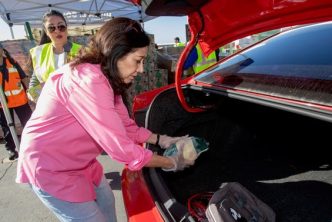
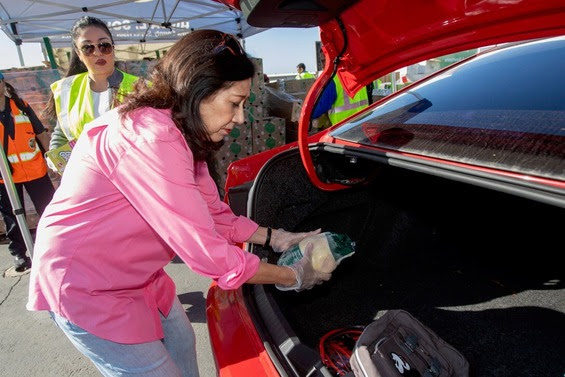
On Saturday the Los Angeles Regional Food Bank hosted a drive-through food distribution event at the San Gabriel Valley Airport in El Monte that assisted 4,000 families in need, according to Solis’ office. The event took place with support from the county Department of Public Works, the city of El Monte, the El Monte Police Officers Association and Police Officers Foundation, the El Monte Business Alliance, the California Highway Patrol and Valley Vista Services.
Last month the county Board of Supervisors OK’d a $10 million contract with the LA Regional Food Bank to expand purchasing capacity for November and to establish additional pop-up and drive-through pantry sites to reach more residents.
The L.A. Care Health Plan has approved $5.4 million in additional food relief efforts, including grocery gift cards.
Orange-based CalOptima Health announced Monday it has pledged $8 million for local food distribution and to help Medi-Cal program participants amid uncertainty about food benefits resulting from the funding uncertainty.
“We are so very grateful to CalOptima Health for their support of the emergency food system supported by Orange County’s two food banks,” Claudia Bonilla Keller, Second Harvest Food Bank CEO, said in a statement. “The food banks support close to 500 pantries in the communities where people live and work. This funding will ensure that these sites have additional, nutritious food on hand during this benefits stoppage.”
CalOptima is contributing up to $1.5 million each to Second Harvest Food Bank of Orange County and Community Action Partnership Orange County. The organizations distribute 65 million pounds of food each year at food banks, senior centers, soup kitchens, homeless shelters and transitional housing facilities across the county, according to the health insurer.
“CalOptima Health is acting to prevent these extraordinary events on the national level from negatively impacting the physical health of individuals in our communities,” Michael Hunn, CEO of CalOptima Health, said in a statement. “We firmly believe that food is health.”
Information on CalFresh, California’s SNAP-dependent food aid program, is available on the program’s website.