


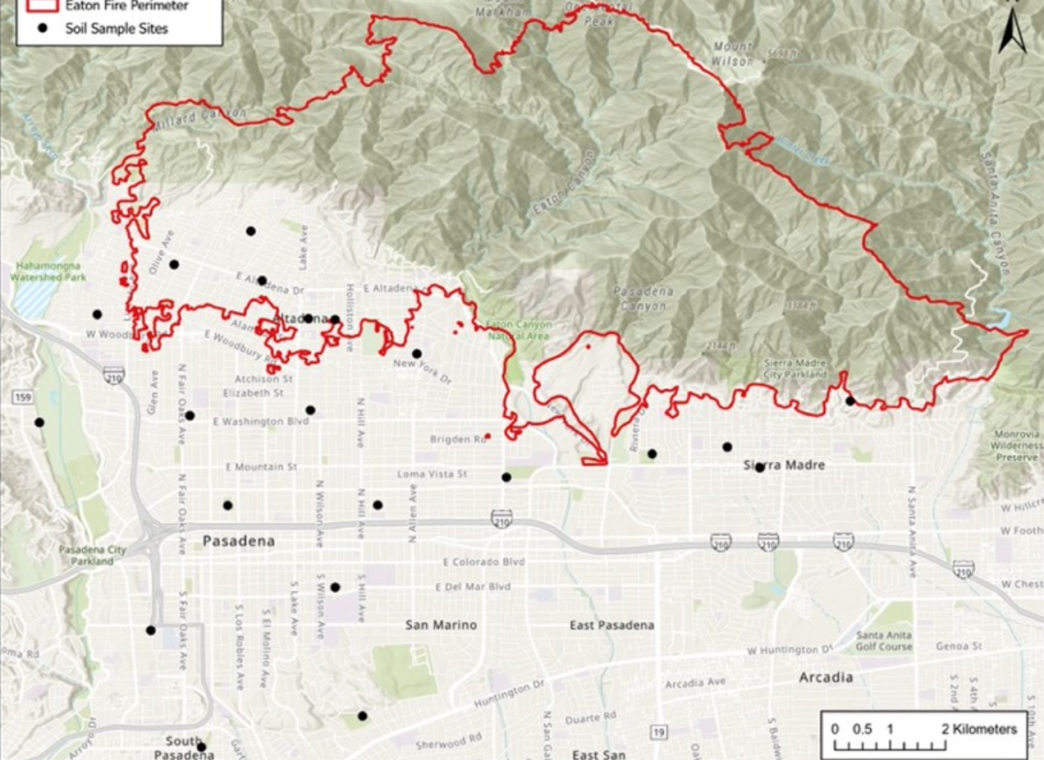
A higher percentage of soil samples from properties downwind of the Eaton Fire showed levels of lead above health-based screening thresholds, the Los Angeles County Department of Public Health reported Friday.
The county’s final findings from post-fire soil testing also confirmed “localized chemical impacts” above screening thresholds in the Palisades Fire area but no evidence of widespread contamination from fire-related chemicals,” according to the health department.
The Eaton Fire in Altadena, Pasadena and neighboring areas and the wildfire in Pacific Palisades and Malibu combined scorched over 39,000 acres, destroyed tens of thousands of structures and caused 31 deaths in January.
Between Feb. 18 and March 26, Roux Associates Inc. analyzed soil and ash samples for levels of harmful substances that may be present after wildfires reach urban areas — heavy metals including lead, polyaromatic hydrocarbons, or PAHs and dioxins and furans, health officials said. Technicians took representative samples from various parcels in different areas and with different property conditions in and around the Eaton Fire and Palisades Fire areas.
“Soil samples were collected throughout a sampling grid of each fire area from destroyed and intact properties within the burn areas, as well as from properties just outside the burn areas, and results were compared to current California Department of Toxic Substances Control’s (DTSC) residential soil screening level thresholds,” according to a health department statement.
The county’s Eaton Fire Region consists of 70 sampling grids, with 23 containing intact homes with minor or no damage inside the fire zone boundary or nearby properties located outside the boundary.
Of the 23 sampling grids for properties with intact homes, 10 grids had average concentrations that were greater than the state’s 80 milligrams per kilogram threshold for residential areas, health officials said. The average lead concentration in the 10 grids with samples above the residential screening level ranged between 80.2 and 167 mg/kg.
The increased lead in downwind soil “is consistent with reports of elevated lead in air samples collected in the days immediately following the fire,” according to the health department. “The source of lead in the fire is reasonably expected to be from the burning of homes with lead-based paint, which was common prior to 1979.”
More than 70% of the houses in the Eaton Fire area were built before 1979, the University of Southern California Lusk Center for Real Estate reported.
Officials noted that because many potential sources of lead exist in soil in the LA area, more analysis may help determine the amount of lead that resulted from the 2025 wildfires versus other sources.
Soil testing in the Palisades Fire area “did not identify any large-scale fire-related soil impacts, including for lead,” health officials said. Testing identified two “isolated areas” where samples showed elevated levels of cadmium and thallium in one area, and arsenic and PAHs in another.
“The source of these impacts and whether they are fire-related is unknown at this time, but these are not consistent with communitywide impacts from fire-related smoke plumes,” according to the health department.
Soil sampling from properties with destroyed structures from both wildfire areas showed a significant reduction in the potential health risk where soil removal by the U.S. Army Corps of Engineers.
“Nonetheless, results show that these parcels can still have areas where the concentration of chemicals in soil exceed residential screening levels, both in areas where soil removal did not occur and in areas where soils were removed,” according to the county.
For efforts to rebuild on lots with destroyed homes, officials advised residents “to manage surface soils to prevent exposure to impacted soils during construction as well as in final landscaping design/installation.”
Individual properties may have unique factors that differ with the county’s representative samples, and the testing data is “not intended to imply cleanup or specific remediation is necessary; rather, the results are intended to provide public health data to help identify areas that may potentially present a health risk and may require additional evaluation,” officials said.
The health department reminded residents to not inhale, ingest or make contact with ash, soot or fire debris and use personal protective equipment.
Residents of areas with elevated screening thresholds should take precautions, officials said and provided an online fact sheet — Public Health’s Frequently Asked Questions — that explains best practices for minimizing exposure to hazardous chemicals and heavy metals.
The county has established a soil-testing program for residents.
Earlier this year, reports surfaced of elevated lead levels at Pasadena schools. Testing at Pasadena parks did not reveal heavy metals above screening thresholds.
The soil-analysis report is available on the health department’s website.