

A temporary restraining order stopping immigration enforcement activity in the Los Angeles area remained in place Monday after a federal appeals court heard arguments but did not rule on the Trump administration’s request for a stay of the restraining order.
The appeal stems from a July 2 lawsuit by Southern California residents, workers and advocacy groups who claim the U.S. Department of Homeland Security’s aggressive mass-deportation operation that involves “abducting and disappearing” community members via illegal arrest tactics, then detaining people in allegedly unlawful, at times extremely unsanitary conditions while denying detainees legal counsel.
Since June 6, federal agents have carried out aggressive enforcement activity following orders from Trump and administration officials who have pledged to crack down on illegal immigration nationwide.
U.S. Department of Justice lawyers want the appeals panel to issue a stay of a Los Angeles federal judge’s July 14 ruling that roving patrols by immigration agents were done illegally without reasonable suspicion or probable cause.
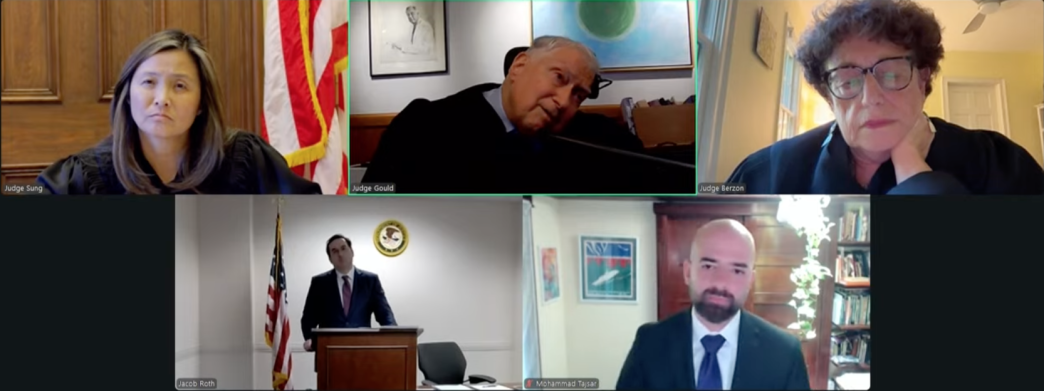
DOJ Attorney Jacob Roth on Monday challenged the lower court ruling by U.S. District Judge Maame Ewusi-Mensah Frimpong, arguing that the immigration detentions were legal, precisely targeted and done with probable cause to make arrests.
During the 90-minute hearing in San Francisco, the three-judge panel from the 9th Circuit Court of Appeals questioned the legality of the immigration enforcement activity and the origins of a reported White House order that requires immigration agents nationwide to make 3,000 arrests of undocumented immigrants each day.
Roth insisted that federal “officers are instructed to find reasonable suspicion before an arrest,” adding that Frimpong’s restraining order “is fundamentally flawed on multiple levels.”
The questions to Roth from the three appeals court panelists had an air of skepticism.
Judge Ronald Gould, an appointee of former President Bill Clinton, asked Roth three separate times to explain the 3,000-person daily arrests strategy and to pinpoint exactly where the quota supposedly originated.
Questioned if there was actually such a policy, Roth responded, “Not to my knowledge, your honor,” adding, “I think it came from a newspaper article.”
Gould ordered Roth to determine the origin of the apparent directive and file the results with the court. According to published reports, White House Deputy Chief of Staff Stephen Miller issued the directive to U.S. Immigration and Customs Enforcement in May.
“It appears they are randomly selecting Home Depots where people are standing looking for jobs,” said Judge Marsha Berzon, also a Clinton appointee.
The appeal stems from a lawsuit filed July 2 by Southland residents, workers and advocacy groups alleging the U.S. Department of Homeland Security is operating a program of “abducting and disappearing” community members using unlawful arrest tactics, then confining detainees in illegal conditions while denying access to attorneys.
The proposed class-action suit in LA federal court by five workers, three advocacy organizations and a legal services provider alleges that immigration enforcement agents have unconstitutionally arrested and detained people in order to meet arbitrary arrest quotas set by the Trump administration.
“There is a non-trivial number of people who are saying this is happening,” Berzon said.
On the issue of probable cause for immigration arrests, Judge Jennifer Sung, an appointee of President Joe Biden, asked Roth for examples of existing case law that supports targeting locations where undocumented immigrants were known to gather in search of work. The lower court’s ruling found that to be insufficient for establishing probable cause for agents to make arrests.
Roth said such “locations are are selected for consensual encounters that may lead to reasonable suspicion.”
Responding to the government’s bid to reverse the temporary restraining order, ACLU of Southern California attorney Mohammad Tajsar contended that many incidents involve federal agents “making stops and arrests without a case-by-case analysis” and without legal cause.
The government has directed immigration agents “with a wink and a nod … to go out there and snatch” suspected undocumented immigrants, Tajsar argued.
The appeals court judges did not set a specific timeline for a ruling in the case.
A hearing in the lawsuit before Frimpong is set for Sept. 24.