

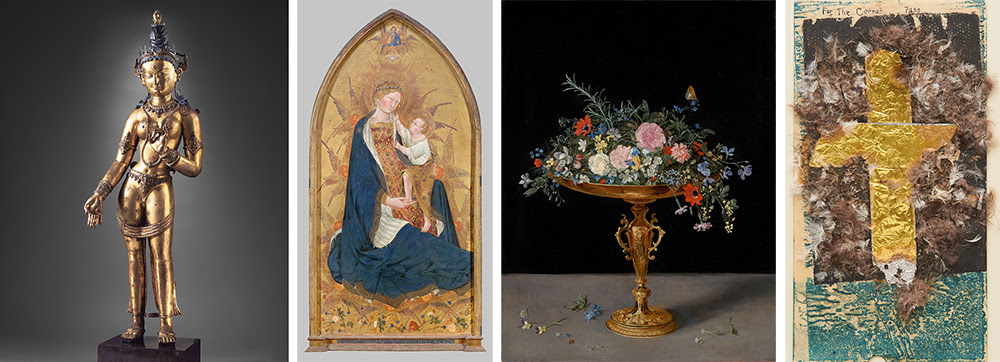
Opening this fall at the Norton Simon Museum, “Gold: Enduring Power, Sacred Craft” explores the artistic and cultural significance of gold in approximately 60 works of art drawn from across the museum’s collections, which encompass South and Southeast Asia, Europe, North Africa and North America. Sculptures, paintings, jewelry, tapestries and photography that span from 1000 BCE to the 20th century will be displayed together for the first time. Presented on the occasion of the museum’s 50th anniversary, a milestone traditionally associated with this metal, the exhibition invites an examination of gold as an artistic medium.
The exhibition is divided into three thematic galleries: power, devotion and adornment. The first gallery displays objects that convey authority through the presence of gold, used by artists to create dazzling effects that underscored their patrons’ wealth and status. In some cases, such power came from direct access to sources of gold, which was extracted from mines and rivers across Africa, Asia, Europe and South America and transported over vast regions. The historical thirst for gold motivated California’s own 19th-century mining practices, the legacy of which is explored in this exhibition through photographs by Ansel Adams and Edward Weston. In the hands of trained craftspeople, gold, a highly malleable metal, was transformed into a variety of objects collected by patrons, including illuminated manuscripts and tapestries woven with golden thread.
The second gallery features religious art that uses gold, a metal valued for both its beauty and durability. Its ability to be shaped without corroding made it ideal for sacred images meant to last. In Hindu and Buddhist traditions, gilt sculptures from the 12th to 20th centuries were often commissioned by donors to honor deities and enlightened beings. Gold symbolized spiritual purity and served as a high-value offering meant to earn religious merit and provide divine protection. In 14th- and 15th-century Europe, artists used extremely thin sheets of hammered gold leaf to depict Christian holy figures surrounded by divine light. The gold’s glow, especially under candlelight in churches and private altars, heightened the spiritual atmosphere.
In a jewel-box setting, the third and final gallery of the exhibition gives special attention to the power of adornment and the artistic skill required to produce precious jewelry worn by Roman patrician women, or that ornamented Egyptian statuettes possibly used for domestic protection in the 7th century BCE.
New technical analysis has helped to identify the fundamental material properties of the wide array of objects on view, prompting further questions about their significance. Close inspection of paintings, manuscripts and sculpture has revealed the variety of ways artists manipulated gilt surfaces to create rich devotional experiences. The team of curators and conservators also discovered that in some cases, what appears to be gold is in fact an illusionistic treatment of another material such as bronze, silver, silk thread or paint. This sort of artistic alchemy evokes the gleaming effects of actual gold. Many such discoveries will be presented in the exhibition, along with technical displays that delve into the artistic practices used to create the objects on view.
“Gold: Enduring Power, Sacred Craft” will be on view in the museum’s lower-level exhibition wing from Oct. 24 (the 50th anniversary of the renaming of the Norton Simon Museum) through Feb. 16, 2026. A series of events, including a film series and lecture program, will be organized in conjunction with the exhibition. Details will be available at nortonsimon.org.