

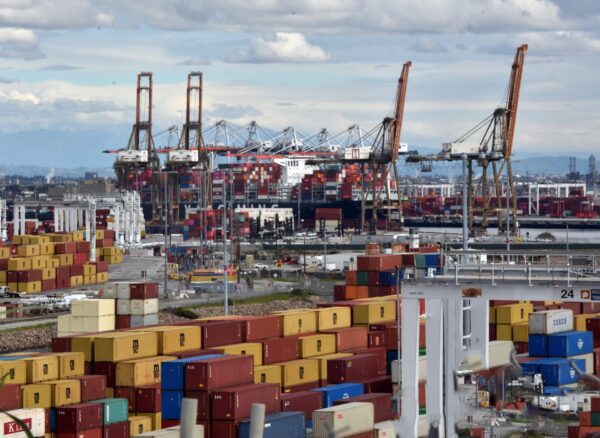
Port authorities in the Los Angeles area on Friday welcomed the U.S. Supreme Court’s decision to strike down President Donald Trump’s widespread emergency tariffs — but also cautioned of uncertainties resulting from a new 10% global tariff Trump announced immediately after the ruling.
In a 6-3 decision Friday, the Supreme Court found it was unconstitutional for the president to create and change tariffs because that power belongs only to Congress. Justices Samuel Alito, Clarence Thomas and Brett Kavanaugh dissented.
Long Beach and LA port officials have noted the importance of clear, predictable trade policy for effective financial planning and moving cargo efficiently to keep products flowing to businesses and consumers.
Port of Los Angeles Executive Director Gene Seroka said the Supreme Court decision affects about two-thirds of the tariffs that have been collected since the administration implemented them last year, leading to new types of uncertainty.
“First, there is not yet clarity on whether there will be refunds from the U.S. Treasury Department on tariffs already paid,” Seroka said in a statement. “Second, the administration has already announced a new 10% global tariff in the wake of the ruling with no indication as to when that will take effect.”
He added that the court’s decision is in the midst of work stoppages for the Lunar New Year holiday. Most factories in China and throughout Asia are closed, with reopening not expected until at least next week.
“The Port of Los Angeles and its network of supply chain partners stand ready to manage any fluctuation in cargo and get it through the system swiftly without delay,” Seroka said.
Port of Long Beach CEO Noel Hacegaba said a predictable approach to tariffs helps businesses plan investments, which in turn enables ports to maximize their contributions to the national economy. He noted that the port is one of the nation’s largest gateways and will continue to work with partners to enhance operations that support the global supply chain, support the 2.7 million jobs tied to the port and enhance U.S. economic competitiveness.
The Supreme Court’s ruling “rescinds most of the tariffs imposed over the last year,” Hacegaba said in a statement. “While this decision rules on the legality of the tariffs, it does not remove the uncertainty.”
Like his LA counterpart Seroka, the Long Beach Port chief also called for “clarity … on whether tariffs already paid will be refunded and when the newly announced 10% global tariff will go into effect.
“For now, the only certainty is more uncertainty. … Freight can’t wait — and certainty helps keep it moving,” Hacegaba said.
The Supreme Court did not rule out allowing importers to request refunds for tariffs imposed by the Trump administration under the 1977 International Emergency Economic Powers Act.
The IEEPA was Trump’s legal basis for the sweeping tariffs on countries with which the U.S. has unfair trade relationships, according to his administration. The tariffs were a large part of the president’s economic agenda that aims to bolster manufacturing and raise revenue to pay down the $38.65 trillion national debt.
In response to the Supreme Court ruling, Trump announced he would impose a worldwide 10% tariff while administration officials seek out other options for trade policy. The new tariff is limited to 150 days.
Trump lashed out at justices who supported the Court’s decision that he called called “deeply disappointing.” He posted a response on his Truth Social platform.
“This was an important case to me, more as a symbol of Economic and National Security, than anything else,” Trump wrote. “The Good News is that there are methods, practices, Statutes, and other Authorities, as recognized by the entire Court and Congress, that are even stronger than the IEEPA TARIFFS, available to me as President of the United States of America and, in actuality, I was very modest in my ‘ask’ of other Countries and Businesses because I wanted to do nothing that could sway the decision that has been rendered by the Court.”
According to government estimates, the reciprocal tariffs would have generated about $3 trillion toward lowering the federal debt.
In April, Trump imposed hefty reciprocal tariffs on countries that have the highest trade deficits with the U.S. — China, 34%; Vietnam, 46%; India, 25%-30%; Japan, 24%; European Union, 20%; Cambodia, 49%; Thailand, 36%; Laos, 40%; and Myanmar, 40%.
Recent estimates from U.S. Customs and Border Protection and independent research organizations shows that between $133 and $200 billion have been collected under IEEPA tariffs.
Gov. Gavin Newsom and California Attorney General Rob Bonta issued statements following the Supreme Court’s rejection of the tariffs.
“Time to pay the piper, Donald. These tariffs were nothing more than an illegal cash grab that drove up prices and hurt working families, so you could wreck longstanding alliances and extort them,” Newsom said. “Every dollar unlawfully taken must be refunded immediately — with interest. Cough up!”
Bonta referred to states’ opposition to Trump’s trade policy.
“The Trump Administration’s illegal and chaotic tariff regime has come to an end. … The highest court in the country has agreed with arguments put forth by California, our sister states, and the dedicated businesses that decided to fight for their livelihoods and for what was right,” Bonta said. “While this is great news, we must not forget the chaos that sent businesses, consumers, and global economies reeling. At a time when more and more families are struggling with affordability and having trouble paying for the basics — their utilities, groceries, gas — this Administration seems intent on making it more expensive for Californians and Americans to live.”
White House spokesman Kush Desai responded in a statement to HeySoCal.com, “Does Gavin Newsom not have a day job to constantly be screeching about President Trump? Millions of Americans have fled California in recent years because of high taxes, cost of living, regulations, and crime — Newsom’s time would be better spent dealing with those issues than ginning up another popcorn headline.”
Alan Morrison, lead counsel for Consumer Watchdog’s amicus brief in the lawsuit opposing the tariffs, said the ruling was a “resounding victory for the principles of separation of powers.”
Morrison, an adjunct professor at George Washington University Law School, said in a statement the decision “returns to Congress the question of whether tariffs are good for America and, if so, how much and on what imports, where it belongs.”
He emphasized that the Supreme Court rejected Trump’s claim that IEEPA “allowed him to impose massive taxes on American businesses and consumers, in whatever amount he decided, for whatever products he selected, and for however long he preferred.”
William Pletcher, litigation director for Consumer Watchdog, added the ruling was a noteworthy win for customers.
“The court made clear that no president can use emergency powers as an end-run around Congress’s exclusive taxing power. Americans cannot be taxed by executive fiat,” Pletcher said in a statement.
The ruling in Learning Resources Inc. v. Trump is on the Supreme Court’s website.
Updated Feb. 23, 2026, 8:39 a.m.