

Tax-delinquent properties in the Inland Empire may offer overlooked opportunities for affordable housing and could help ease the statewide housing shortage if combined with broader policy and planning support, according to researchers at the University of California, Riverside.
“Exploring Land Banking as a Tool for Affordable Housing in the Inland Empire: A Proof-of-Concept Study” from the School of Public Policy Center for Community Solutions maps out tax-defaulted parcels throughout Riverside and San Bernardino counties. The study also explores how land banking — acquiring and holding distressed land for future use — could support local housing strategies.
Researchers created interactive maps that enable users to zoom in and identify tax-delinquent properties. The maps also provide “context layers” revealing environmental concerns such as wildfire risk, as well as access to transit, jobs and other community features.
“We see this report and its mapping tools as a resource for policymakers to assess whether land banking might be viable in their jurisdictions,” Kristen Kopko, the report’s lead author and research manager at CCS, said in a statement.
Residential properties in California can be auctioned after five years of tax delinquency, and a three-year window exists for commercial parcels. Because counties seek only unpaid taxes, the properties often sell at relatively low prices. That makes them attractive to local governments or nonprofits looking to secure land for future housing, according to researchers.
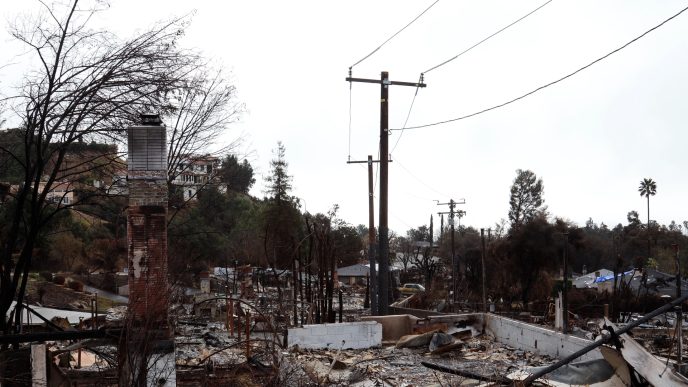
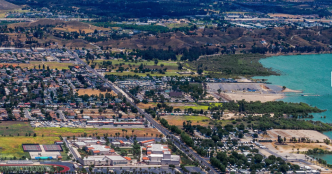
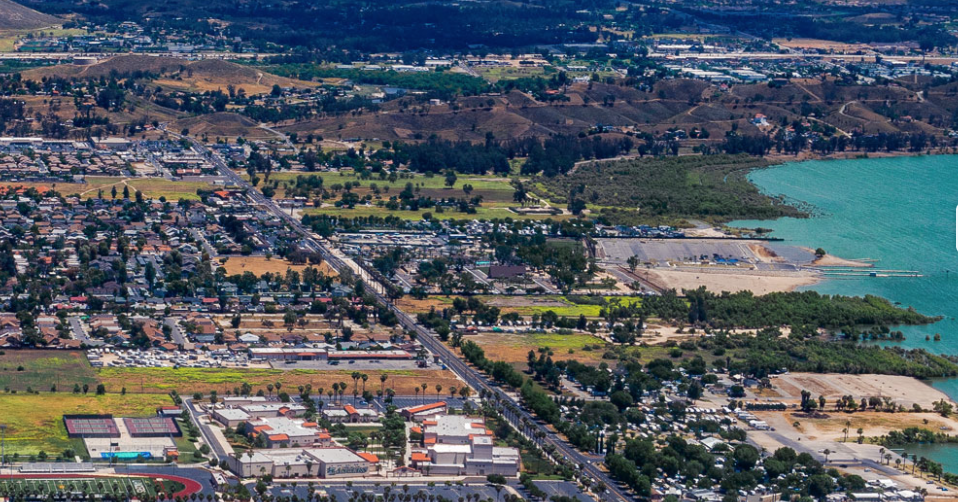
The UCR report identifies notable concentrations of tax-delinquent properties, such as Lake Elsinore and Lake Arrowhead, where 18% and 15% of lots, respectively, were delinquent this year. Both areas face major development hurdles, however, including high fire risk, limited transit and few nearby employment centers, the report revealed.
Land banking in these areas would likely require investments both in transportation infrastructure and fire mitigation, the report notes.
Other Inland Empire cities with high rates of property tax default between 2017 and ’23 include Cabazon, Menifee, Wildomar and Desert Hot Springs in Riverside County and Crestline, Big Bear and Twentynine Palms in San Bernardino County.
Riverside County’s high rate of parcel redemptions, where owners repay owed taxes before auction, suggests delinquency may serve as an early sign of housing instability, according to the report. Researchers suggested this presents an opportunity to take preventive action.
The report addresses priority areas for housing and the need for data to identify patterns of property distress, while emphasizing the need for further study. More research is needed to explore how environmental hazards, public transportation and job availability affect land banking in specific neighborhoods.
The report also highlights the need for better property data systems in the two counties and stronger interagency coordination to better access the availability of tax-defaulted properties.
The study was funded by Neighborhood Partnership Housing Services, a nonprofit housing assistance organization based in Southern California.
Visit UCR’s website to access the full study.