

A study by Los Angeles County agencies outlined rebuilding and recovery efforts and reported on the billions of dollars lost and other economic impacts as a result of the January wildfires, officials announced Wednesday.
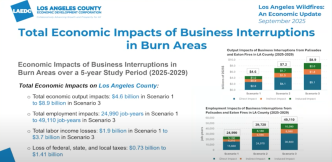
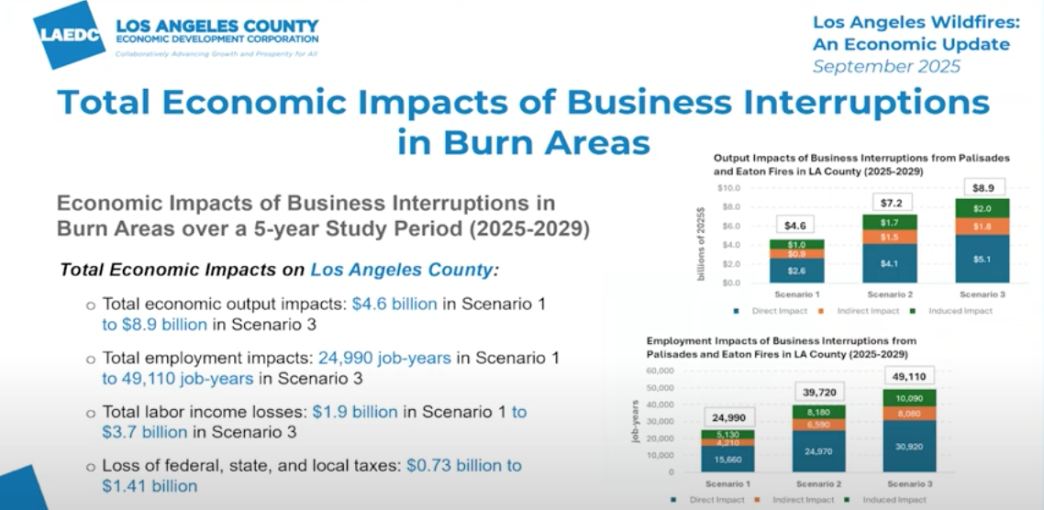
For the next four years losses were projected between $5.2 billion and $10.1 billion impacting 28,000 to 55,000 “job-years,” which refers to the number of people working during a 12-month period, according to the Department of Economic Opportunity and LA County Economic Development Corp.’s Institute for Applied Economics. Workers’ income losses were estimated at $2.2 billion to $4.2 billion, and tax revenue losses for governments could total $900 million to $1.6 billion.
“The January wildfires have tested our communities in unimaginable ways — taking homes, livelihoods, and peace of mind from tens of thousands of Angelenos,” LA County Supervisor Lindsey Horvath said in a statement. “This analysis makes clear the economic toll we are still reckoning with, but it also highlights the strength and resilience driving our recovery. We are not just rebuilding structures; we are rebuilding lives, jobs, and hope for the future.”
The DEO and EDC are in the midst of a yearlong economic impact study with quarterly public updates on recovery efforts and economic impacts of the wind-fueled firestorm that devastated Altadena, Pacific Palisades and nearby communities in January. According to the agencies:
- The Eaton and Palisades fires destroyed more than 16,000 structures, including over 11,600 residences, 100 schools and nearly 200 commercial buildings.
- Combined, the burn areas and “secondary fire areas” impacted more than 6,800 businesses and over 47,000 workers.
- Businesses in burn areas generated $1.4 billion annually prior to the fires, with secondary fire areas accounting for $6.8 billion in annual revenue.
- “The majority of secondary disruption occurred in the Eaton area, which represented 76% of affected businesses and 75% of job losses in SFAs,” officials reported.
“Secondary” impacts include significant disruption in an area due to evacuation orders, smoke conditions and business closures, officials said.
The county also reported these “recovery indicators”:
- As of July 31, 93% of filed insurance claims had been partially paid, totaling $20.4 billion.
- 95% of destroyed or damaged parcels were cleared of debris within seven months.
- Nearly 800 rebuilding permits have been issued with an average processing time of 52 business days.
- Short-term rent spikes occurred in fire-adjacent ZIP codes, with rents returning to 2024 trend levels within six months.
- Housing listings and sales in affected communities did not show evidence of mass resident flight.
“As we continue the work of rebuilding after the January wildfires, this economic analysis underscores the profound impact on our communities — from lost homes and businesses to displaced jobs,” county Board of Supervisors Chair Kathryn Barger said in a statement. “It is critical that all levels of government understand these realities so resources can be directed where they are most needed.”
Barger, whose 5th District includes the Eaton Fire area, said she supports “streamlining processes and advocating for policies that protect our residents and ease their path towards rebuilding their homes and lives.”
DEO Director Kelly LoBianco said in a statement, “The data makes clear what so many already know firsthand: the economic fallout from the January wildfires has been deep and widespread. But this analysis is more than a report — it’s a tool to guide targeted recovery. By understanding where losses are greatest, we can ensure resources reach the workers, businesses, and communities that need them most.
LoBianco added that the DEO seeks “an inclusive, equitable recovery, one that not only rebuilds but reimagines a more resilient economic future for LA County.”
The yearlong study and quarterly webinar series tracks indicators such as the progress of business and workforce recovery efforts, rebuilding work as well as the repair and restoration of housing and infrastructure. Officials said future sessions will focus on business and workforce disruptions, rebuilding costs and progress, workforce needs in recovery industries, housing market dynamics and policy recommendations aimed at achieving long-term resilience and disaster mitigation.
“This analysis provides a clear picture of the economic impacts of the January wildfires and a baseline for measuring recovery over time, EDC President and CEO Stephen Cheung said in a statement. “Through our collaboration with the Department of Economic Opportunity and other partners, LAEDC is committed to delivering data that helps policymakers and stakeholders allocate resources effectively and support a strong, coordinated recovery.”
Presentation materials and a video of the first session held on Sept. 15 are available on the county’s website.
The DEO also has a website with information, resources and services available for fire-affected workers and businesses.
The county’s economic impact study is funded through the California Jobs First initiative, officials said.