


A homelessness data-sharing agreement that loosens privacy restrictions is now in place in San Bernardino County, officials announced Thursday.
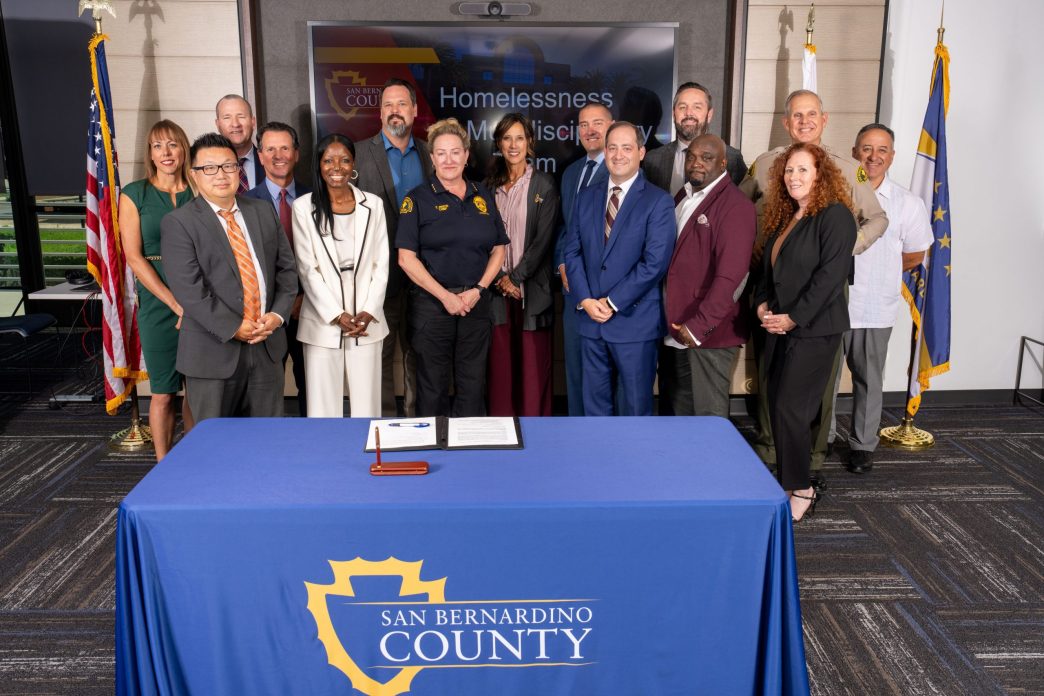
Law enforcement officials and department leaders on the homeless multidisciplinary team gathered Aug. 13 at the County Government Center in San Bernardino to sign the agreement, which resulted from Sheriff Shannon Dicus’ longtime advocacy and discussions held within the Homelessness Ad Hoc Committee, officials said. Board of Supervisors members Joe Baca Jr. and Curt Hagman are committee co-chairs.
The discussions led to the committee’s finding that enhanced data sharing by county departments is key to streamlining efforts and improving service delivery to people experiencing homelessness.
“Many individuals facing homelessness often cycle through various public systems, such as emergency rooms and jails, before ever connecting with stable support,” Baca said in a statement. “By improving coordination and implementing data sharing, we can break these cycles and directly connect people experiencing homelessness with the services they need to rebuild their lives.”
Privacy concerns led to limited data sharing among county departments, but a state law that took effect in 2018 authorizes counties to establish multidisciplinary personnel teams to assist unhoused individuals and families, according to the county. Assembly Bill 210 allows service-providing agencies to share certain information for the purpose of coordinating housing and supportive services to ensure continuity of care, while remaining in compliance with federal privacy laws.
Officials said the newly signed agreement includes policies and procedures on how county departments will align their activities and share data to support residents experiencing homeless. Signers included Dicus, District Attorney Jason Anderson, Public Defender Thomas Sone, department heads from Aging and Adult Services-Public Guardian, Arrowhead Regional Medical Center, Behavioral Health, Community Development and Housing, Innovation and Technology, the Office of Homeless Services, Probation, Public Health, Transitional Assistance and Veterans Affairs.
“This is a significant milestone for our county, and I want to thank all of our county departments for making this happen,” county CEO Luther Snoke said in a statement. “Each of our departments collects valuable data, and now with this agreement in place, we will be able to connect the dots and improve service delivery across the entire continuum of care.”
The data-sharing pact was the county’s latest step to address homelessness. Over the last year, the county has secured state and federal funding to increase shelters and housing capacity.
Officials noted the expansion of the Pacific Village housing campus in Highland that will have 58 permanent supportive housing units, 32 recuperative-care beds and 32 beds for people in need of treatment for substance abuse.
“The county also acquired two motels that upon conversion will provide 50 permanent supportive housing units for encampment residents and 130 beds of interim housing for homeless patients who are transitioning out of medical care,” according to a county statement. “In addition, county leaders unveiled a new Adolescent Behavioral Health Unit at Arrowhead Regional Medical Center on Aug. 7, which will offer vital support to young people facing mental health issues.”
More information about ongoing efforts to address homelessness is a homelesstohome.sbcounty.gov.
Mainstream Voucher Program
The Behavioral Health Department and county Housing Authority have agreed to a “non-financial memorandum of understanding” for the Mainstream Voucher Program, approximately 372 housing vouchers for housing support for eligible individuals and families at risk of or experiencing homelessness.
“Behavioral Health will offer in-kind supportive behavioral health services to voucher recipients, including case management, employment assistance, life skills, mental health services and substance use disorder treatment services,” according to the county. “The grant will also provide funding to develop housing for clients in substance use disorder and recovery services.”
The voucher program will start Sept. 1 and will be effective through August 2030.
Copies of the policy guidelines regarding specific types of personal information set for sharing was not immediately available.